A welding robot needs a route for its torch. The finished joint needs evidence that it will hold. Recent Chinese research makes the distance between those requirements unusually visible: a language-assisted vision system prepares a path, another model predicts mechanical performance from the welding process, and a new training facility aims to connect practice with inspection feedback.[1][2][3]
These are separate projects. Read together, they suggest where industrial AI is becoming more useful: in the connections between a camera observation, a robot movement and a measured result. Each connection needs its own test.
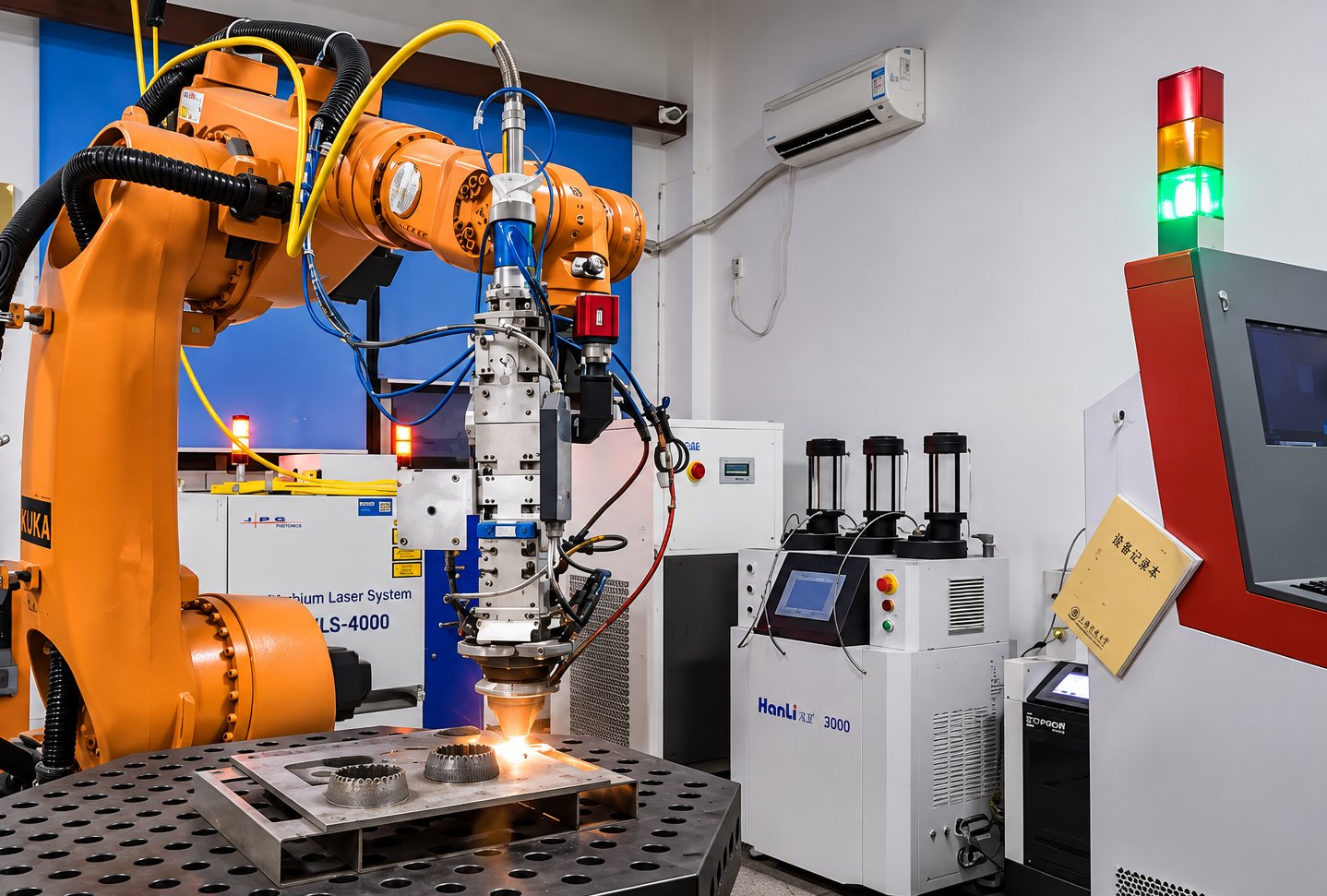
A training ground with something to inspect
On October 21, 2026, Nanjing’s Jiangbei New Area and the Jiangsu institute known as JITRI Intelligent Manufacturing unveiled a training ground for embodied welding robots. The municipal account describes physical workstations representing shipbuilding and construction-machinery tasks, with cameras and sensors collecting process data. Quality-inspection feedback is intended to inform further training.[1]
That arrangement addresses a concrete weakness in preprogrammed motion. A shifted workpiece or a complicated curved seam can make a previously prepared route unsuitable. The announcement presents repeated work under real conditions as a way to connect material properties, temperature changes and movement.[1]
The evidence so far is the facility and its stated training design. The announcement supplies no controlled comparison of production yield or defect rates. Its significance is an investment in the place where such evidence could be collected: a robot performs a task, the resulting weld is examined, and the next attempt can be informed by what happened.
What a language model contributes before welding
A Shanghai Jiao Tong University study, first published online on September 14, 2026, tackles the preparation stage. Reflective surfaces, weak texture and similar-looking edges make it difficult to decide which image feature is the seam. The system combines stereo depth, visual candidates and groove geometry, with a large language model assisting candidate interpretation and feedback review.[2]
Its outputs include a seam centreline, a local three-dimensional point cloud and a sequence of tool-centre-point poses: positions and orientations that prepare the torch’s route. Language-assisted interpretation is thus tied to geometric evidence and a specific physical output.[2]
The reported test boundary matters. Across 13 welding scenes, the region-of-interest intersection-over-union score was 0.8743, measuring overlap between identified and reference regions. Separately, after aligning the generated and line-laser reference trajectories at a common starting point, the average three-dimensional deviation was 1.100 millimetres over a 341.61-millimetre overlapping segment.[2]
Those results concern perception and path agreement before welding. They leave a further question for the workcell: what joint does that movement actually produce?
Reading the process for evidence of strength
Southwest Jiaotong University’s June 22, 2026 research account starts closer to the molten metal. Its PlasmaFuse-CascadeNet, or PF-CN, uses characteristics of the plasma plume produced during laser welding to predict the tensile performance of a titanium–aluminium joint.[3]
The model passes information through three stages. A neural network estimates weld cross-sectional dimensions from plume features; XGBoost estimates elemental composition from those dimensions; a random forest then predicts the joint’s tensile result. This sequence attempts to connect a visible process signal with geometry, metallurgy and mechanical behaviour.[3]
For the reported joint experiments, the cascaded model achieved a mean absolute error of 0.0714 kilonewtons and an R² of 0.9133. These figures describe that experimental prediction task. They do not establish performance on other material combinations, production lines or defect types.[3]
The researchers also identify error propagation through the stages. Uncertainty in the estimated geometry can affect the final prediction. That is a useful qualification: making intermediate quantities explicit creates places to investigate a mistaken answer, even as it creates additional ways for error to travel.
An earlier result shows why the setting matters
A 2025 Shanghai Jiao Tong study supplies a valuable comparison in how evidence is reported. For robotic metal active gas welding, it combined weld-pool images with arc sound, current and voltage to identify defects, then tested the approach on excavator-boom welding.[4]
The laboratory’s account distinguishes 96.59% recognition accuracy on the paper’s test set from roughly 90% average recognition accuracy for four tested defect categories in field trials, with alarms within two seconds. The two figures come from different evaluation settings.[4]
They should remain separate. A reader cannot infer that the test-set number is the accuracy a factory will receive, or that the field result covers every possible flaw. Likewise, a defect alarm, a predicted tensile result and a geometrically accurate path answer different questions. Keeping those distinctions visible makes the progress easier to assess.
What the next convincing demonstration would connect
My reading of these signals is that China’s welding AI is acquiring more specific responsibilities. Language-assisted vision prepares movement; process models estimate consequences; physical training facilities offer somewhere to test the relationship repeatedly. The cited projects have not demonstrated a single integrated system spanning all three.[1][2][3]
A persuasive next demonstration would follow the same workpieces through the whole sequence: the proposed path, the executed weld, the prediction and the independently measured outcome. It would also report how often the system needed correction when the material or workpiece position changed.
The most revealing record may therefore be an ordinary inspected joint. It connects what the model thought it saw with what the robot actually made.
Sources
- Nanjing Municipal Government, “China’s first embodied-intelligence robot welding training ground opens in Nanjing,” October 23, 2026; Chinese-language account of the October 21 launch, equipment and intended training process.
- Shanghai Jiao Tong University, Intelligentized Robotic Welding Technology Laboratory, “LLM-enhanced binocular visual perception and TCP pose generation for embodied intelligent welding,” 2026; research summary identifying September 14 online publication and the perception/trajectory evaluation boundary.
- Southwest Jiaotong University, Key Laboratory of Advanced Technologies of Materials, research account of “Tensile property prediction of titanium and aluminum alloys dissimilar joint by plasma plume characteristics based on a multi-stage cascade model,” June 22, 2026; PF-CN design, experimental results and error propagation.
- Shanghai Jiao Tong University, research summary of K. Zhu et al., “Robotic MAG welding defects and quality assessment with a defect threshold decision model-driven method,” Mechanical Systems and Signal Processing 224, 112056, 2025; separate test-set and excavator-boom field results.
- Shanghai Jiao Tong University, Intelligentized Robotic Welding Technology Laboratory, official website; source of the photograph labelled “KUKA robot laser-welding workcell,” accessed October 30, 2026.