As of 2026-04-18 UTC, the cleanest way to read iFlytek's office-facing AI push is not as one more general assistant trying to win attention in a crowded China model market. The more durable signal sits in a narrower workflow: capture speech, survive language mixing, turn the result into usable text, and keep that text inside the same office stack long enough to become minutes, tasks, or draft output.[1][2][3]
My inference from iFlytek's official product pages and 2025 launch notes is that the company's most exportable wedge in ai-china is this language-first office loop. It starts with multilingual meeting capture, moves through recognition and translation, passes into meeting-summary and writing layers, and stays attached to dedicated hardware and private-deployment options instead of dissolving into a generic chat box.[1][2][3][4][5][6] That is a narrower claim than "iFlytek has the strongest office AI." It is also a more defensible one, because the public materials repeatedly describe the same chain from recording to整理 to follow-up text.
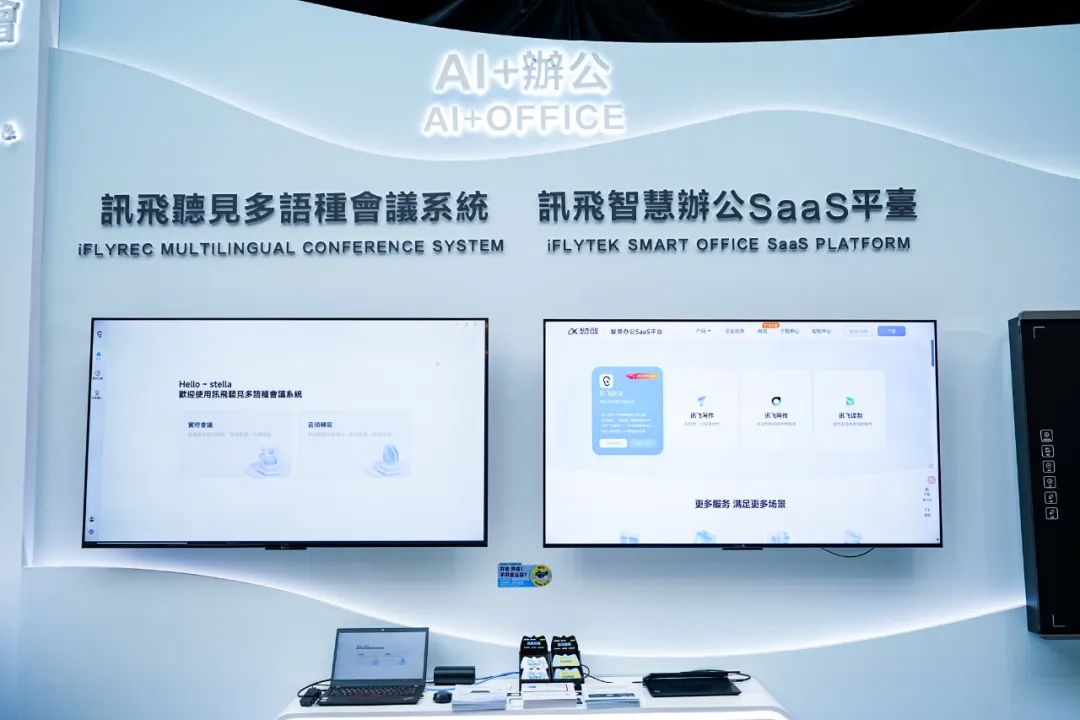
Image context: the cover uses a real photograph from iFlytek's Hong Kong launch event for its AI office products. It works here because the article is about a visible workflow surface rather than an invisible model benchmark: the wall literally puts the multilingual conference system and the smart office SaaS platform side by side.[3]
The workflow starts with mixed-language capture, not with a chat prompt
The strongest proof sits in the Hong Kong launch material from June 24, 2025. iFlytek did not present its office story there as a floating assistant. It launched an iFLYREC multilingual conference system for Hong Kong and Macao and described the target environment in practical terms: meetings where Cantonese, Mandarin, and English are mixed, records need to be produced quickly, and organizations still care about security and local deployment choices.[3] The official write-up says the system supports multilingual recognition and translation without manual language switching, can generate meeting minutes, and offers both cloud and offline options, including versions suited to stricter data-governance needs.[3]
That matters because mixed-language capture is where many office AI stories break. It is easy to demo a monolingual assistant. It is harder to keep a meeting usable when speakers switch languages midstream, named terms have to survive intact, and the final output has to be reviewed or published inside an institutional setting. iFlytek's public materials keep returning to exactly that problem boundary.[2][3]
The same Hong Kong rollout also gives the argument a real operating environment rather than a hypothetical one. The company says the Legislative Council's smart transcription system, deployed since 2022, reached 96% transcription accuracy, lifted transcription efficiency by more than 2x, improved summary efficiency by 10x, and increased information-disclosure efficiency by about 4x in a trilingual setting.[3] Those numbers come from the company's own reporting, so they should be read as product-side evidence rather than independent audit. Even so, they show what iFlytek wants buyers to notice: not an abstract assistant personality, but a measurable office-processing chain under multilingual pressure.[3]
The system is designed to convert speech into governed text
The product pages make the next step clearer. On the iFLYREC homepage, iFlytek describes a stack that already spans recording-to-text, AI writing, multilingual interpretation, translation, and enterprise services, while the customer examples emphasize meeting notes, interview cleanup, summary generation, and first-draft production rather than casual chat.[1] That wording is important. The homepage is not organized like a frontier-model leaderboard. It is organized like an office pipeline.
The dedicated smart meeting system page adds the operational details. iFlytek says the product can handle Chinese-English transcription, Chinese-English translation, and meeting record generation in offline or private-cloud settings; it quotes 97% Mandarin transcription accuracy, 93% native-English transcription accuracy, BLEU >= 43 for Chinese-English translation, and <= 500 ms real-time transcription latency.[2] It also lists functions that matter to institutional office work more than to consumer chat: voiceprint role separation, mixed Chinese-English recognition, intelligent semantic segmentation, meeting-record intelligent summaries, and user-management tooling.[2]
That is the center of gravity. iFlytek is not only trying to hear speech correctly. It is trying to make meeting language legible as governed office text: who said what, what mattered, what can be summarized, what can be stored, and what can be pushed forward into the next document state.[1][2]
Hardware matters because it keeps the loop close to real work
The workflow would be thinner if it ended at SaaS. iFlytek's own materials show that the company wants the office loop to stay attached to hardware surfaces. At MWC 2025, the company highlighted its smart office pad, saying it supports 14 languages of real-time transcription, can accurately record meetings through audio capture or stylus writing, and can deliver instant translation across seven languages including Chinese, English, Japanese, and Korean.[4]
The newer AINOTE 2 product page extends that same logic rather than changing it. iFlytek says the device offers AI-generated meeting summaries, speech capture in 16 languages, real-time translation across 11 languages, handwriting-to-text in 133 languages, calendar sync, and cloud storage with AWS-backed privacy controls.[6] Those details are partly global-product marketing, but they still reveal the same product instinct: office AI should not begin and end with a browser tab. It should sit on a device that captures speech, preserves notes, converts handwriting, and keeps follow-up work close to the meeting artifact itself.[6]
This is what makes the wedge exportable. A hardware-plus-SaaS workflow can travel into organizations that do not want to redesign everything around one open chat interface. It gives iFlytek more than one entry point: room systems, personal note devices, transcription software, translation services, and private deployment options.[2][3][4][6]
Scale matters here as workflow density, not just as user vanity
The April 29, 2025 translation-association coverage helps quantify the ecosystem side. In that write-up, iFlytek says its smart office SaaS platform serves 85 million users and integrates intelligent recording, multilingual translation, and AI writing as one product ecology, while its interpretation system has supported international conferences across more than 50 countries.[5] Again, this is company-reported scale, so it should not be treated as a neutral market share figure. But it does help clarify how iFlytek sees its own office business: as a dense language-service environment rather than a single software SKU.[5]
That distinction matters in ai-china because many companies still tell their office story through one assistant front end. iFlytek's public materials tell a different story. The meeting room, the transcription engine, the writing layer, the translation layer, and the note-taking device all reinforce one another.[1][2][4][5][6] If a company adopts only one part of the loop, iFlytek still has a foothold. If it adopts several, switching costs rise because the workflow itself becomes the product.
Why this use case is stronger than a generic assistant pitch
The office use case looks strongest where three conditions hold at once:
- speech arrives faster than people can type;
- more than one language or register is present in the room;
- the value is not the transcript alone, but the transformation of that transcript into minutes, tasks, summaries, or draft text.[1][2][3][4][5][6]
That is why the Hong Kong launch matters so much. It compresses the whole thesis into one difficult environment: trilingual speech, public-sector record keeping, summary production, and security-sensitive deployment choices.[3] A company that can show competence there is making a more specific claim than "our assistant can chat about your documents." It is claiming that language-heavy office work can be operationalized end to end.
The boundary is still clear. None of these pages proves that iFlytek has solved every office workflow, nor do they prove that its assistant layer will dominate broader enterprise AI. The public evidence is stronger on capture-to-text-to-draft continuity than on open-ended autonomous action. That limitation is useful, because it keeps the thesis tight. iFlytek's exportable wedge is not office AGI. It is a language-first workflow surface that turns messy meetings into usable institutional text.
Sources
- iFLYREC, "讯飞听见" homepage (AI voice recording assistant, AI writing, multilingual interpretation, translation, and office-oriented workflow examples).
- iFLYREC, "智能会议系统|离线会议系统|私有云转写翻译" (Chinese-English transcription and translation, meeting-record generation, voiceprint separation, intelligent summaries, private-cloud deployment, and quoted accuracy/latency figures).
- iFLYREC, "科大讯飞智慧办公系列产品落地香港 开启AI办公新纪元" (June 25, 2025; Hong Kong launch, trilingual office environment, 96% transcription accuracy, efficiency claims, multilingual conference system, and smart office SaaS rollout).
- iFlytek, "科大讯飞携多款AI应用产品亮相世界移动通信大会" (March 6, 2025; smart office pad, 14-language real-time transcription, and 7-language instant translation at MWC 2025).
- iFlytek, "2025中国翻译协会年会召开,科大讯飞获'译研工程'首批基地授牌" (April 29, 2025; 85 million smart-office SaaS users, integrated intelligent recording, multilingual translation, and AI writing ecosystem).
- iFlytek, "AINOTE 2" product page (AI-generated meeting summaries, 16-language transcription, 11-language real-time translation, 133-language handwriting-to-text, and cloud/privacy features).