As of 2026-04-18 UTC, the sharpest way to read Meituan's AI push is to stop asking whether it wants to become one more public chatbot brand. The stronger signal sits inside the company's own local-service machine. Meituan's March 26 full-year release says 2025 R&D spending rose 23% to RMB 26.0 billion and explicitly says the company kept pushing AI into the physical world.[1] Read beside the last few months of Meituan technical and business posts, that line points to a specific company shape: Meituan is building an action loop in which multimodal models, merchant tools, trust-and-safety systems, app-surface automation, and rider hardware all feed the same local-service operating system.[1][2][3][4][5][6]
That is a narrower claim than "Meituan has a strong model," and it is a better one. In ai-china, many companies can now show a competitive model card or a polished assistant demo. Far fewer can connect models to merchant operations, transaction trust, GUI state changes inside real consumer apps, and the last-mile worker tools that actually move food and retail orders through a city. My inference from Meituan's own materials is that the company is trying to turn AI into infrastructure for local life rather than into a freestanding chat destination.[1][2][3][4][5][6]
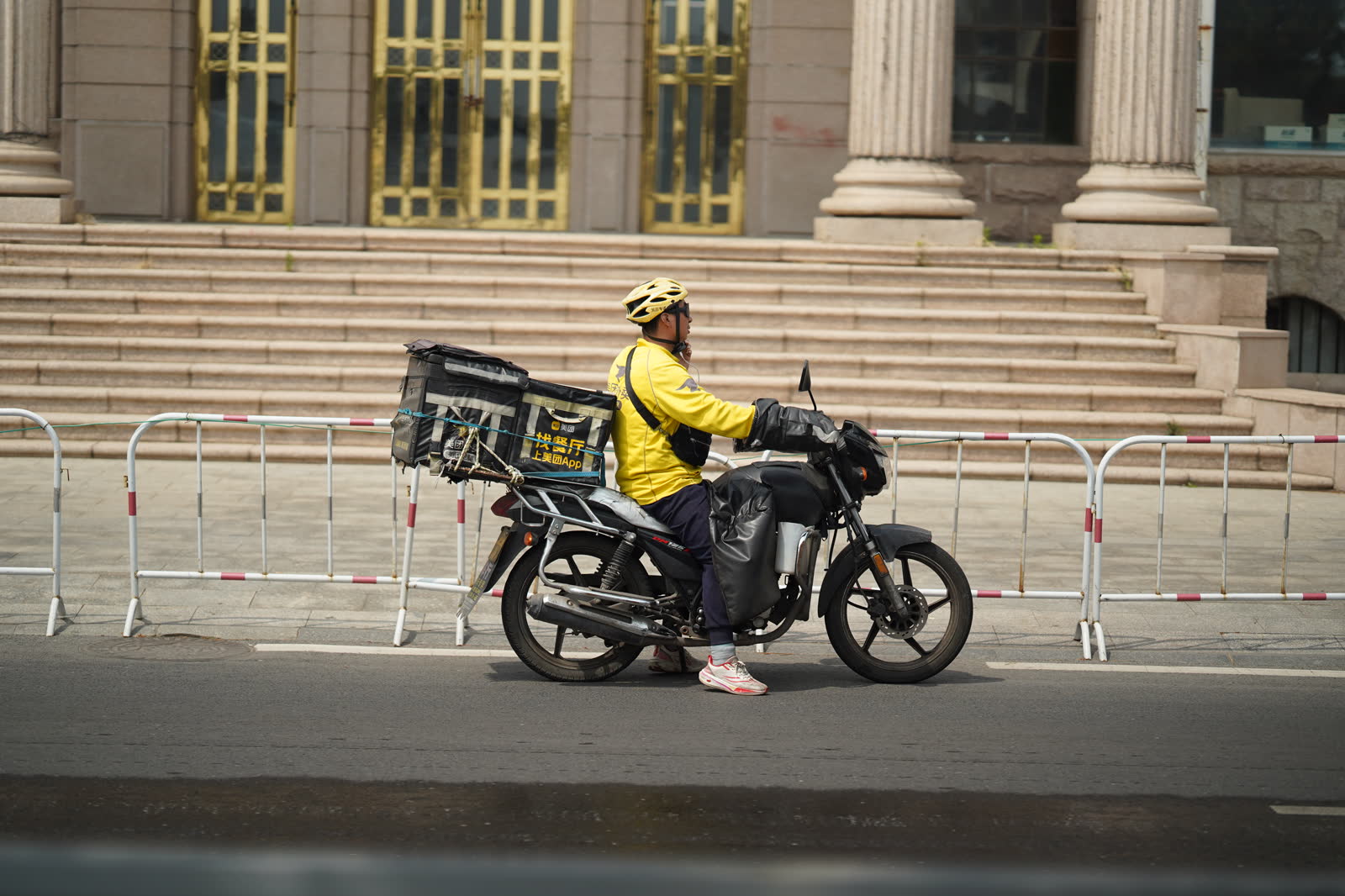
Image context: the cover uses a real Wikimedia Commons street photograph of a Meituan delivery rider in Qingdao. It fits this article because the core thesis is about execution in the physical world: models matter here insofar as they improve the moving system of merchants, orders, interfaces, reviews, and delivery labor.[7]
The model layer matters because it is being trained for service work
The clearest model-side signal is LongCat-Next, which Meituan introduced on 2026-04-02 as a native multimodal system spanning vision understanding, image generation, audio, and agents inside one discrete-token framework.[2] The technical note is revealing not only because it claims broad capability, but because the public benchmarks already lean toward Meituan's operating environment. In the company's reported results, LongCat-Next posts 73.68 on the retail slice of τ²-Bench, well ahead of the Qwen comparison Meituan publishes, while also posting 43.0 on SWE-Bench and competitive scores in document-heavy and multimodal tasks.[2]
That mix matters. It suggests Meituan does not want LongCat to live only inside a generic assistant wrapper. It wants the model to cross between text, image, voice, coding, and tool use in the kinds of messy settings local-service platforms actually create: merchant dashboards, product imagery, customer-support interactions, operations tools, and mobile app flows.[2] The model layer, in other words, is being shaped for service work rather than for benchmark theater alone.
The March 26 earnings release makes the same point from the corporate side. Management frames AI spending around "applications in the physical world," not around a single flagship-chat product line.[1] That phrasing makes sense only if the company believes its advantage appears when model capability is tied to real operational surfaces.
Merchant tools show where monetizable intelligence is supposed to land
The merchant side is where the dossier becomes more concrete. In Meituan's 2026-02-06 merchant-ecosystem post, the company says it has opened AI restaurant-operation tools powered by its self-developed LongCat model, covering functions such as track analysis, site selection, and dish development.[3] The same post says more than 670 restaurant brands and 4,000 community stores had joined the experience program, generating 320,000 reports, and that the site-selection tool reached 87% accuracy.[3]
The bigger signal is what happened after trial mode. Meituan says its dine-in operating AI tool "智能掌柜" was fully rolled out in November 2025 across all Meituan in-store restaurant partners; nearly 100,000 merchants now interact with it actively each week; and the system has helped 527,000 merchants resolve 4.296 million operating questions in aggregate.[3] Those are company-reported numbers, so they should be read as product-distribution evidence rather than as an independent market audit. Even with that boundary, they show where Meituan wants AI value to settle: inside everyday merchant decisions, not only in a consumer-facing assistant tab.
This is the company-level advantage many AI-China discussions miss. Meituan does not need AI to win attention only at the model layer. It can push intelligence into merchant acquisition, store operations, menu decisions, campaign planning, and local-service supply. When a platform already sits between consumers and merchants at national scale, an internal copilot can become less a feature than a control surface.[3]
Trust and app-state control are part of the moat too
The next layer is harder to imitate because it depends on Meituan's closed-loop marketplace data. In 2026-03-24, Dianping's 2025 transparency report said the app received nearly 450 million user reviews in the year, covering about 9.029 million merchants across more than 400 merchant categories, and that the platform used AI-agent-assisted review moderation to handle 11.61 million AIGC reviews.[4] That is important because local-service platforms live or die on the credibility of their review and ranking layer. A model that helps merchants and users is useful; a model that also protects the trust substrate under recommendations is much harder to dislodge.[4]
Meituan's KuiTest paper-post adds a second control point: app behavior itself. In 2026-01-13, the team described a large-model-based UI interaction traversal testing system spanning 10 internal business lines. In the reported experiments, the best two-step decomposition setup reached 86% average precision and 85% recall.[5] That may look like a narrow testing story, but it matters strategically. A local-service super-app is not only a text problem. It is a state machine made of buttons, icons, route transitions, confirmation dialogs, and edge cases across many vertical flows. If your models and internal tools keep learning how those interfaces behave, then "agent capability" stops being abstract. It becomes knowledge of how your own service surfaces actually move.[5]
Taken together, the review-governance post and the KuiTest work suggest that Meituan's moat is partly made of feedback boundaries. The company is not only training models to answer or generate. It is also training systems to police authenticity and understand real app-state transitions at scale.[4][5]
Rider hardware closes the loop in the street
The last layer is the one most public AI vendors do not have: worker hardware in the delivery network. In Meituan's 2025-08-15 smart-helmet engineering post, the company says the helmet has already become a core production tool for riders, improving both delivery efficiency and safety in practical use.[6] More revealing is the roadmap sentence at the end: the next-generation helmet is described not simply as an interaction tool, but as an important entry point and data-collection platform for Meituan's self-developed multimodal large model.[6]
That sentence is the dossier in miniature. It ties model development to field hardware, sensor input, rider workflow, and city-scale execution.[6] A company that can place AI on the merchant console, in the trust-and-safety stack, inside app-state testing, and on the rider's head is not just building an assistant. It is assembling a physical-world learning loop.
What to watch next
The most important question is not whether LongCat becomes a famous standalone consumer brand. The more important question is whether Meituan keeps deepening the loop between model layer, merchant operating layer, trust layer, app-state layer, and rider execution layer.[1][2][3][4][5][6]
If that stack keeps tightening, Meituan's AI advantage will look different from the advantage of an API-first lab. It will look like local-service compounding: better merchant advice creates better supply, better review governance protects trust, better UI understanding improves automation inside the app estate, and better rider hardware produces both safer execution and richer real-world feedback. That is a harder system to copy than a chatbot skin.
Sources
- Meituan, "Meituan releases 2025 Q4 and full-year results" (March 26, 2026; revenue, R&D spending of RMB 26.0 billion, and management framing around AI applications in the physical world).
- Meituan Tech, "Meituan releases native multimodal LongCat-Next" (April 2, 2026; LongCat-Next architecture and Meituan-reported benchmark results across retail tool use, SWE-Bench, and multimodal tasks).
- Meituan, "What merchant questions did we improve in 2025?" (February 6, 2026; LongCat-powered merchant tools, 320,000 generated reports, 87% site-selection accuracy, and rollout/adoption figures for 智能掌柜).
- Meituan, "Dianping discloses 2025 AIGC review-governance data" (March 24, 2026; 450 million reviews, 9.029 million merchants, and 11.61 million AIGC reviews handled with AI-agent-assisted moderation).
- Meituan Tech, "KuiTest: UI interaction traversal testing based on large-model general knowledge" (January 13, 2026; coverage across 10 business lines and reported 86% precision / 85% recall in the preferred setup).
- Meituan Tech, "Meituan smart helmet R&D practice series 02: software functions" (August 15, 2025; current rider-tool effects and the roadmap for the next helmet as a multimodal-model entry point and data-collection platform).
- Wikimedia Commons, "File:Food delivery driver in Qingdao.jpg" (source page for the cover photograph used in this article).