As of 2026-04-18 UTC, Alibaba's AI story is no longer most usefully read as a single giant capex promise. The sharper reading is that Alibaba is beginning to show a commercial return path from infrastructure spending back into behavior and revenue. The company committed RMB 380 billion to AI and cloud infrastructure over three years, later reported 36% year-over-year growth for Cloud Intelligence Group revenue, said AI-related product revenue had delivered triple-digit growth for the tenth consecutive quarter, and tied that cloud push to a consumer layer where Qwen App had already passed 300 million monthly active users across all platforms as of February.[1][4] Read together with Alibaba Cloud's September 2025 roadmap update and the January 2026 Qwen App upgrade, the pattern is more structural than promotional: open models widen demand, cloud products monetize enterprise usage, and the consumer app creates a behavior surface that keeps feeding the stack.[2][3][4][5]
My inference from those disclosures is narrower than "Alibaba has solved AI monetization." The stronger claim is that Alibaba now has the outline of a four-layer AI capital loop: infrastructure spend, open-model distribution, enterprise cloud monetization, and consumer execution surfaces.[1][2][3][4][5] That matters in ai-china because many companies can show one or two of those layers. Fewer can show all four inside one balance-sheet and product system.
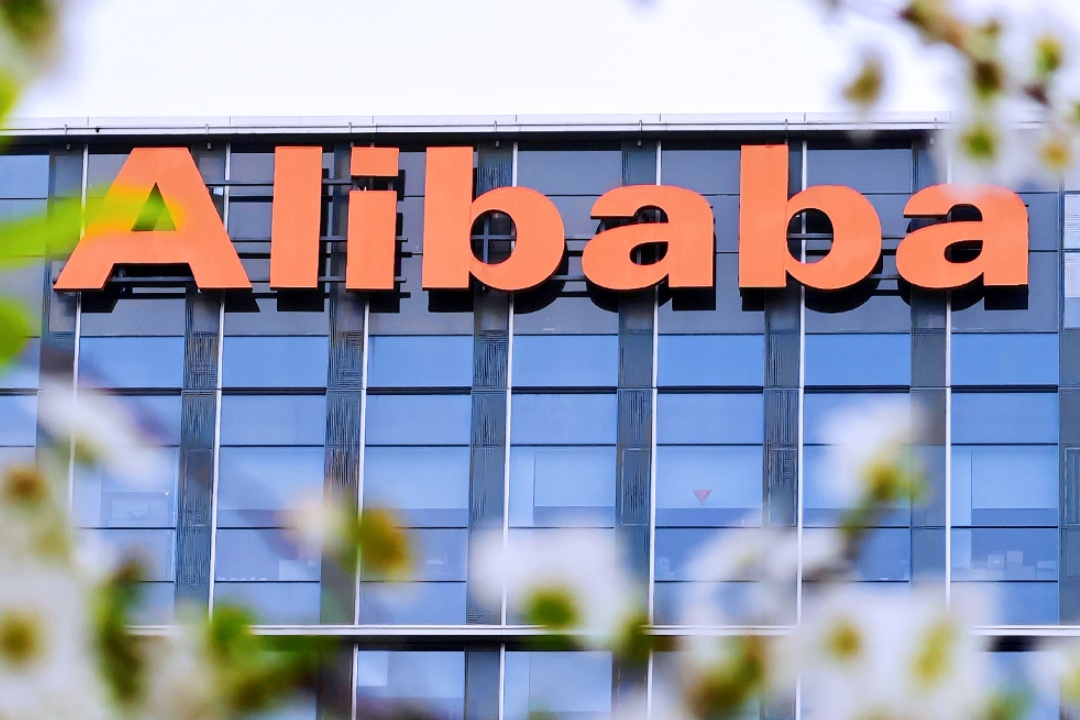
Image context: the cover uses an official Alibaba headquarters photograph from the company's March 19, 2026 AI-and-cloud update. It works here because the article is about corporate loop formation rather than model aesthetics. A real company building is a more honest signal than a synthetic "AI future" visual.[4]
The capex line matters only because Alibaba is starting to show a route back
The RMB 380 billion commitment from February 2025 was always big enough to invite the wrong question.[1] The lazy version of the question was whether Alibaba was simply spending too much. The better question is whether the company can build enough surfaces above that infrastructure to keep the spending from behaving like a one-way sink.
That is where the more recent evidence changes the frame. By March 2026, Alibaba was no longer talking about infrastructure in isolation. It was reporting that Cloud Intelligence Group revenue had reached RMB 43,284 million, up 36% year over year, and that AI-related product revenue had maintained triple-digit growth for ten straight quarters.[4] Those are not proof of full capital efficiency, but they do show that the company is already attaching visible revenue growth to the AI-and-cloud push rather than asking investors and customers to accept an indefinitely future payoff.[4]
This is the macro point. AI capex is strategically different when the same company controls multiple return channels above it. In Alibaba's case, the relevant question is less "How large is the spend?" and more "How many monetizable surfaces now sit on top of that spend?"[1][2][4]
Open Qwen distribution is not charity. It is demand formation
Alibaba Cloud's September 24, 2025 roadmap update is the cleanest public source for the middle of the loop. The company said it had open-sourced over 300 AI models across Qwen and Wan, and that those models had generated more than 600 million downloads and 170,000+ derivative models.[2] On the same page, Alibaba said over 800,000 agents had been created on Model Studio and that model calls through Model Studio had increased 15 times over the previous twelve months.[2]
Those numbers are important because they stop open-model distribution from reading like a purely ideological move. Open release creates brand reach, developer familiarity, derivative experimentation, and workflow habit.[2] Model Studio then gives Alibaba a managed surface where some portion of that ecosystem energy can be pulled back into hosted tooling, enterprise agents, and paid inference.[2]
That is why Alibaba's open-model posture should not be separated from the monetization story. The open side and the managed side are not opposites here. They are adjacent layers in the same commercial architecture.[2]
Qwen App turns the stack into a behavior machine
The consumer layer is what makes Alibaba's loop more interesting than a standard cloud-upgrade story. In November 2025, Alibaba said Qwen App surpassed 10 million downloads within its first week of public beta launch, rose into the top three free apps in China's App Store, and was framed from the beginning as a personal assistant that could do more than chat.[5] On January 15, 2026, Alibaba hardened that framing by saying Qwen App had moved from "AI that responds" to "AI that acts", with deep links into Taobao, Taobao Instant Commerce, Alipay, Fliggy, and Amap.[3]
That change matters economically. A consumer AI app that only summarizes and chats can create traffic, but it does not necessarily create a durable behavior loop. A consumer AI app that starts routing shopping, travel, payment, and task completion is different.[3][5] It begins to sit on top of services that already have commercial density.
Alibaba's March update made the scale signal harder to ignore. The company said Qwen's consumer-facing surfaces had exceeded 300 million monthly active users across all platforms as of February, and that Qwen App helped facilitate nearly 200 million orders during the recent Chinese New Year period for shopping, travel booking, and entertainment planning.[4] The narrower interpretation is not that every one of those orders proves long-term monetization. It is that Alibaba now has a visible consumer execution layer where AI usage can become repeat operational behavior rather than isolated curiosity.[3][4][5]
Cloud monetization is what closes the first visible loop
Consumer scale alone would not be enough. Plenty of internet companies can subsidize traffic. What gives Alibaba's AI story more economic shape is that the consumer, platform, and enterprise layers are appearing together in public disclosures.
Alibaba's March 2026 statement did not present Qwen App as an isolated app success. It placed the app beside cloud revenue growth and repeated AI-product growth, effectively telling one integrated story: infrastructure investment below, cloud monetization in the middle, consumer execution and transaction routing above.[4] The September 2025 roadmap page fills in the developer and enterprise middle layer with open models, Model Studio agents, and sharply rising model-call volume.[2] Put differently, Alibaba is no longer asking the market to believe in a model family alone. It is asking the market to see one loop:
- spend aggressively on AI/cloud infrastructure;[1]
- use open Qwen releases to widen ecosystem pull and builder familiarity;[2]
- convert part of that demand into hosted cloud and agent usage;[2][4]
- use Qwen App to create large-scale consumer execution habits on top of Alibaba-owned service rails.[3][4][5]
That is the most important macro distinction. In many AI narratives, capex still sits too far away from daily user behavior. Alibaba is beginning to shorten that distance.
What this still does not prove
The loop is visible, but it is not fully proven.
First, the strongest evidence still sits where Alibaba controls the service rails most tightly: Qwen App is more economically meaningful precisely because it can route into Taobao, Alipay, Fliggy, and Amap.[3] That does not yet prove the same behavior will hold as strongly in third-party environments.
Second, cloud growth and AI-product growth do not tell us how quickly infrastructure returns clear the full capital burden.[1][4] A company can show strong growth while the payback period on incremental infrastructure remains long.
Third, the consumer proof is partly tied to campaign moments and ecosystem depth. The Chinese New Year order numbers are impressive, but the harder question is whether the app keeps producing ordinary, repeat behavior outside event-driven peaks.[4][5]
Even with those limits, the macro reading has changed. Alibaba's AI effort now looks less like a pure spending thesis and more like a company trying to own every important step between model creation, developer distribution, enterprise monetization, and consumer execution.
Bottom line
Alibaba's AI economics in 2026Q2 are becoming easier to read because the company is finally showing a route from capex to cloud revenue to app behavior.[1][2][3][4][5] The infrastructure commitment remains enormous, but it no longer sits alone. Open Qwen distribution broadens demand, Model Studio and cloud products create monetizable enterprise surfaces, and Qwen App gives Alibaba a consumer layer where AI can become a routing habit tied to real transactions.[2][3][4][5]
That does not mean the returns are settled. It does mean Alibaba is one of the clearest ai-china cases where AI capital spending is starting to behave like a system rather than a slogan.
Sources
- Alibaba Group, "Alibaba to Invest RMB380 Billion to Advance AI and Cloud Computing Infrastructure Over Next Three Years" (February 24, 2025; three-year infrastructure commitment and capex framing).
- Alibaba Cloud, "Alibaba Cloud Unveils Strategic Roadmaps for the Next Generation AI Innovations" (September 24, 2025; 300+ open-sourced AI models, 600 million downloads, 170,000+ derivative models, 800,000+ agents on Model Studio, and 15x model-call growth).
- Alibaba Group, "Alibaba’s Qwen App Advances Agentic AI Strategy by Turning Core Ecosystem Services into Executable AI Capabilities" (January 15, 2026; "AI that acts" framing and deep integration with Taobao, Alipay, Fliggy, and Amap).
- Alibaba Group, "Alibaba Reports Solid Progress in AI + Cloud on the Strength of Its Full-Stack Capabilities" (March 19, 2026; 36% Cloud Intelligence revenue growth, triple-digit AI-product growth for the tenth consecutive quarter, 300 million monthly active users across Qwen consumer surfaces, and nearly 200 million holiday orders).
- Alibaba Group, "Alibaba’ Qwen App Surpasses 10 Million Downloads within the First Week of Public Beta Launch" (November 25, 2025; early download scale, top-three App Store ranking in China, and initial personal-assistant positioning).