As of 2026-04-02 UTC, the most useful way to read Baidu's current consumer-AI push is no longer as a search-side chatbot contest. The sharper signal sits where documents already live. In December 2024, Baidu said the monthly active users of Baidu Wenku's AI-enabled features had reached 94 million, up 216% year over year and 83% quarter over quarter.[1] In August 2025, Baidu said Baidu Wenku and Baidu Drive had jointly launched GenFlow, a general-purpose agent platform that lets users complete productivity tasks through multi-agent collaboration and natural-language interactions.[2]
Those two disclosures matter more together than separately. One says the company already had real scale on the Wenku side before the GenFlow label became central.[1] The other says Baidu did not want that usage to remain a narrow "document assistant" feature. It wanted Wenku and Drive to become the raw-material layer for a broader agentic workflow surface.[2]
By the end of 2025, that direction had become organizational, not just promotional. Baidu said it had established the Personal Super Intelligence Business Group (PSIG), integrating Wenku and Baidu Drive to accelerate AI application innovation.[5] My inference from the full sequence is that Baidu does not need GenFlow to win primarily as one more chat destination. It needs GenFlow to become the layer that reads, combines, and re-expresses material already sitting inside Baidu's document and storage products.[1][2][5]
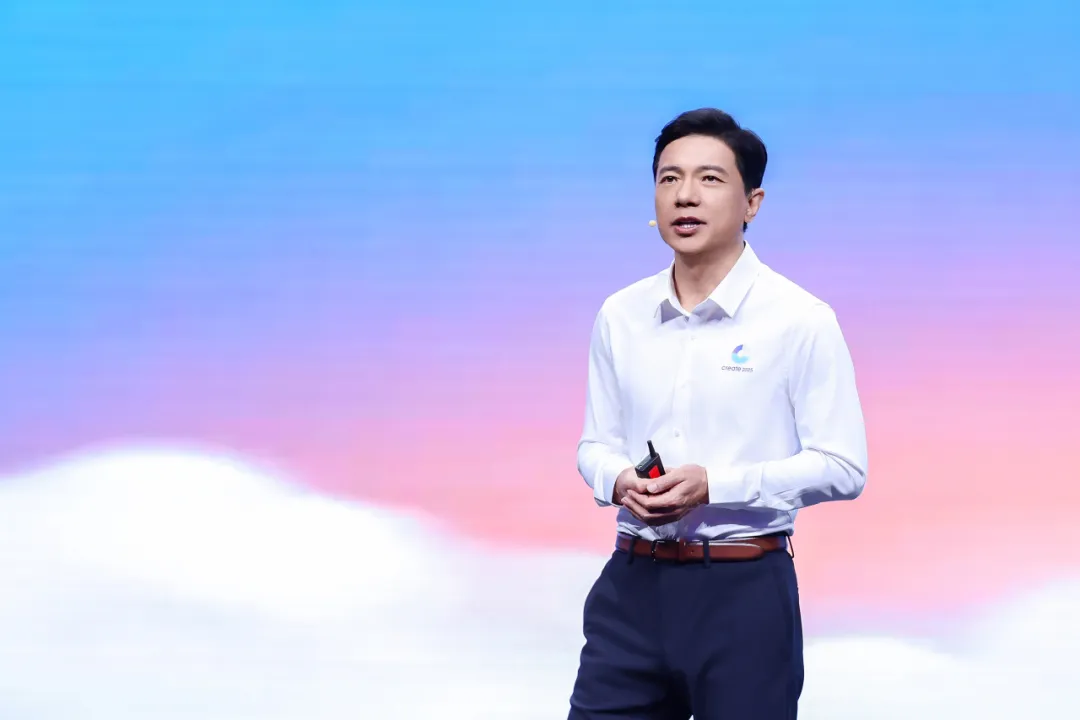
Image context: the cover uses a real keynote photograph from Baidu Create 2025. A stage image is the right visual here because the article is about a public product direction Baidu is explicitly presenting: models matter, but the company is increasingly packaging them inside application surfaces such as content tools, agents, and workflow systems.[3]
The sequence shows a product boundary moving outward
The sequence is the story.
Start with the Wenku number. A product with 94 million AI-feature MAUs is already operating at a scale where marginal improvements in workflow can matter more than one benchmark headline.[1] That is the background condition for GenFlow. Baidu did not launch it into a vacuum. It launched it on top of an existing document habit.
Then comes the more revealing August 2025 wording in Baidu's third-quarter results. The company did not describe GenFlow as a writing bot or a single creative tool. It called it a general-purpose agent platform for productivity tasks, enabled by multi-agent collaboration and natural-language interactions.[2] That phrasing expands the product boundary immediately. A general-purpose agent platform is supposed to orchestrate steps, not merely answer prompts.
The Create 2025 recap pushes the framing further. In Baidu's own summary of the event, Robin Li presented a broader application push that included Xinyiang App, CangzhouOS as a content operating system, and several agent-oriented product directions across digital humans, coding agents, and multi-agent collaboration.[3] GenFlow is not named in the visible excerpt from that recap, but the surrounding frame matters: Baidu is talking about consumer and developer AI less as isolated assistants and more as coordinated application systems.[3]
Finally, the PSIG reorganization matters because it ties the consumer workflow thesis to internal structure. Once Wenku and Drive are formally integrated to accelerate AI application innovation, the company is signaling that stored files, document retrieval, and generated output belong in one operating loop.[5]
Why Wenku plus Drive is a stronger starting point than a blank prompt
Consumer AI products are easier to abandon when every interaction starts from zero. A blank chat box asks the user to bring all the context each time. A document-and-storage stack works differently. The context is already nearby: prior files, templates, downloaded reports, uploaded materials, and the user's own archive.
That is why the current GenFlow surface is strategically interesting. The App Store listing for Baidu Wenku - GenFlow says GenFlow 3.0 is positioned as an all-platform universal agent, with minute-scale delivery of PPTs, research reports, picture books, code, posters, and charts.[4] The same listing says users can generate from a topic, from Wenku documents, from uploaded files and templates, or by referencing multiple documents together.[4] That is not a prompt-first story. It is a source-material story.
Once a product can begin from stored documents instead of from a blank conversation, the economics of stickiness change. Wenku contributes discovery, templates, and public document inventory. Drive contributes personal storage and continuity. GenFlow then sits above both and tries to convert raw material into outputs that can actually be used or sent on.
In that sense, "document factory" is the clearest way to read the product direction. The value is not only that Baidu can answer questions about a file. The value is that the system can pull from files, merge references, remember preferences, and then emit a deliverable in the format the user needs next.[2][4][5]
The current GenFlow 3.0 surface looks more like orchestration than chat
The App Store page is unusually helpful because it shows what Baidu thinks is worth emphasizing right now. The listing highlights AI blog generation with audio-story playback, AI video generation from a single sentence, and a memory center that remembers personal preferences and calls memory information proactively.[4] It also emphasizes multi-document reference generation and multimodal outputs rather than one premium text-only exchange.[4]
That matters because it suggests the consumer surface is being shaped around orchestration and format conversion. A chat product can feel impressive in-session and still struggle to become habit. A product that can take a pile of materials and turn them into a report, deck, poster, code snippet, audio object, or lightweight video has a clearer place in recurring work.[4]
This is also where Baidu's application framing and organizational move line up. The Create 2025 framing says the company wants to push models outward into application systems.[3] The PSIG move says Wenku and Drive now belong to one AI-application unit.[5] The GenFlow 3.0 listing shows the resulting consumer surface: memory, multi-document synthesis, and output conversion across media types.[4]
What could make this thesis too optimistic
The thesis weakens if GenFlow remains broad in marketing language but shallow in actual workflow reliability.
It weakens if multi-document generation mostly produces templated sludge instead of genuinely useful synthesis.[4] It weakens if memory features add personalization theater without materially improving repeat use.[4] And it weakens if Wenku discovery and Drive storage still feel like separate silos that happen to share AI branding rather than one joined workflow system.[2][5]
There is a simpler risk too. A document factory becomes valuable only if users trust it with source material and accept the outputs as good enough to keep moving. If the outputs require too much cleanup, the system becomes one more draft generator rather than the default place where work gets converted.
What to watch next
First, watch whether Baidu starts disclosing more operating detail around PSIG, Wenku, Drive, or GenFlow conversion behavior, not just model updates.[5]
Second, watch whether the product keeps deepening multi-document and memory workflows rather than merely adding more output formats.[4] The durable edge is not the number of buttons. It is whether the system gets better at reusing what the user already has.
Third, watch whether Baidu keeps presenting consumer AI as an application layer tied to content and storage surfaces rather than as a free-floating assistant brand.[2][3][5]
Bottom line
Baidu's more durable GenFlow move is not that it launched one more AI assistant. The more important move is that it is trying to turn Wenku and Drive into the input layer for a personal document factory.[2][4][5]
That is a stronger consumer-AI position than a blank chat icon. Files, templates, storage, memory, and agentic generation can reinforce one another. If Baidu can make that loop reliable, GenFlow becomes less like a feature and more like the operating surface where documents get turned into finished work.
Sources
- Baidu, "Baidu Announces Fourth Quarter and Fiscal Year 2024 Results" (February 18, 2025; Baidu Wenku AI-enabled features reached 94 million MAUs in December 2024, up 216% year over year and 83% quarter over quarter).
- Baidu, "Baidu Announces Third Quarter 2025 Results" (November 18, 2025; in August 2025, Baidu Wenku and Baidu Drive jointly launched GenFlow as a general-purpose agent platform with multi-agent collaboration and natural-language interactions).
- Baidu Smart Cloud Qianfan Community, "一文回顾Create2025重要发布!模型、应用、MCP…应有尽有" (Create 2025 recap; Robin Li's application push including CangzhouOS and multi-agent directions).
- App Store, "百度文库-GenFlow全能AI内容获取及创作" (current listing viewed April 2, 2026; GenFlow 3.0 features including multimodal outputs, memory center, AI blog generation, AI video generation, and multi-document reference generation).
- Baidu, "Baidu Announces Fourth Quarter and Fiscal Year 2025 Results" (February 18, 2026; Baidu established PSIG, integrating Baidu Wenku and Baidu Drive to accelerate AI application innovation).