As of 2026-04-03 UTC, Huawei is easy to misread if you force it into the same frame used for consumer-facing model companies. The public Huawei stack does include frontier-model language, but the stronger read sits elsewhere. Huawei's visible AI push is built around controlled deployment: industry-layered Pangu models, a managed adaptation surface in ModelArts, third-party model support, and an on-premises hybrid cloud product that treats locality, governance, and integration as first-class features.[1][3][4][5]
That matters because Huawei's own product pages do not tell a pure "best chatbot wins" story. The Pangu Large Models page says the line is designed for ToB markets and organized as a three-layer architecture: L0 foundation models, L1 industry-tailored models, and L2 scenario-specific models.[1] The company is telling buyers, up front, that the commercial object is not one universal assistant. The commercial object is a deployment ladder that gets closer to the customer's own industry and workflow as it moves downward.[1]
The surrounding Huawei material makes the same point from different angles. At HDC 2025, Huawei paired Pangu Models 5.5 with an AI Cloud Service built on CloudMatrix 384 supernodes and presented the package as industrial AI infrastructure, not merely a model-release ceremony.[2] The 2026 support docs then show ModelArts Studio supporting third-party model training with preset images, while the third-party NLP model API is explicitly described as being based on DeepSeek and Qwen models.[3][4] Put together, those sources point to one coherent company thesis: Huawei wants to own the execution layer where enterprises adapt, host, and govern model behavior, even when the underlying model is not Huawei's alone.
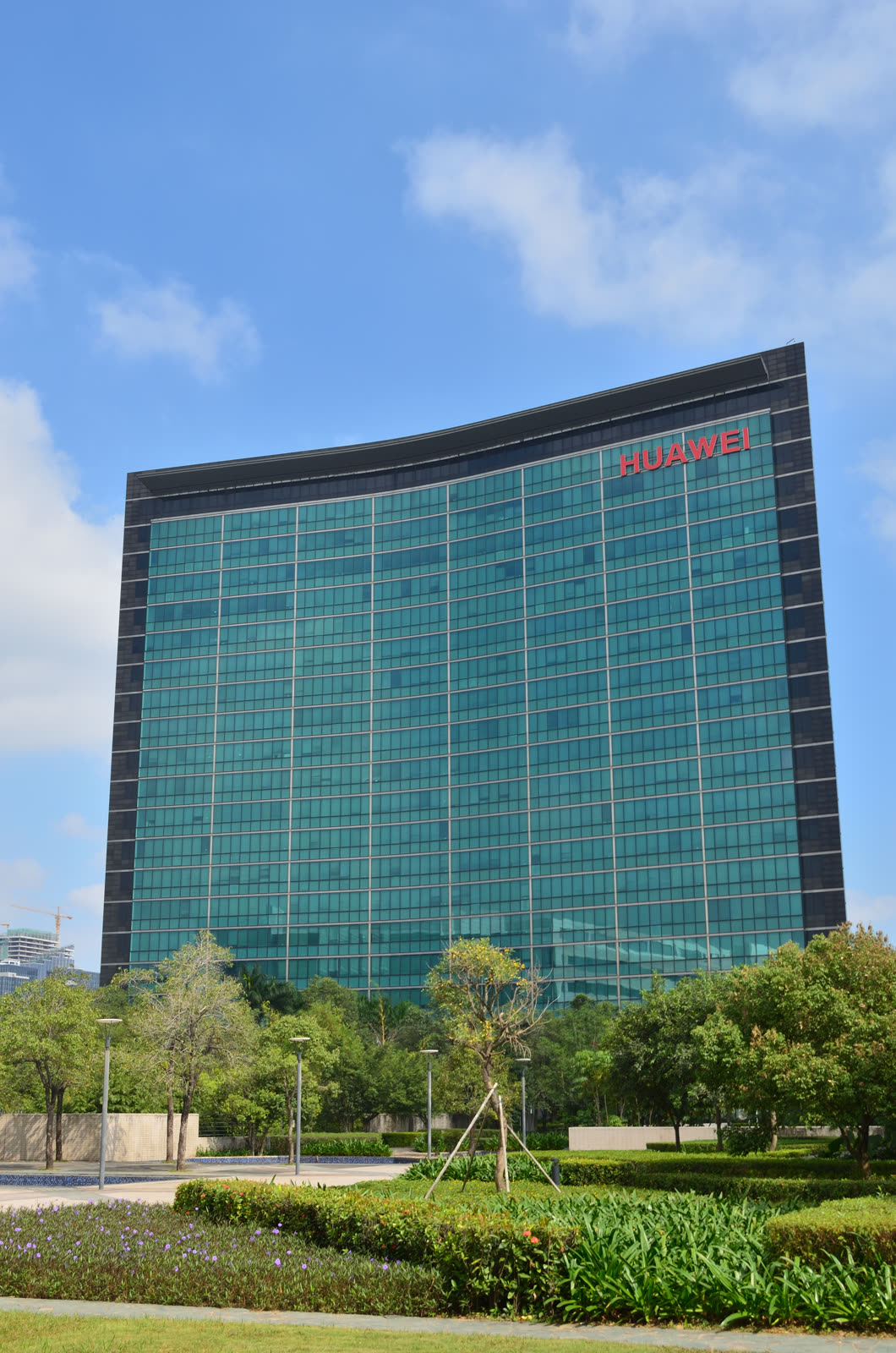
Image context: the cover uses a real Wikimedia Commons photograph of a Huawei building in Shenzhen. A documentary office image is the right visual here because the article is about a company-level deployment stack with real institutional boundaries, not an abstract rendering of model internals.[6]
1. Huawei's public architecture starts with industry structure, not a general assistant
The cleanest first signal is the Pangu product page itself. Huawei does not describe Pangu as one monolithic public model trying to dominate every use case. It describes a three-layer decoupled architecture for flexible industry adaptation, with L0 for foundation models, L1 for industry-specific models, and L2 for scenario-specific models.[1] That wording is strategically revealing. A company that wants public mindshare starts by simplifying the message into one flagship object. A company that wants enterprise adoption starts by explaining how model capability gets translated into sector workflows.
This is why Huawei belongs in a different bucket from companies whose public momentum depends on consumer app rankings or developer buzz around a single endpoint. Huawei's own language suggests that the model is only the first layer of value capture. The harder and more defensible layer sits lower down, where industries have specialized data, established systems, and compliance constraints.[1]
The HDC 2025 release reinforces that interpretation. Huawei says Pangu Models 5.5 were upgraded across five capabilities: natural language processing, computer vision, multimodal, prediction, and scientific computing.[2] That breadth matters, but it matters mainly because it expands the stack Huawei can carry into enterprise accounts. The release then moves quickly into infrastructure language, introducing AI Cloud Service and emphasizing the compute needed to support large-model applications in production.[2] In other words, Huawei's public model story is already nested inside a deployment story.
2. ModelArts matters because Huawei is turning adaptation into a managed surface
The second signal is even more important. Huawei's Model Training Types guide says ModelArts Studio supports third-party model training using preset images, then lists concrete model families such as DeepSeek-R1-distill-Qwen-32B, Qwen3-235B-A22B, Qwen3-32B, and Qwen2.5-72B with different training-unit requirements and supported tuning modes.[3] That is a major tell.
If Huawei were trying to defend Pangu purely as a closed ideological stack, these pages would look different. Instead, the documentation shows Huawei making room for non-Huawei models inside the same training surface.[3] That turns ModelArts from a brand accessory into something more interesting: a managed adaptation environment where the control point is not just the base model name, but the workflow that surrounds training, tuning, and later deployment.
This is the clearest reason the dossier's thesis is about controlled deployment rather than model prestige. Once a vendor can host training flows for rival or adjacent model families, it is no longer selling only its own checkpoint. It is selling the enterprise habit of running adaptation inside its environment.
That point gets stronger when paired with the third-party NLP model API page. Huawei describes that API as a service based on DeepSeek and Qwen models, built for text interaction across multiple scenarios and quick content generation.[4] Again, the important move is architectural. Huawei is showing that its inference layer can also expose outside model families. The company is gradually defining the value center as the surface of control rather than the exclusive ownership of every underlying model.
3. Cloud Stack turns locality, sovereignty, and lifecycle control into product features
The third signal sits in Huawei Cloud Stack 8.5.1. The datasheet calls it "the preferred on-premises hybrid cloud" and says it supports on-premises deployment while providing comprehensive cloud services for governments and enterprises.[5] That is not a cosmetic detail. It is the opposite of consumer-AI logic.
Huawei Cloud Stack is presented as an AI-native cloud with 120+ cloud services, AI-ready infrastructure, ModelArts, Pangu Models, and industry-oriented capabilities spanning government, finance, telecommunications, and other sectors.[5] The document also says Huawei has launched over 50 scenario-based solutions and built industry coverage across 5 industries, 20 domains, and 80+ scenarios.[5] Those are the numbers of a systems integrator and platform vendor, not a company optimizing only for public demo appeal.
This is where Huawei's positioning becomes unusually clear. Local deployment, hybrid cloud, and sovereign control are not side conditions. They are part of the value proposition. For many regulated or state-linked buyers, that changes the competitive field immediately. The relevant question stops being "which model is most exciting in the public internet conversation?" and becomes "which stack can run where we need it, with the lifecycle controls we need, and with the integration posture we can live with?"[5]
The datasheet also makes explicit that ModelArts is a one-stop AI development platform spanning data processing, model development, and application development, with a goal of simplifying model building, training, and deployment.[5] That is exactly the kind of wording that supports a control-plane thesis. Huawei wants enterprises to stay inside its lifecycle: data, model, deployment, operations.
4. AI Cloud Service and CloudMatrix 384 show that Huawei wants compute advantage to feed deployment advantage
The compute layer matters, but it matters in service of the same strategy. Huawei's HDC 2025 announcement says the new AI Cloud Service is based on CloudMatrix 384 supernodes, described as the first industry implementation of peer-to-peer interconnection across 384 proprietary NPUs and 192 Kunpeng CPUs through a high-speed MatrixLink network.[2] Huawei also says the architecture can deliver 2,300 tokens per second, roughly a fourfold improvement over non-supernode configurations, and that the service was already providing compute to more than 1,300 customers.[2]
Those details are useful because they show how Huawei wants its infrastructure story to work. The company is not presenting compute as a separate race detached from products. It is presenting compute as the reason its managed AI service can support large-model applications at enterprise scale.[2]
That is an important distinction in AI-China. Some companies sell model capability first and then talk about deployment once customers ask. Huawei's public material does the reverse. Compute, platform, and industry adaptation are already braided together. Pangu 5.5 becomes more credible because AI Cloud Service exists beneath it. ModelArts becomes stickier because Cloud Stack can host it in the environments enterprises actually use.[2][5]
5. What could weaken this thesis
Two failure modes would matter.
First, the thesis weakens if Huawei's third-party model support remains broad in documentation but shallow in practical enterprise uptake. Listing DeepSeek and Qwen in training or inference pages is strategically meaningful, but the long-run value depends on whether customers actually treat Huawei as the preferred environment for those workloads.[3][4]
Second, the thesis weakens if Cloud Stack and AI Cloud Service add complexity faster than they reduce operational risk. A sovereign or hybrid deployment story only stays compelling if it delivers predictability in training, inference, lifecycle management, and system integration. If those layers become too heavy, the platform pitch loses force.
Still, the current public record points in one direction. Huawei is steadily broadening the surfaces where customers can train, host, and govern model behavior, while keeping locality and enterprise fit at the center of the sales message.[1][2][3][4][5]
Bottom line
Huawei's visible AI strategy is best read as a controlled deployment business. Pangu gives the company a model family with clear industry layering.[1] ModelArts Studio and the third-party NLP API show that Huawei is willing to make its platform useful even when the model family extends beyond its own weights.[3][4] Huawei Cloud Stack gives that strategy an on-premises and hybrid-cloud body, and AI Cloud Service supplies the compute story underneath it.[2][5]
That combination is more durable than chasing consumer-chat gravity. Huawei is trying to become the place where enterprise AI actually lives.
Sources
- Huawei Cloud, "Pangu Large Models" product page (ToB framing and the L0/L1/L2 architecture for industry adaptation).
- Huawei Cloud, "Huawei Cloud Announces Pangu Models 5.5 and All-new AI Cloud Service, Positioned as the AI Pioneer in Industries" (June 20, 2025; Pangu 5.5 upgrades, CloudMatrix 384, 384 NPUs, 192 Kunpeng CPUs, 2,300 tokens/s, and 1,300+ customers).
- Huawei Cloud Support, "Model Training Types" for PanguLargeModels / ModelArts Studio (updated February 24, 2026; third-party training support across DeepSeek and Qwen-family models with listed training modes and unit requirements).
- Huawei Cloud Support, "Third-Party NLP Model" API reference (API service based on DeepSeek and Qwen models for text interaction scenarios).
- Huawei, Huawei Cloud Stack 8.5.1 Datasheet (2024; on-premises hybrid cloud, 120+ cloud services, 50+ scenario-based solutions, ModelArts, Pangu Models, and industry deployment positioning).
- Wikimedia Commons, "File:HuaweiShenzhen.jpg" (source page for the cover photograph used in this article).