
As of 2026-04-02 UTC, the most useful way to watch MiniMax's 54-second official clip "Hailuo AI | Video 02 Model," published on June 18, 2025, is to stop reading it as a generic reel of pretty AI shots.[1] The video is full of showmanship: circus lights, juggling, a bear on stage, acrobats, a unicycling clown, fire, storm clouds. But the accompanying release notes make the argument much narrower than "look how cinematic this looks." MiniMax says the piece was assembled by three artists over 1.5 days from multiple 6-10 second clips, and it uses the same three claim words in both English and Chinese: native 1080p, instruction following, and extreme physics mastery.[2][3]
Those claims matter because the surrounding documentation turns them into a product surface rather than a one-off launch boast. MiniMax's API docs list Hailuo 02 as both text-to-video and image-to-video, with 1080p 6s output and lower-resolution longer options.[4] A later feature update keeps pushing on the same axis, arguing that start-and-end-frame control only matters if instruction comprehension, motion continuity, and camera movement stay reliable under pressure.[5] A partner integration note for Envato makes the commercial intention even clearer: MiniMax wants Hailuo 02 to circulate inside existing creator tools as something "realistic, controllable, and cinematic," not as an isolated demo page.[6]
My inference from the launch clip and the follow-on materials is that Hailuo 02 is being marketed as a controllability model first, a beauty model second.[1][2][3][4][5][6] MiniMax does use cinematic language, but it repeatedly chooses examples where failure would be obvious. Acrobatics, balancing acts, animal motion, fire, and rapid camera movement are not just visually exciting; they are unforgiving test cases for temporal coherence and prompt obedience. The video is therefore less a mood trailer than a compressed proof that the model can keep difficult motion legible without making the economics collapse.
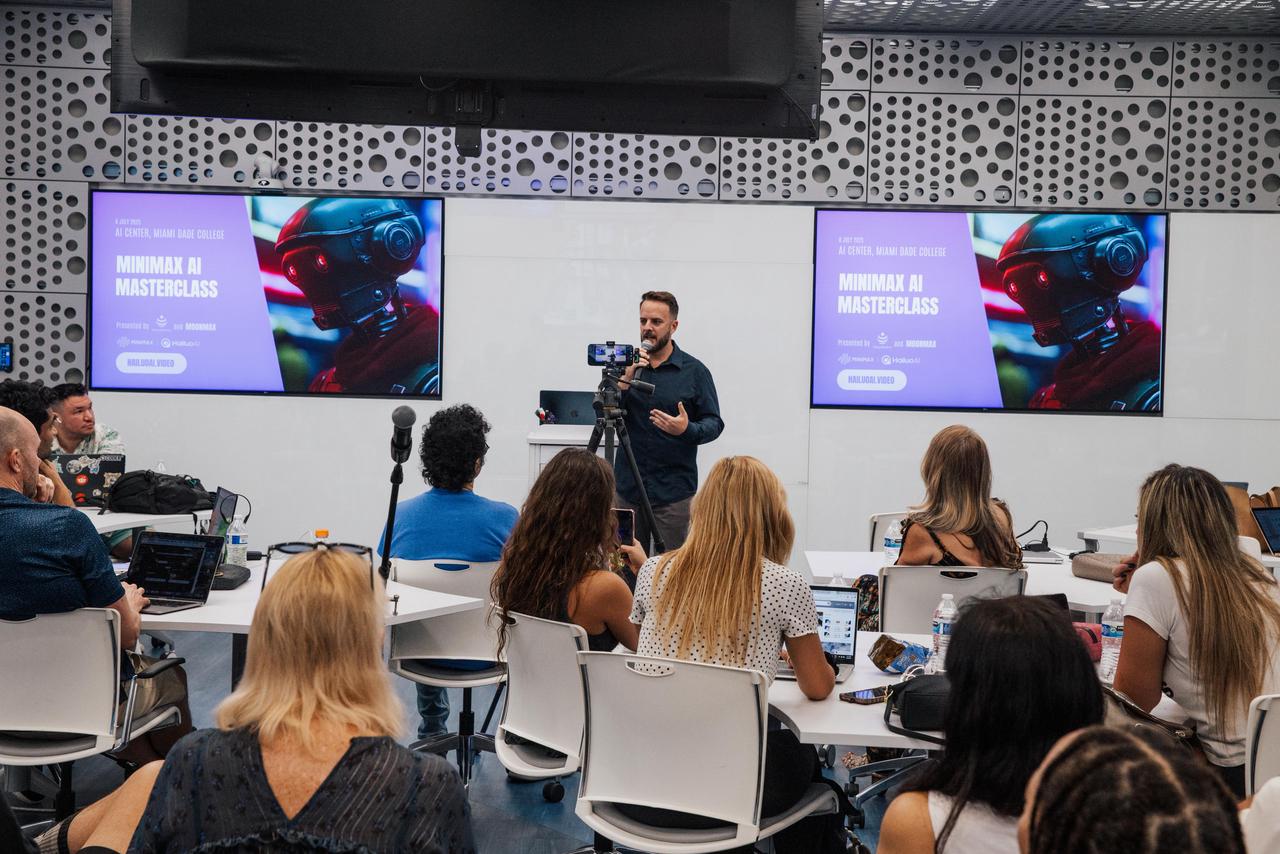
Image context: the cover uses a real MiniMax masterclass photo from Miami Dade College. That is the right visual here because Hailuo 02 is not being positioned only as a lab result. MiniMax is taking it into hands-on creator education, where lighting, camera movement, and workflow discipline matter as much as the model name itself.[7]
Around 0:03, the circus setting tells you the benchmark is motion coherence
The opening seconds matter because MiniMax does not begin with landscapes or portrait beauty. It begins with a juggler in a ring, under colored light, with multiple moving objects crossing the frame.[1] That choice is strategic. In still images, many models can look impressive. In video, the weak point is what happens when limbs, props, and camera attention all have to stay synchronized over time.
The written release note confirms that reading. MiniMax says Hailuo 02's headline advances are not only "world-class quality" but specifically instruction following and extreme physics mastery, and it ties those gains to a new architecture, Noise-aware Compute Redistribution, plus 3x the parameters, 4x the training data, and 2.5x better training and inference efficiency at comparable scale.[2][3] In other words, the circus opener is not decorative. It is the kind of scene you choose when you want viewers to feel continuity as a technical claim.
This is also why the clip's pacing is so fast. MiniMax assumes that viewers already know text-to-video can produce atmosphere. The harder sell is that Hailuo 02 can preserve believable object behavior across rapid edits and short shot lengths. The company is asking you to watch whether hands, props, balance, and body orientation break apart. The model is being judged on obedience under strain, not on whether it can make one pretty still-like frame.
Around 0:13 to 0:31, animal motion, juggling, and balance shift the video from spectacle to control
The middle third of the clip sharpens the thesis. Around 0:13, a bear enters the circus space; around 0:20, a clown rides a unicycle while juggling; around 0:30, a performer crosses high above the ring.[1] These are almost cartoonishly risky choices for a launch video, which is exactly why they are useful. They compress several failure modes into a few seconds: body weight, balance, prop continuity, momentum, and camera framing all have to feel stable enough that the viewer does not mentally mark the sequence as fake for the wrong reasons.
MiniMax's later start-and-end-frame update makes the same product logic explicit. The company argues that older video-control systems struggled with poor instruction comprehension and high error rates, then defines the next step in terms of complex instructions, extreme physics-based motion dynamics, and dynamic cinematic camera control.[5] That follow-on note is useful because it reveals what the launch clip was already trying to prove. Hailuo 02 is not being sold as a model that occasionally lands a beautiful shot. It is being sold as a model that can carry motion constraints through a sequence without losing the user's requested structure.
That same logic helps explain why MiniMax's Chinese release note says artists found Hailuo 02 uniquely strong in highly complex scenarios such as gymnastics.[3] Whether or not one accepts the global-superlative wording at face value, the selection pressure is obvious. MiniMax wants viewers to associate Hailuo 02 with scenes where continuity failures cannot hide behind soft lighting or abstract composition. The more visible the physical challenge, the stronger the controllability signal if the shot holds together.
Around 0:38 to the ending, fire and weather convert visual flair into an economics argument
The closing stretch escalates from balance to force. A fire-breathing clown appears around 0:38, and the last seconds move into storm-heavy spectacle before the clip ends.[1] That escalation would be empty if MiniMax were only claiming artistry. What makes it matter is the company pairing those images with a cost story. The English and Chinese launch notes both argue that Hailuo 02's efficiency gains let MiniMax offer native 1080p at an affordable price rather than treating high resolution as a premium-only showcase.[2][3]
This is where the API docs matter. They show Hailuo 02 as a productized menu: text-to-video and image-to-video, 1080p 6s, 768p 6s/10s, and 512p 6s/10s.[4] That table changes how the video reads. The circus footage is not only there to suggest creative ambition; it is there to justify a practical ladder of outputs that a creator or developer can actually buy and route. MiniMax is trying to collapse three ideas into one promise: the model obeys, the motion survives, and the usable resolution does not become prohibitively expensive.
The partner rollout pushes the same point downstream. By July 3, 2025, MiniMax was already saying Hailuo 02 had been integrated into Envato's VideoGen, where the selling words were again realistic, controllable, and cinematic.[6] That matters because it shifts the story from "our site has a stronger video model" to "our model can live inside another creator workflow without losing its identity." The video is therefore the top of a funnel whose real destination is distribution into tools where creators already work.
Why the clip is worth revisiting now
The strongest reason to rewatch this launch video is that MiniMax's broader rollout makes the clip easier to decode in retrospect. The Miami masterclass shows the company teaching Hailuo 02 in practical terms such as prompt structure, lighting, camera movement, and scene composition.[7] The start-and-end-frame update doubles down on controlled transitions, camera paths, and motion continuity.[5] The Envato integration shows distribution into an established creator platform.[6] Each step repeats the same core message in a different register.
That is why the launch clip should not be filed away as just another fast-cut AI video trailer. Its real thesis is narrower and more durable. MiniMax is arguing that the next competitive line in AI video is not merely raw visual beauty. It is whether a model can hold onto physical plausibility, camera intention, and prompt structure tightly enough that creators can plan around it. In AI-China terms, that is a meaningful shift. The point is no longer only to amaze viewers with one miraculous shot. The point is to make controllable motion cheap and reliable enough to become a recurring production surface.
Sources
- HailuoAI (MiniMax), "Hailuo AI | Video 02 Model," official YouTube video, published June 18, 2025.
- MiniMax, "MiniMax Hailuo 02, World-Class Quality, Record-Breaking Cost Efficiency" (June 18, 2025; 1.5-day artist build, 3x parameters, 4x data, 2.5x efficiency, native 1080p, and 768p/1080p product ladder).
- MiniMax, "Hailuo 02,打破全球视频模型效果成本纪录" (2025-06-18; Chinese first-hand release note on 1080p native output, complex-instruction following, extreme physics, and the NCR architecture).
- MiniMax API Docs, "Models" guide (Hailuo 02 listed as text-to-video and image-to-video with 1080p 6s, 768p 6s/10s, and 512p 6s/10s options).
- MiniMax, "MiniMax-Hailuo-02 Start & End Frames Feature is Now Live, Mastering Complex Instructions and Extreme Physics-Based Dynamics" (August 28, 2025; start/end-frame control, motion continuity, and camera-control claims).
- MiniMax, "Hailuo-02 is Now Integrated into Envato's VideoGen" (July 3, 2025; distribution into Envato's creator toolchain and emphasis on realistic, controllable, cinematic output).
- MiniMax, "MiniMax AI Masterclass Comes to Miami" (July 30, 2025; source page for the event photo used here and MiniMax's description of hands-on Hailuo 02 workflow teaching).