A volunteer looking at an underwater photograph had two decisions to make. First came a series of choices between edits of the same picture. Then, with only the winner left on the screen, came a question the tournament could never settle on its own. Was this version actually satisfactory? On sixty photographs, even the winning edit failed to clear that bar. [1]
Those sixty belong to the Underwater Image Enhancement Benchmark (UIEB), published in 2019 by Chongyi Li, then at City University of Hong Kong and the Chinese Academy of Sciences, and colleagues. The team wanted a way to test image-processing software on photographs taken in real water. A simulation can start with a clear picture, add haze, and keep the original in a drawer for marking answers. A diver comes home with just the picture the water allowed. [1]
An answer key made of edits
For each of 950 photographs, the researchers produced twelve candidate edits. Fifty volunteers, half with image-processing experience, compared candidates two at a time with the original in view. They could zoom in and take as long as they liked. A favorite advanced to face another edit. Eleven choices gave each viewer a winner, and a vote across viewers determined which edit would serve as the reference. The separate satisfaction judgment gave them a way to reject even that choice. [1]
The project distributes 890 photographs with selected references and the remaining sixty as a challenge set. That division preserves a piece of information an ordinary ranking would lose. Imagine two edits of a fish in shadow. One reveals its fins but gives its belly a pink cast. The other leaves the fins hard to see. A viewer can consistently prefer the first and still find the pink implausible. Counting the preference alone would turn that reluctant choice into a target for the next model to imitate. [1][2]
What earned Water-Net a higher score
The team trained its baseline model, Water-Net, on 800 of the accepted pairs. It worked with three edits of each original. White balance adjusted the color cast, histogram equalization redistributed tones to bring out contrast, and gamma correction changed brightness. The network learned how much each edited version should contribute in different parts of the frame. That flexibility matters in a picture with a bright patch of sand and a dark crevice. An adjustment that opens up the crevice can wash out the sand. [1]
On the remaining 90 accepted pairs, Water-Net scored 19.11 decibels on peak signal-to-noise ratio, compared with 17.61 for an earlier fusion method. Here a higher score means a smaller pixel error against the chosen edit. The calculation has an exact target even though people had to exercise judgment to choose it. The sixty challenge photographs sit outside that average for precisely the reason they are interesting. Nobody evaluating those frames has an accepted edit against which to compute the same error. [1][2]
The card on the seabed
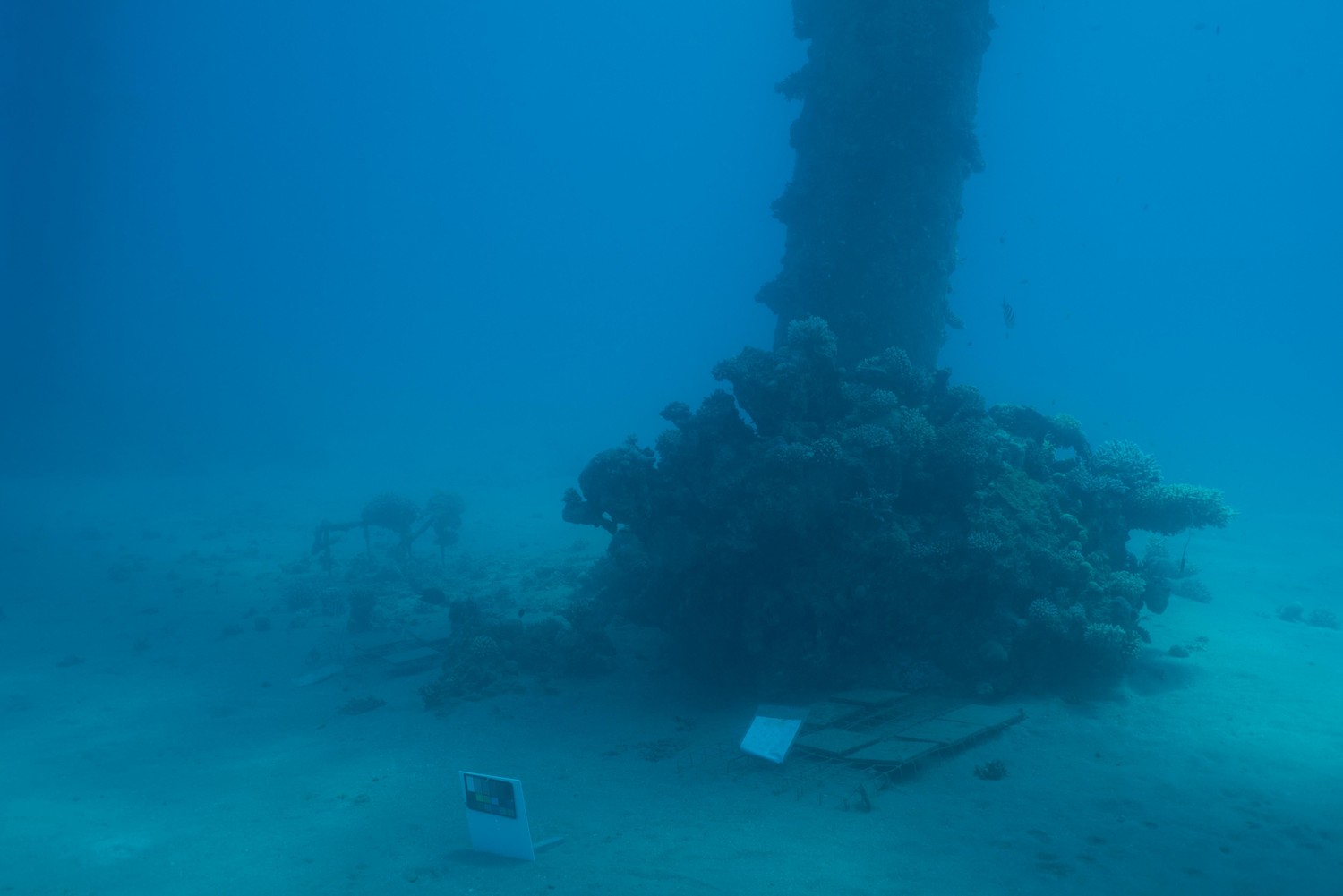
Near the lower edge of the Katzaa photograph is a little card with rows of colored patches. A photographer has put something in the scene whose colors can be checked afterward. Farther back, a second pillar is barely visible. Even if an editor gets the card in the foreground exactly right, the light from that pillar has traveled through a longer stretch of water. The SQUID researchers collected stereo pairs and supplied distance maps, making that difference available for study. [3]
In a separate 2019 experiment, Derya Akkaynak and Tali Treibitz used the distance to points in a scene to estimate how much scattered light reached the camera and how much light from the objects themselves was lost along the way. That work suggests a practical follow-up when someone presents a beautifully corrected reef photograph. To find out whether viewers can make out the reef more easily, show them the competing edits. To find out how faithfully an edit recovered color, look for an independent measurement from the dive. Fifty people can examine a picture at leisure. The diver gets one chance to put the card in the frame. [1][3][4]
Sources
- Chongyi Li and colleagues, “An Underwater Image Enhancement Benchmark Dataset and Beyond,” including the voting protocol and Table V (2019)
- Chongyi Li, UIEB project page and downloadable paired and challenge sets
- Dana Berman and colleagues, SQUID stereo dataset, collection details and Katzaa photographs
- Derya Akkaynak and Tali Treibitz, “Sea-Thru,” CVPR (2019)