On August 22, 2017, a patch of sky drifted through the beam of China's FAST radio telescope. Something in it pulsed about once every 1.83 seconds. On September 10, astronomers pointed the Parkes dish in Australia at the same patch and picked up the beat again. Between those observations lay the part of the discovery a machine could help with. Someone had to decide which of a night's thousands of apparent signals deserved a second look. [1]
What the software could see
A pulsar is a spinning neutron star whose beam sweeps past Earth. To tease a faint one out of a recording, astronomers can cut the recording into strips of equal duration and stack them. Choose a strip length that matches the star's rotation and the pulses line up, each adding a little to the same peak. Choose poorly and the peak smears out. The search software tries many possible periods. Even a night with just one interesting star can leave an observer with page after page of peaks to inspect. By May 2018, the early FAST drift survey had accumulated more than ten million candidates. [1][2]
The image in Pulsar Image-based Classification System, or PICS, is a page of diagnostic plots. One panel shows the pulse after stacking. Another lets the reader see whether the peak holds its place as time passes. A third breaks the signal out by radio frequency. A sharp peak looks more persuasive if it persists through the observation and across the receiving band. The developers trained classifiers on examples people had already labeled, then combined their judgments into a score that could order the review queue. [1][3]
FAST astronomers also inspected candidates by eye and used a plotting tool to pick out unusually strong signals at distinctive periods. In their discovery paper they report that two searches for periodic signals and a third search for individual pulses all picked up the August source. Those searches shared a recording. Running three analyses gave the observers several reasons to book telescope time, while leaving open what another instrument would hear. [1]
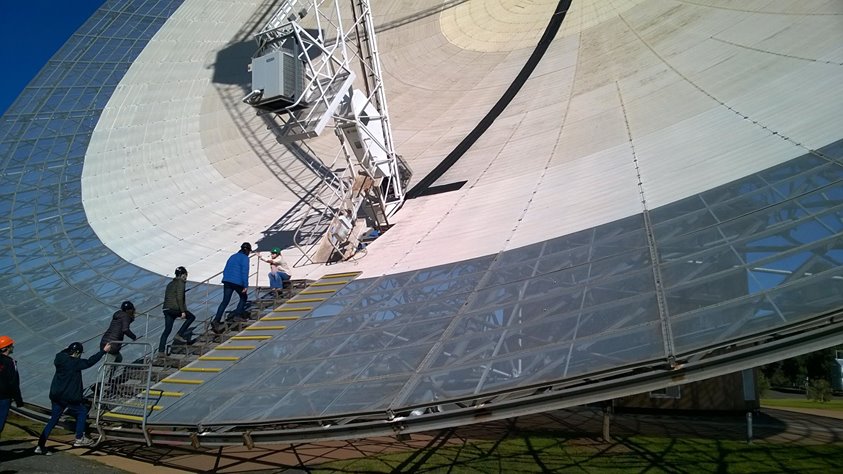
Something to listen for at Parkes
The Chinese team could send more than a sky position and a period. As a radio pulse travels through the electrons between stars, its lower frequencies arrive later. The FAST team had estimated how much delay to correct for to bring the pulse into focus. An observer at Parkes thus had three details to check against a fresh recording. They knew where the signal came from, how often it repeated and how it spread out across frequencies. Parkes confirmed the source, now called PSR J1900−0134. Subsequent timing measurements pinned down its position more precisely than the original drift across the FAST beam allowed. [1]
There was also an older Australian record of the star. The Parkes Multibeam Pulsar Survey had spent 35 minutes per pointing, recording thirteen patches of sky at a time and storing the data on tape. Reprocessing its observations turned up a candidate at the FAST position with a similar period and frequency delay. The distinction matters for the discovery credit. Parkes had recorded enough information to recover the beat years later. FAST supplied the observation that made astronomers turn a dish toward it again. [1][4]
Sources
- Lei Qian and colleagues, “The First Pulsar Discovered by FAST,” discovery observation and Parkes follow-up (2019).
- Hong-Feng Wang and colleagues, “Pulsar candidate selection using ensemble networks for FAST drift-scan survey,” on the scale of candidate review (2019).
- Weiwei Zhu and colleagues, “Searching for pulsars using image pattern recognition,” the original PICS design.
- NASA HEASARC, Parkes Multibeam Survey New Pulsar Catalog, observing setup and data storage.
- Benjamin Shaw, “CSIRO Parkes radio telescope,” original photograph and license (2019).