A pedestrian in dark clothes is easy to pick out in the foreground of a photograph from the RESIDE collection. Farther up the street, riders and vehicles fade into air almost the same color as the road. Imagine adjusting the contrast until the street looks clear. How would you tell whether a computer could now find one more rider? [1]
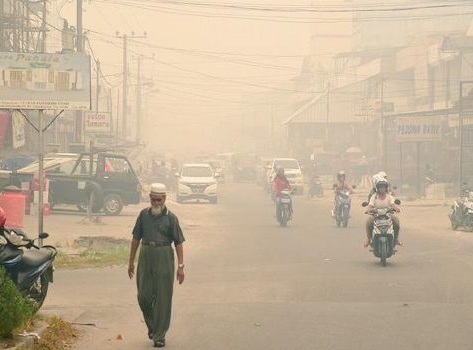
That question gave Boyi Li and colleagues, including researchers at the Chinese Academy of Sciences and the University of Science and Technology of China, a way to test single-image dehazing on real traffic. Their RESIDE benchmark, published in 2019, let two things serve as an answer key. One was a clear picture of the scene. The other was a set of boxes drawn around the things a camera ought to find. [1][2]
The photograph you can't take twice
A clear reference photograph makes a good test possible. Researchers can add haze mathematically, run a restoration algorithm, and measure how closely its output recovers the original pixels. A separate project, O-HAZE, managed a physical version of the experiment. Its researchers photographed 45 outdoor scenes under matching illumination with and without haze from professional haze machines. That gave them a clear reference even for light scattered on its way into a real lens. [1][3]
Try that experiment on the street in the photograph. By the time the air clears, the pedestrian has walked out of the frame. Even perfect restoration would put that person in the wrong place relative to a photograph taken later. But an annotator looking at the original can still mark where the person stood.
RESIDE’s Real-world Task-Driven Testing Set contains 4,322 hazy photographs gathered from the web, mostly traffic scenes. Annotators marked people, cars, buses, bicycles and motorbikes. The team used the familiar PASCAL Visual Object Classes format, in which a detector names an object and locates it with a rectangle. This makes a useful distinction on a busy road. A system can correctly report that the picture contains a bicycle and still draw its box around the wrong rider. [1][2][4]
One filter, two verdicts
Read across a single row of Table X in the RESIDE paper. Faster R-CNN scored 37.58 percent mean average precision on the original hazy photographs. After a filter called the dark channel prior processed the same pictures, the score rose to 40.58. Now move down one row. YOLOv2 started at 40.37 on the originals and fell to 39.81 with that same filter. The score summarizes how well each detector ranks and locates objects across the five categories, so a three-point gain cannot be read as three extra people found per hundred. [1][4]
The telling comparison runs within each row. The researchers held the detector fixed and changed the image it received. Comparing the raw scores between rows introduces another difference alongside the choice of detector. The Faster R-CNN model had trained on PASCAL VOC 2007 data. YOLOv2 had trained on the combined 2007 and 2012 sets. The experiment shows that the benefit changed sign between those two setups. It leaves open which features of the filtered street each model used. [1]
There is one more decision hidden in that table. Of 41,203 annotated boxes, the authors marked 11,606 as difficult and left them out of the evaluation. If the practical question is whether clearing haze helps a camera pick up the faintest rider at the far end of a road, that exclusion matters. For a picture editor, a clear reference or a viewer’s preference can settle which version to print. For someone choosing a filter for a traffic camera, the informative test begins with the detector they intend to use, the original frame beside the filtered one, and an explicit account of which riders count. [1]
Sources
- Boyi Li and colleagues, “Benchmarking Single Image Dehazing and Beyond,” especially Figure 1 and Tables IX–X.
- RESIDE project, extended dataset release and contents of the Real-world Task-Driven Testing Set.
- Codruta O. Ancuti and colleagues, “O-HAZE,” the paired outdoor photography experiment, 2018.
- PASCAL Visual Object Classes Challenge 2007, object-detection task and evaluation criteria.