TransitLM is a useful benchmark precisely because it does not ask the usual AI-China question: which frontier model reasons better in the abstract? It asks a narrower systems question: can a model learn enough public-transit topology from route-planning records to produce connected, structured routes without calling a map engine at inference time?
As of 2026-06-05T20:32:07Z UTC, the public artifact set includes an arXiv paper, a Hugging Face dataset, a ModelScope mirror, a GitHub evaluation repository, and a Chinese ModelScope technical writeup.[1][2][3][4] The important signal is not that maps are obsolete. The important signal is that domain data can move the bottleneck away from general reasoning scale and toward the shape of the corpus, the output contract, and the evaluation funnel.
What The Benchmark Actually Tests
The arXiv abstract describes TransitLM as a large-scale dataset and benchmark for map-free transit route generation. Its reported corpus covers more than 13 million transit route-planning records from four Chinese cities, with 120,845 stations and 13,666 lines.[1] The public Hugging Face dataset card exposes a benchmark split with 90,000 training rows and 60,000 test rows, tagged for transportation, route planning, public transit, instruction tuning, and benchmark use.[2]
Those two numbers should be read together. The paper discusses the larger route-log corpus used for continued pretraining, while the released benchmark split gives researchers a practical evaluation surface.[1][2] This distinction matters because a model can look stronger or weaker depending on whether the question is pretraining scale, supervised benchmark replication, or out-of-domain generalization.
The task contract is deliberately concrete. Inputs include a natural-language query, origin and destination coordinates, and a city. Outputs are structured JSON: line sequence, station sequence, total distance, travel time, fare, and access or egress transfer information.[2][3] That output shape is the benchmark's strength. It forces the model to be judged as a route generator, not as a chat assistant that gives plausible travel prose.
Why A Small Model Can Beat A Bigger Generalist Here
The ModelScope writeup argues that the baseline problem is topology, not generic intelligence. Traditional route planning uses station topology, schedules, candidate recall, ranking, and route engines; a general LLM can describe travel but may hallucinate stations or break route connectivity when asked to generate the route itself.[4]
TransitLM attacks that failure mode with a domain vocabulary move: the writeup says the authors register all 120,845 station IDs as independent tokens. Inference from the published method: this narrows the generation space and lets station co-occurrence patterns act as a learned topology signal, which is very different from asking a general model to spell station names from memory.[4] The model is still generating text, but the text is constrained by a station-token world that was built for the transit task.
The second move is two-stage training. The ModelScope writeup describes continued pretraining on 13.9 million route-planning texts, then supervised fine-tuning on three planning tasks.[4] The paper frames the dataset as both a continual-pretraining corpus and benchmark data.[1] That is the China-AI lesson worth keeping: in a bounded industrial workflow, the data pipeline can be more decisive than buying a larger general model.
This is why the 4B-model result is interesting. The writeup says the system uses Qwen3-4B-Base as the lightweight backbone and reports that even a 0.6B model remains usable on connectivity.[4] Treat those numbers as directional unless the same setup is reproduced locally, but the shape is plausible: once the model has domain tokens, route logs, and a JSON target, extra general reasoning capacity is not automatically the limiting resource.
The Evaluation Boundary
TransitLM's GitHub repository is the most useful part of the release because it makes the evaluation boundary visible. The README says the evaluator decomposes route quality into reachability, station grounding, structural consistency, and plausibility of distance, time, and fare estimates.[3] It covers single-route planning, preference-aware planning, multi-route diversity, and a general-purpose LLM evaluation mode through a remote route-eval API.[3]
That layered scoring is better than one headline percentage. A route can be connected but not preferred. It can pick a plausible boarding station but produce poor time or fare estimates. It can match a line sequence while choosing a weak access leg. The GitHub code's funnel-style checks make those differences legible.[3]
The reported headline from the ModelScope writeup is strong but bounded: the Qwen3-4B TransitLM setup reaches at least 93% connectivity, at least 96% station grounding, 71.0% exact match in a core setting, and 73.7% exact match for the joint model, while a tool-augmented route-engine alternative is reported at 71.7% to 74.4% exact match.[4] These are benchmark claims, not a guarantee that the model can replace live navigation in a changing city.
The boundary is especially important because public transit is not static. New stations open, routes detour, lines are renamed, fares change, service is interrupted, and walking access changes with construction. The ModelScope writeup explicitly lists dynamic network changes, real-time traffic, and limited geographic coverage as current limitations.[4] That limitation is not a footnote. It defines the production risk.
What This Says About AI-China
TransitLM fits a broader China-AI pattern: instead of waiting for a frontier model to become universally reliable, teams are packaging domain logs, local platform data, and narrow evaluators into task-specific model systems. The four-city scope is also notable. Beijing, Shanghai, Shenzhen, and Chengdu are not generic toy graphs; they are large Chinese transit environments with dense station, subway, and bus interactions.[4]
The likely production path is not "delete the map engine." A safer deployment would use TransitLM-like models as a fast route generator, an offline fallback, a candidate generator for low-connectivity settings, or a personalization layer that can propose structured alternatives before a conventional engine validates current service status. In that role, the model's value is lower latency, fewer API calls, and domain-aware generation; the engine remains the authority for live constraints.
That split also explains why the benchmark matters outside transit. Many Chinese AI deployments face the same architecture choice: call a specialized tool repeatedly, or train a small domain model to internalize enough of the tool's output distribution for a bounded task. TransitLM is a public example where the latter approach becomes measurable. It does not prove that every city system should become a language model. It proves that the tool-versus-model boundary is now an empirical question.
The watch item is reproducibility. The released dataset, ModelScope page, and evaluation code make it possible to inspect the task format and scoring pipeline, but serious adopters still need city-by-city validation, leakage checks, route freshness tests, accessibility and wheelchair constraints, abnormal-service scenarios, and comparisons against live routing APIs under the same request distribution.[2][3][4] Without those checks, "map-free" is a lab phrase. With them, it could become a useful deployment mode for constrained transit planning.
The best reading is therefore practical. TransitLM does not make a bigger-model boast. It says a route is a structured object, a transit network is learnable from logs up to a boundary, and evaluation has to inspect connectivity, grounding, overlap, preferences, diversity, and estimates separately. That is a more useful AI-China signal than another leaderboard screenshot.
Sources
- Hanyu Guo, Jiedong Yang, Chao Chen, Longfei Xu, Kaikui Liu, and Xiangxiang Chu, "TransitLM: A Large-Scale Dataset and Benchmark for Map-Free Transit Route Generation," arXiv, submitted May 21, 2026 - paper abstract, scope, corpus counts, and DOI.
- GD-ML/TransitLM dataset page on Hugging Face - public benchmark split, task tags, license, example rows, and structured prompt/label format.
- HotTricker/TransitLM on GitHub - official companion evaluation code, task settings, route JSON contract, and layered metrics.
- ModelScope community, "不用地图也能规划公交路线?| TransitLM:首个大规模端到端公交路线生成数据集与基准" (June 4, 2026) - Chinese technical writeup with method summary, benchmark figures, limits, and release links.
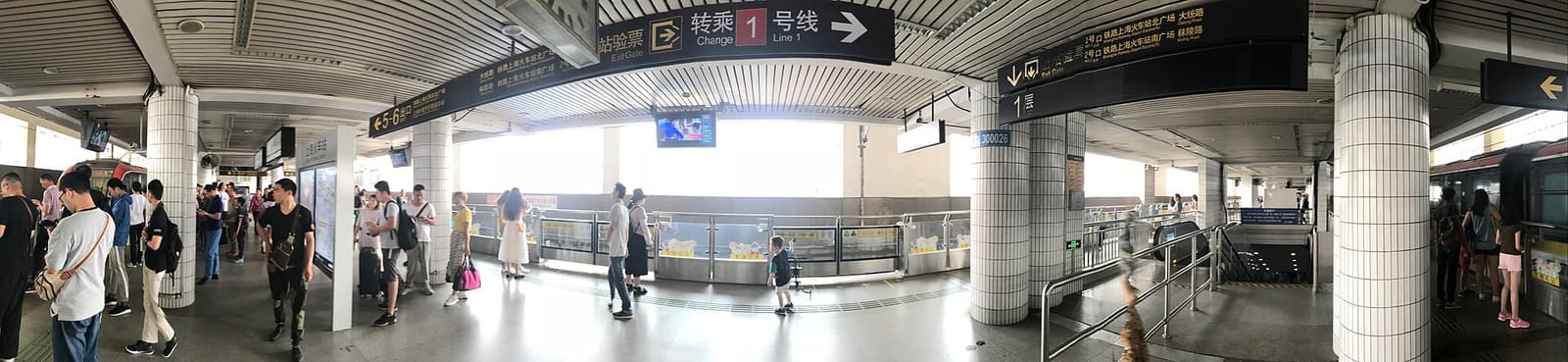
- Wikimedia Commons, "File:201806 L3,4 Platform Panorama of Metro Shanghai Railway Station.jpg" - source page for the real photographic image used in this article.