As of 2026-06-06T07:02:56Z UTC, Stanford HAI's 2026 AI Index is most useful for AI-China watchers if it is read against a bad habit: compressing the whole U.S.-China AI race into one model leaderboard. The report's headline is dramatic enough. It says U.S. and Chinese models have traded the lead several times since early 2025, DeepSeek-R1 briefly matched the leading U.S. model in February 2025, and by March 2026 Anthropic's top model led the top Chinese model by only 2.7 percent.[1] But the sharper benchmark lesson is that the comparison has split into lanes.
China looks close on frontier model performance, strong on research volume, strong on total patents, strong on industrial robot installations, strategically important in open-model diffusion, weaker on private AI investment, and still exposed to data-center and chip-supply constraints.[1][2][3] Those signals do not collapse into a single score. A builder, investor, policymaker, or enterprise buyer gets a more accurate view by asking what is being measured, what the measurement excludes, and whether the metric captures capability, adoption, supply-chain control, or institutional follow-through.
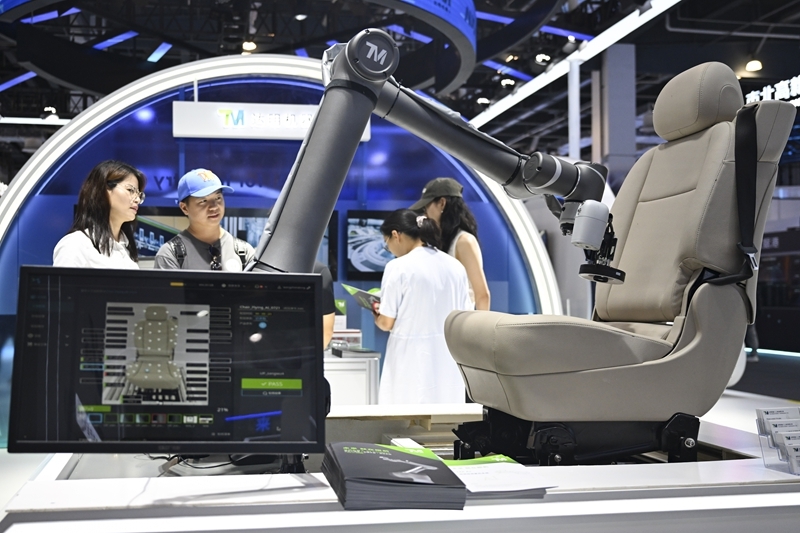
Image context: the cover uses a real Xinhua photograph of visitors inspecting a robotic quality-checking system at the 2025 World AI Conference in Shanghai. That setting is deliberately physical. The article is not about an abstract "AI race" graphic; it is about why China's measurable AI position now runs through model scores, industrial robotics, exhibitions, deployment targets, open-source ecosystems, and application surfaces at the same time.[5]
The model gap is no longer the whole benchmark
The AI Index's most quoted China point is that the model-performance gap has effectively closed.[1][2] That matters because frontier-model comparisons used to provide an easy shorthand: one country or company was plainly ahead, and the rest were catching up. A 2.7 percent gap, after multiple lead changes, does not support that kind of lazy hierarchy.[1] It says the top of the market has become close enough that product context matters as much as a raw rank.
That does not mean all models are interchangeable. The same Stanford summary says the United States still produces more top-tier AI models.[1] It also points to a "jagged frontier" where models can perform extremely well on some science, math, coding, and agent benchmarks while still failing awkwardly on tasks such as analog clock reading, longer planning, video coherence, financial analysis, and real household robotics.[1][2] In benchmark terms, this is the first boundary: the U.S.-China gap may be narrow at the frontier, but frontier closeness is not the same thing as universal deployability.
For China-specific analysis, that distinction is essential. A Chinese model that lands near the top of a public benchmark may be strategically important even if it is not clearly superior, because it can still compress prices, seed downstream fine-tunes, force compatibility work, and give local platforms a credible base model. Conversely, a U.S. model can lead a leaderboard and still fail to dominate in a Chinese deployment lane where data access, platform distribution, local regulation, and model-hosting economics matter more than a few benchmark points.
The useful question is therefore not "who won AI?" It is "which capability lane is close enough that adoption and cost now decide the next step?"
Output metrics say China is deep, but not in the same way across the stack
Stanford's China signal becomes broader when the report moves away from model rank. The AI Index says China leads in publication volume, citation counts, total patent output, and industrial robot installations, while the United States leads in more top-tier models, higher-impact patents, and private investment.[1][2] That mix is analytically awkward, which is why it is useful.
Publication volume and citations point to research density. Total patent output points to organized invention and filing capacity, though patent quantity is not the same as patent quality or commercial defensibility. Industrial robot installations point to a manufacturing environment where AI and automation can be pushed into real equipment and process control. Top-tier model production points to frontier-lab concentration. Higher-impact patents point to different quality weighting. Private investment points to capital markets and company financing. These metrics describe related but non-identical systems.
The trap is to choose whichever one flatters a preexisting thesis. A China-maximalist reading can cite publications, citations, patents, and robots. A U.S.-maximalist reading can cite top-tier models, data centers, higher-impact patents, and private investment. The better reading is that both countries have asymmetric strengths. China's advantage is not simply that it has one model near the top. It is that near-frontier models are appearing inside a large research, manufacturing, and policy system that wants to turn AI into industrial and social infrastructure.
That is why the State Council's AI Plus guideline belongs beside the AI Index even though it is a policy source rather than a benchmark source. The guideline says China wants significant AI integration across six sectors by 2027, with penetration of new-generation intelligent terminals and AI agents above 70 percent, then above 90 percent by 2030.[4] Whether those targets are fully achieved is a separate question. As measurement context, they show what Beijing is trying to make count: not only lab capability, but terminal penetration, agent adoption, sector integration, governance use, data supply, compute capacity, open-source ecosystems, and talent.[4]
Capital tells a different story from capability
The AI Index also makes the financing gap impossible to ignore. Stanford reports $285.9 billion of U.S. private AI investment in 2025, more than 23 times China's $12.4 billion.[1][2] That number should not be treated as a complete capital map, because Stanford itself notes that private-investment comparisons likely understate China's total AI spending where government guidance funds and state-directed capital matter.[1][2] Still, the gap is large enough to change how model convergence should be interpreted.
If U.S. firms are spending vastly more private capital while China's top models remain close, the benchmark question shifts from "who has the most capital?" to "which system turns available capital into capability, distribution, and cost declines most efficiently?" That is not a settled question. U.S. spending may buy a deeper compute moat, stronger data-center capacity, and more resilient frontier research. Chinese cost pressure may keep forcing smaller-model efficiency, open-weight reuse, local adaptation, and aggressive API pricing. Both outcomes can be true at once.
This is where the AI Index's data-center note matters. The report says the United States hosts 5,427 data centers, more than 10 times any other country, and that leading AI chips are heavily dependent on TSMC fabrication in Taiwan.[1] That is a U.S. infrastructure advantage and a global supply-chain concentration risk. For China, it defines the constraint around many otherwise strong metrics: research density and open-model diffusion do not automatically produce abundant frontier compute.
The benchmark boundary is clear. Capability scores tell us what models can do under test conditions. Capital and infrastructure metrics tell us how repeatably a system can train, serve, deploy, and improve them under real demand.
Open models turn benchmarks into distribution signals
The USCC's "Two Loops" paper supplies a useful second frame: China's open AI strategy is not just a licensing preference, but a feedback system where open models accelerate uptake, uptake drives iteration, and successful iteration reinforces industrial adoption.[3] The paper notes that policy support, platforms such as ModelScope, domestic frameworks such as PaddlePaddle and MindSpore, and the post-DeepSeek push for open models all sit inside a longer Chinese effort to build open technology infrastructure.[3]
That matters for benchmark interpretation. An open or open-weight model with a slightly lower score can still have outsized impact if it is cheap, easy to fine-tune, locally hostable, and wrapped in tools that enterprises can actually use. A closed model with a higher score can still dominate high-end users but have less ecosystem reach. For AI-China, the most important metric may therefore be "credible enough and widely adopted," not "first by a clean margin."
USCC's measurement caveat is also important: adoption inside applications is harder to distinguish cleanly by open versus closed model strategy.[3] Once a model is embedded in an office agent, phone assistant, code tool, industrial workflow, customer-service stack, or robot-control pipeline, users may not know or care which base model is underneath. The adoption surface hides the model boundary. That makes public model benchmarks necessary but incomplete.
The practical evaluation question becomes: does a Chinese model release create a measurable downstream path? Look for derivative models, hosted API usage, enterprise platform integration, developer-tool support, local hardware compatibility, procurement references, and real application telemetry. Without those, a benchmark win is news. With them, it becomes infrastructure.
What to watch next
The next AI-China scorecard should separate at least five lanes.
First, watch frontier model proximity: not only whether a Chinese model briefly leads a public ranking, but whether multiple Chinese labs stay within a narrow band across reasoning, coding, multimodal, long-context, and agent tasks.
Second, watch deployment penetration: whether AI Plus targets become visible in terminals, agents, industrial tools, education systems, health workflows, public services, and enterprise procurement rather than only in policy language.[4]
Third, watch open-model compounding: whether open Chinese model families continue to generate downstream derivatives, tool support, foreign adoption, and cost pressure on closed providers.[3]
Fourth, watch infrastructure constraints: whether domestic accelerators, power, data centers, networking, and serving software narrow the gap between model availability and production-scale usage.
Fifth, watch measurement quality itself. The AI Index is strongest because it refuses to tell one simple story. It puts model performance beside investment, data centers, patents, publications, robots, adoption, talent, environmental cost, and governance gaps.[1][2] That is the right discipline for AI-China coverage. The race is no longer reducible to one "China caught up" or "the U.S. still leads" sentence. It is a matrix of capability, capital, diffusion, industrialization, and control.
The falsifier for this article is straightforward: if future AI Indexes show Chinese frontier models falling materially behind while open-model derivatives, industrial deployments, and AI Plus adoption fail to translate into measurable usage, then today's measurement-gap thesis weakens. But if model rankings remain close while Chinese systems keep compounding through open releases, manufacturing adoption, agent penetration, and cost pressure, then the 2026 report will look less like a one-year surprise and more like the moment the scoreboard had to be rebuilt.
Sources
- Stanford HAI, The 2026 AI Index Report - report page and top takeaways on U.S.-China model-performance convergence, private AI investment, data centers, top-tier models, publications, patents, citations, and industrial robot installations.
- Stanford HAI, "Inside the AI Index: 12 Takeaways from the 2026 Report" - narrative summary covering the China/U.S. lead shift, investment gap, talent flow, capability boundaries, and transparency concerns.
- U.S.-China Economic and Security Review Commission, Two Loops: How China's Open AI Strategy Reinforces Its Industrial Dominance (March 2026) - research paper on open-model diffusion, ModelScope, Chinese open-source infrastructure, state support, and adoption-measurement challenges.
- State Council English site / Xinhua, "China issues guideline to accelerate 'AI Plus' integration across key sectors" (August 27, 2025) - English summary of AI Plus sector priorities and 2027/2030 penetration targets for intelligent terminals and AI agents.
- English.gov.cn / Xinhua, "2025 World AI Conference kicks off in Shanghai" (July 27, 2025) - source page for the real Xinhua WAIC exhibition photograph used as the article image.