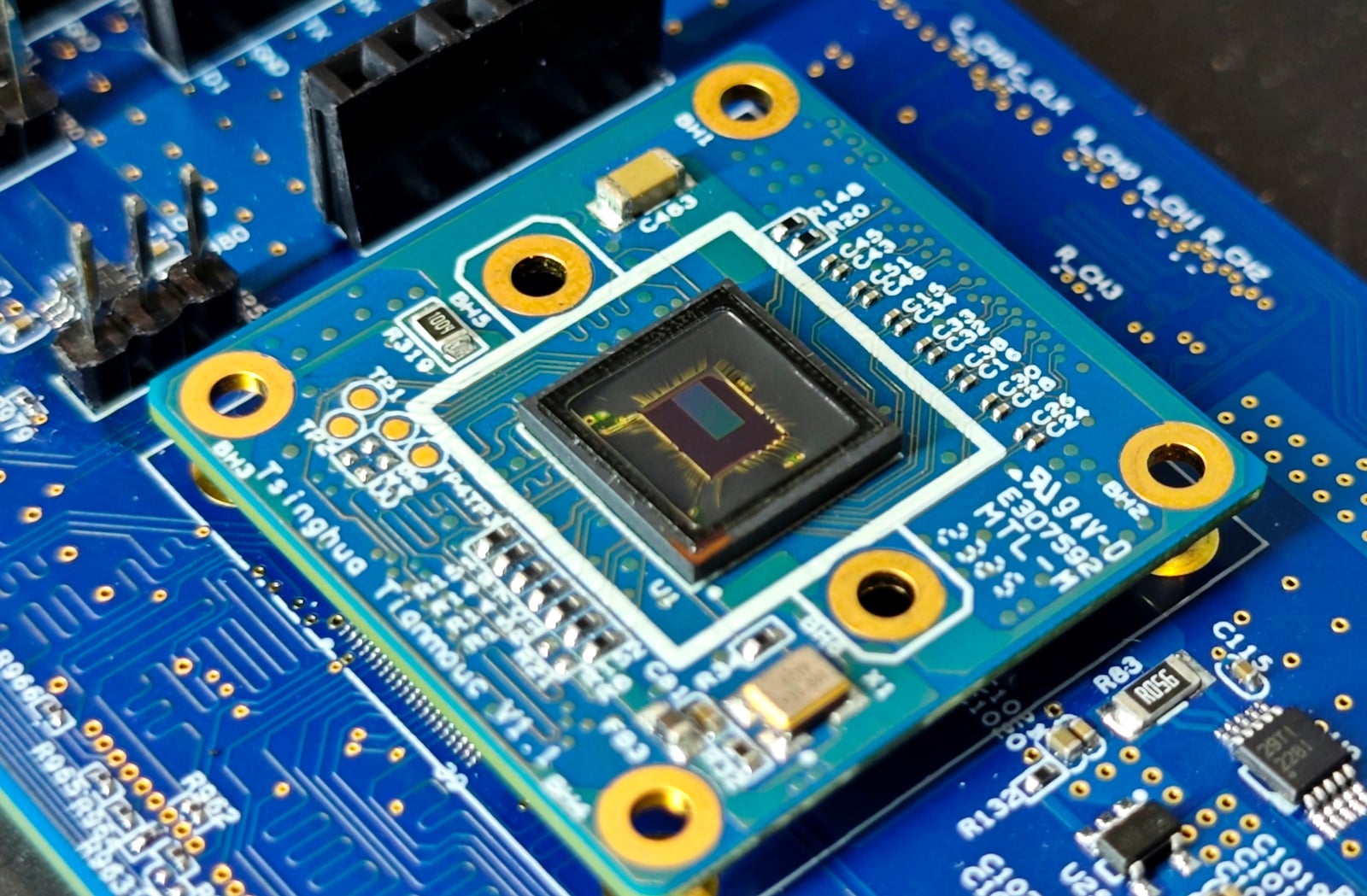
A car emerging from a tunnel needs to recognize the road while coping with an abrupt change in light. Those demands arrive together, but a camera need not describe them in the same way. Tianmouc, developed by a Tsinghua University team with collaborators at Beijing’s Lynxi Technologies, makes that separation part of the sensor itself. The university’s May 30, 2024 announcement placed tunnel entrances, sudden hazards, and nighttime flashes at the center of the problem.[2]
The resulting research offers a revealing thread through China’s embodied-AI work: choices about what a machine sees begin before its recognition model runs. Read together, the original paper, the public software, and a subsequent scientific challenge tell a more useful story than the launch’s headline frame rate. They show an attempt to make visual information travel in forms suited to different jobs.
Two ways to describe the same scene
Published online on May 29, 2024, the Nature paper describes complementary pathways: one oriented toward recognizing the scene, the other toward responding quickly. Its hybrid pixel array and readout architecture support that division. The authors reported sensing up to 10,000 frames per second, a 130-decibel dynamic range, and an adaptive 90 percent bandwidth reduction.[1]
Those figures need their operating context. The project’s Chinese-language documentation, labeled for TianMouCV version 0.4.2.0 and accessed on September 28, 2026, identifies a color-image stream at 30.3 frames per second and a separate difference-data stream reaching up to 10,000. The latter records temporal and spatial differences: changes over time and variation across the image. The documentation keeps the streams in separate data folders and provides a reader that pairs them.[3]
That makes the headline speed easier to understand. It does not promise ten thousand complete color photographs every second. The official algorithm-library README further distinguishes 757 fps at 8-bit precision from 10,000 fps at 2-bit precision. Speed and the precision of the difference measurements must be read together.[4]
Consider, as an illustration, an object moving across a road. Detailed color information can help identify it; rapidly updated changes can help track its movement. A system designer can ask each stream to contribute where it is useful. Whether that improves a particular driving task still depends on the algorithms and the conditions of the test.
The software makes the separation tangible
TianMouCV’s public library includes data decoding, image processing, motion estimation, grayscale reconstruction, and neural-network examples. These are the pieces needed to turn unfamiliar sensor output into something an application can use.[4] Their presence matters because a new camera representation creates work for the software around it. A team cannot evaluate the sensor simply by feeding every output into a pipeline expecting ordinary video.
The minimum C++ SDK makes that practical difference especially clear. Its example application runs two visualization branches at different rates, displaying color and difference information separately. Its README also records a deployment constraint: without access to the full SDK source, the supplied shared libraries support x86 and were compiled under Ubuntu 24.04.[5]
That is a modest but concrete ecosystem signal. A paper’s architecture is becoming an interface that other engineers can inspect and try. The demonstration does not establish broad hardware portability, and it supplies no evidence of fleet-scale adoption. It does reveal what an integration experiment would involve: acquiring two streams, keeping their timing meaningful, and choosing how they feed the task.
The library’s reconstruction tools introduce another useful distinction. A reconstructed image is produced from sensor data by an algorithm.[4] It should therefore be evaluated as an output of that processing chain. For an engineer studying a missed obstacle, preserving the original measurements alongside the reconstruction would make it easier to determine where information disappeared.
A published challenge changes how to read the numbers
On June 4, 2025, Nature published a Matters Arising comment by Minhao Yang and colleagues. The authors acknowledged the work of building and demonstrating Tianmouc, while disputing both the novelty of its conceptual basis and its claimed performance superiority over existing sensors. They situated hybrid, multi-pathway sensing within an established line of research.[6]
That criticism belongs beside the original results. The 130-decibel figure remains a claim reported by the Tianmouc paper; a comparative verdict requires the measurement definitions and test conditions to line up. Likewise, a bandwidth saving needs a specified reference, output representation, and precision. These are questions for interpreting the evidence, rather than grounds for declaring either universal superiority or universal failure.
The original paper also reports integration into an autonomous-driving system and perception demonstrations under difficult road conditions.[1] Such experiments establish a research case for the design. They do not, on their own, establish how often a deployed vehicle would miss a hazard across changing weather, traffic, and camera configurations.
What progress would look like from here
My reading of these sources is that Tianmouc’s most durable contribution may be the explicit division of visual work. The research proposes a representation, the software exposes it, and the criticism pushes the field to describe its benefits precisely. Each step makes a different part of the proposition testable.
A convincing application result would connect those parts: which stream and precision were used, how much data and processing the complete system needed, and whether the task improved against an appropriate camera baseline. For driving, that would mean reporting failures and response timing as well as attractive sample images.
The larger lesson for following China’s AI hardware is concrete. A camera helps decide what evidence reaches a model. Tianmouc makes that decision unusually visible—and gives researchers a way to test whether seeing different things at different speeds is worth the complexity.
Sources
- Zheyu Yang et al., “A vision chip with complementary pathways for open-world sensing,” Nature, May 29, 2024; sensor architecture, reported performance, and autonomous-driving perception demonstration.
- Tsinghua University, Department of Precision Instrument research announcement, May 30, 2024; first-hand Chinese account of the project, collaborators, operating challenges, and original hardware photograph.
- TianMouCV, Chinese-language algorithm-library documentation, labeled version 0.4.2.0; color and difference streams, file structure, and paired data reader, accessed September 28, 2026.
- Tianmouc, official TianMouCV repository; V1 data modalities, speed–precision settings, reconstruction, and algorithm tools, accessed September 28, 2026.
- Tianmouc, minimum C++ SDK repository; two-stream demonstration and restrictions of the precompiled-library route, accessed September 28, 2026.
- Minhao Yang et al., “Dynamic range and precision of hybrid vision sensors,” Nature, June 4, 2025; published challenge to conceptual novelty and comparative performance claims.