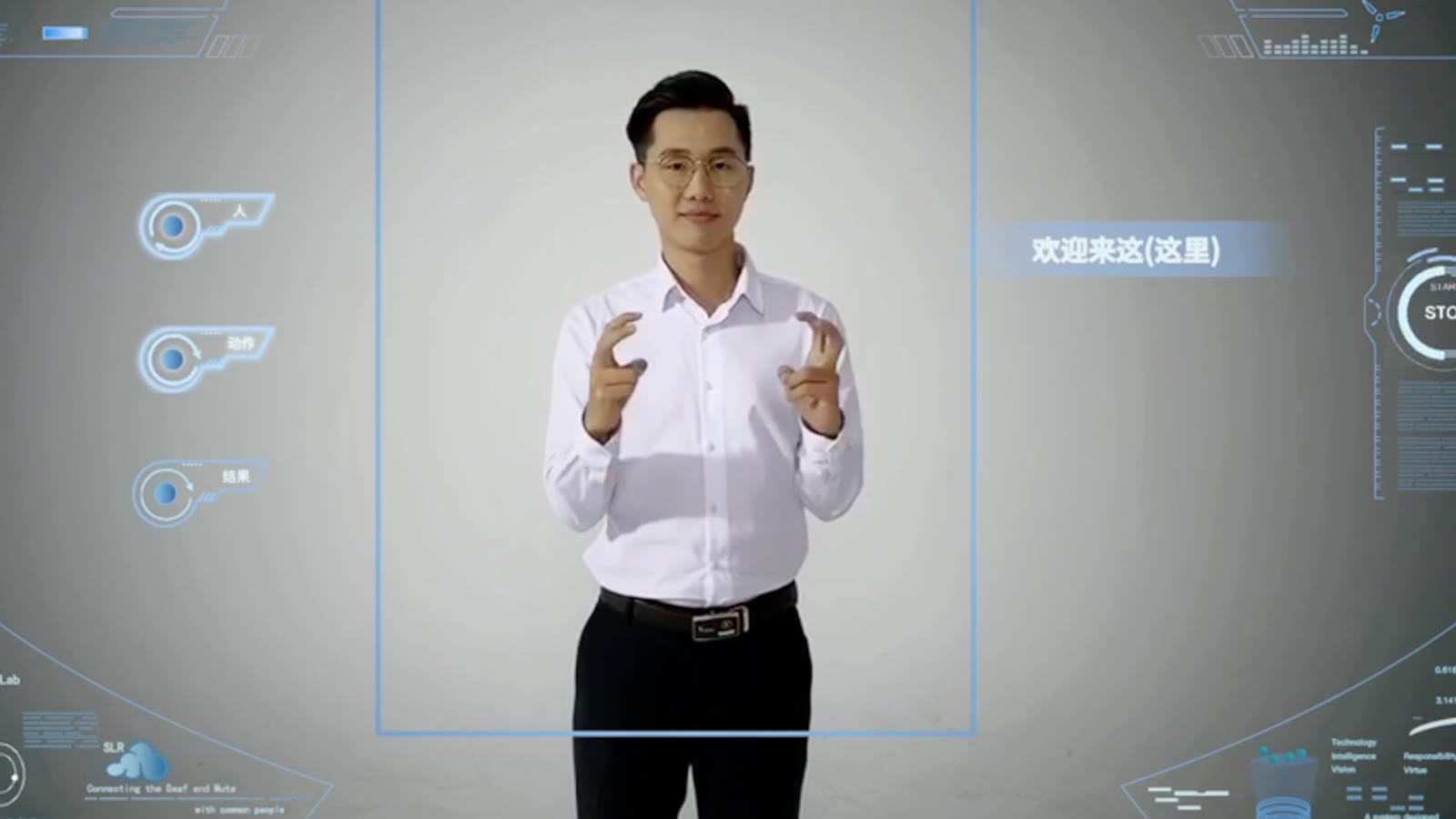

The most revealing sentence in this 56-second report is not the claim that Tencent YouTu Lab's AI sign-language platform is “ready to serve” Deaf and hard-of-hearing people. It arrives about halfway through, when the narrator explains why the demonstration remains limited: the signer needs to stand in front of a white wall. The video gives its promise first and its test conditions second. Watching those two statements together turns a brisk technology showcase into a useful lesson about what a public-service translation system would actually have to prove.[1]
The clip dates from May 2019, when YouTu and the Shenzhen Accessibility Research Association presented a prototype that used an ordinary camera and a back-end computer to turn signing into Chinese text. Its stated destinations included government-service counters, airports, and railway stations. Yet CGTN's written companion report was more guarded than the video's opening: it said the system was not on the market, still needed improvement, and was headed for initial trials.[2][5] That distinction matters. The footage records an early capability demonstration, not evidence of a fielded service.
It is worth viewing today because the underlying problem has not shrunk to hand-shape classification. Continuous signing carries motion, timing, spatial structure, facial expression, regional variation, and sentence context. The useful question is therefore not “Did the words appear on the screen?” It is “What had to remain controlled for those words to appear, and what happens when that control disappears?”
0:00 — “Ready” arrives before the test conditions
The opening shot places a signer inside the product interface. A rectangle tracks his upper body while Chinese text accumulates alongside the image. The sequence communicates an attractive systems idea: replace gloves or dedicated sensors with a camera that could already exist at a service counter.[1][2] Lowering the hardware burden is meaningful. It can also make the remaining problem look deceptively small.
At about 0:14, the film moves to a trade-show booth. A second signer faces the camera, and the screen produces text in real time. The background is plain; the body is centered and unobstructed; the camera position is fixed. Nobody walks between signer and lens. The clip provides no accuracy figure, latency distribution, held-out-signer test, or comparison with a human interpreter. That does not make the demonstration false. It defines what the demonstration can establish: under these visible conditions, the prototype can map a prepared stream of signing to a plausible text output.
CGTN's companion feature supplies the status label the moving images lack. It describes a technology at an early stage, not yet commercially available, with public locations proposed for trials.[5] Reading the film that way avoids two equal mistakes: treating a prototype as a deployed solution, or dismissing it because it is a prototype. Its value is that the controlled booth lets us see the research boundary.
0:14 — The camera is reading a sequence, not a pose
The Chinese technical account published around the launch explains what lies behind the apparently simple rectangle. YouTu combined two-dimensional convolutional processing for relatively static hand and body information with three-dimensional convolutional processing for small, rapid changes across frames. An LSTM then incorporated neighboring information at the word level, followed by sentence context. The stated goal was whole-sentence recognition without requiring a signer to insert artificial pauses or perform special start and stop gestures.[2]
That sequence is the real technical subject. A still pose can resemble another still pose while meaning changes through direction, duration, transition, or context. An online system also has to act before the future half of the sentence exists. A later Tencent-affiliated ECCV paper—not documentation of this exact product—describes continuous sign-language recognition in similar terms: spatial and temporal information must be learned together, signing speeds vary, and an online recognizer must work from partial observations rather than a complete recorded sentence.[3] The distinction between the prototype and the later paper is important, but so is the shared problem.
The text appearing in the booth is therefore the end of a chain of decisions: where one unit ends, which motion belongs to it, how adjacent units alter the reading, and when the evidence is sufficient to emit a word. Calling the task “gesture recognition” makes that chain disappear. Calling it language recognition keeps the temporal and grammatical problem in view.
0:29 — The white wall is the most important frame
Around 0:29, the video names the white-background requirement. This is its strongest moment because it supplies a falsifiable condition. A railway station is not a white wall. It contains shifting light, patterned clothing, luggage, partial occlusion, variable camera angles, people crossing the frame, and signers whose height, speed, range of motion, and language experience differ. Moving the same camera from the booth to the concourse changes the data before it changes the user interface.
Later research makes clear that background control was not a cosmetic inconvenience. A 2024 preprint introducing a Chinese continuous-sign dataset for complex environments argues that many public datasets had been collected in laboratories or extracted from television, leaving relatively uniform backgrounds unlike everyday scenes. Its proposed dataset contains 5,988 continuous clips across more than 70 complex backgrounds.[7] The study does not evaluate YouTu's 2019 system, but it identifies precisely the transfer problem exposed in the clip.
A credible public trial would therefore report results across environments, not just an aggregate score. It would separate familiar from unseen signers; daylight from poor lighting; plain from cluttered backgrounds; front-facing from imperfect camera placement; and clean signing from natural interruptions. It would publish latency and failure rates, including how often the system abstains instead of producing confident but wrong text. Those are proposed evaluation requirements, inferred from the gap between booth and public-service counter—not claims about tests YouTu did or did not run.
0:43 — A vocabulary count is not a language boundary
In its final seconds, the report points to scale: the narration describes a database of 900 Chinese sign-language phrases and recognition of nearly 1,000 common expressions.[1] The contemporaneous Chinese account describes the release slightly differently, as nearly 1,000 everyday sentences and 900 common words.[2] Rather than force those figures into one tidy statistic, they are best read as launch-era descriptions of a bounded corpus. Neither number tells us which domains are covered, how evenly examples are distributed across signers, or how performance changes outside rehearsed service exchanges.
Coverage is especially difficult to summarize in China. A 2026 CHI study based on interviews with 13 Chinese Deaf online content creators describes Chinese Sign Language not as one widely adopted, standardized national language, but as a family of regional variants. It also stresses that sign languages have their own vocabularies, grammar, and syntax, with meaning carried through visual-spatial features including facial expression, body movement, and the location of signs.[4] A thousand catalogued units cannot by itself demonstrate that a system understands those relations.
There is also a difference between recognizing a sequence and choosing a faithful Chinese rendering. The same CHI study documents how Deaf creators mix signing, captions, speech, images, examples, and storytelling to bridge languages and cultures. Its participants' work shows translation as meaning-making rather than mechanical word replacement.[4] The text box in the YouTu interface hides this interpretive layer. Once one Chinese sentence appears, the viewer cannot see which alternatives were possible, which regional expression was normalized, or whether a fluent Deaf reader would judge the output natural.
The missing participant is the person receiving the translation
The 2019 launch did include a promising institutional step: YouTu and the Shenzhen Accessibility Research Association formed a joint project group intended to expand data and improve the algorithm through contact with Deaf people and sign-language users.[2] That is more substantial than designing a vocabulary without signing communities. The public materials, however, do not provide field-trial outcomes, participant-level errors, or evidence about who could correct the system when its output changed the intended meaning.
That missing feedback loop is not a secondary usability concern. At a government counter, an incorrect translation could alter an application, a destination, a deadline, or consent. The person signing needs an obvious way to inspect what the system inferred, reject it, try a different expression, and request a human interpreter. The staff member receiving the text also needs to know whether it is a confident translation, a partial hypothesis, or an abstention. Smooth output is less important than recoverable output.
The CHI researchers argue that future sign-language technology should move beyond a fixed “interpreter” model that merely converts signing into written or spoken language. They propose supporting wider communication practices, multiple translation suggestions, collaborative refinement, and the continued development of sign language itself. They also call for collaboration with Deaf communities and domain specialists rather than treating generic user approval as sufficient evidence.[4] Applied to the 2019 prototype, that means Deaf signers should help define the target language, acceptable errors, correction flow, trial scenarios, and release threshold—not only contribute examples to a dataset.
What a convincing public-service trial would show
The clip suggests a useful evidence plan even though it does not carry one out. First, evaluate continuous, unrehearsed signing with unseen signers from different regions and language backgrounds. Second, cross that signer test with the environmental conditions the intended venues actually contain. Third, score the meaning of the full translated sentence as well as unit-level recognition, and publish latency, abstentions, and consequential error categories. Fourth, let Deaf participants judge whether the interaction preserves intent and offers an acceptable repair path. Finally, keep a human fallback available and measure whether the system makes access faster without making assistance harder to request.
These requirements are stricter than asking whether a camera can generate text, because the proposed setting is stricter than a booth. They also leave room for a narrower system to be useful. A prototype might work well for a carefully disclosed set of routine questions, in a designed counter space, with immediate confirmation and interpreter escalation. Honest limits can make a service safer; a universal label cannot make the underlying coverage universal.
Watch the video again and notice how much of the story fits between its two backgrounds. The clean wall demonstrates a genuine compression of hardware: camera in, text out. The promised airport or public-service hall expands everything the wall suppresses—visual noise, linguistic variation, stakes, repair, and accountability. The lasting insight of this 2019 artifact is not that an AI “solved” sign-language translation. It is that a readable booth demonstration makes the distance to dependable translation unusually easy to see.
Sources
- CGTN, “AI interpreter for people with hearing loss: Translating Chinese sign language to words in real time,” official YouTube video, May 24, 2019.
- Machine Heart, “践行科技向善,腾讯优图发布 AI 手语翻译机,” contemporaneous Chinese technical account republished by Tencent Cloud Developer Community, May 22, 2019.
- Ka Leong Cheng, Zhaoyang Yang, Qifeng Chen, and Yu-Wing Tai, “Fully Convolutional Networks for Continuous Sign Language Recognition,” ECCV 2020.
- Xinru Tang and Anne Marie Piper, “Reimagining Sign Language Technologies: Analyzing Translation Work of Chinese Deaf Online Content Creators,” CHI 2026.
- CGTN, “Tech for Good: New tech translates sign language,” written feature on the prototype's status, constraints, and proposed trials, May 23, 2019 (updated May 24, 2019).
- CGTN, video page and archival poster image for the 2019 YouTu sign-language demonstration used as this article's cover.
- Qidan Zhu et al., “A Chinese Continuous Sign Language Dataset Based on Complex Environments,” arXiv preprint, 2024.