In 1959, a team from two institutes of the Chinese Academy of Sciences used a computer built for numerical problems in a Russian–Chinese translation experiment. The machine was the Model 104, a room-size general-purpose computer that had only begun trial calculations that April. The report says the team translated comparatively complex sentences representing nine different types.[2][4]
That small demonstration carries a large historical label. A later account from the Institute of Computing Technology calls it China’s first Russian–Chinese machine-translation experiment.[1] Read too quickly, the phrase can sound like the arrival of a usable translator. Read against the surviving evidence, it marks something more precise: linguists and computer specialists had used a real computer in a bounded translation experiment.
The nine sentence types were enough to establish a use case. They were not enough to establish general capability. The distinction is the most interesting thing about the experiment—and the reason it belongs in the history of Chinese AI rather than in a parade of primitive machines.
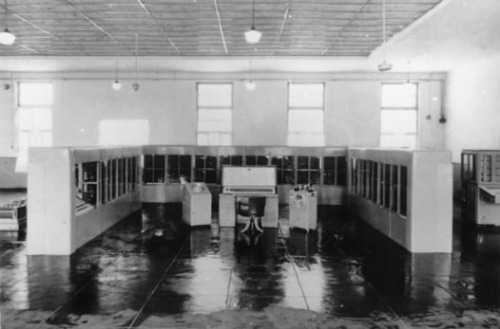
The archival photograph above shows the Model 104, not a documented translation session. That boundary matters: the image establishes the physical machine, while the written record establishes that researchers used it for a translation experiment.[5]
The translation problem entered the plan before it entered the computer
China’s national 1956–1967 science and technology plan placed “automatic translation” in item 41 in December 1956.[1] A Chinese-language survey gives the task’s fuller scope: machine translation, rules for translating natural language, and a mathematical theory of natural language. In 1957, linguist Liu Yongquan and colleagues at the CAS Institute of Linguistics began Russian–Chinese research with the CAS Institute of Computing Technology.[2]
The pairing was structural, not ceremonial. A linguistics institute could analyze Russian and Chinese, devise dictionaries and rules, and decide what counted as a valid transformation. A computing institute could turn that procedure into operations the available hardware would accept. Neither side had a complete use case alone.
The machine was still becoming usable while the language work advanced. Official ICT history says the Model 104 began trial calculations in April 1959, was reported by People’s Daily in September, and was declared complete around National Day. It averaged 10,000 operations per second. It was manufactured in China from the Soviet BESM-II design, with Soviet technical assistance, and seven units were eventually produced.[4]
That lineage deserves exact wording. “Made in China” is supported; “independently designed in China” is not. ICT’s own history distinguishes the 104 from the independently designed machines that followed.[4] The translation experiment therefore joined two transfers: researchers were converting Russian into Chinese while engineers were absorbing and operationalizing a Soviet computer design.
Nine types are a demonstration, not a distribution
The best detailed survey says the experiment translated sentences from nine different types and describes them as comparatively complex.[2] It does not reproduce the Russian inputs, the Chinese outputs, a dictionary, a rule set, an error log, or an accuracy score. The broader CAS history records a successful experiment but adds no evaluation data.[1]
What, then, did the run establish? Researchers had to represent language in a form the computer could process, encode at least part of a linguistic procedure, run a program on the 104, and inspect the result as translation. This is evidence that language analysis and computer execution met. It is not a record showing that every translation stage was automatic.
The word types is revealing, but it must be read as a clue rather than a protocol. It suggests—without proving—that researchers chose cases to exercise distinct linguistic constructions. That is a sensible way to debug a rule system: choose a case, expose a transformation, and see whether the output follows the intended analysis. It does not tell us how the procedure would handle an unseen newspaper paragraph, an unknown word, an ambiguous sentence, or a new combination of familiar structures.
A modern evaluation samples or withholds data, specifies a metric, reports failure rates, and describes the conditions under which the score was produced. The surviving account of the 104 test provides none of those. So “nine types translated” cannot be converted into a percentage, and “successful” cannot be expanded into “general-purpose.” The strongest defensible claim is narrower: researchers used the Model 104 in a Russian–Chinese translation experiment covering nine reported sentence types.
There is a second priority boundary. The CAS retrospective calls this the first Russian–Chinese experiment in China, while the technical survey notes that teams at Beijing Foreign Languages Institute, Beijing Russian Institute, South China Institute of Technology, and Harbin Institute of Technology were also pursuing Russian–Chinese or English–Chinese computational translation in this period.[1][2] “First” is therefore an institutional historical claim, not evidence that the CAS group worked in isolation.
Before learned weights, the model was a linguistic procedure
No corpus-trained model sat inside the 104. The intellectual work was explicit: decide which features of a sentence mattered, give them a representation, and specify transformations a computer could carry out.
A historical survey of Chinese information processing names an “intermediate-component theory” proposed by Liu Yongquan, Liu Zhuo, and colleagues in 1958 as important to the early machine-translation work. It also places machine translation across multiple layers—morphological analysis, syntax, semantics, and language generation—rather than treating it as word-for-word substitution.[3]
Even characters were an engineering problem. The same survey says the earliest Chinese computer input for Russian–Chinese translation used telegraph codes and four-corner codes, systems that represented characters numerically before standardized Chinese input methods existed.[3] Translation could not begin with a neat line of Unicode text. The team first had to make Chinese characters addressable to the machine.
This changes the scale at which to view the achievement. The sources collectively point to character codes, linguistic categories and operations, program instructions, and interpreted output. Those elements form a useful conceptual map of the handoffs a demonstration could require; the histories do not document the exact 1959 pipeline or show that every possible layer was implemented. A failure anywhere between representation and machine operation could still appear to researchers as a bad translation.
It would be tempting to draw a straight line from this symbolic procedure to a present-day language model. The technologies are too different for that. Modern neural systems learn distributed parameters from enormous corpora; the 1959 experiment depended on human-authored linguistic distinctions and a small reported test. The genuine continuity is the systems question: what representation crosses the boundary between language and computation, and how do we know what it can do?
The computer was part of the experiment
The official photograph gives the Model 104 its proper scale: long cabinet banks curve around a central console, occupying a machine room rather than a desk.[5] Its 10,000 operations per second were a national computing milestone, but raw speed did not create a software environment.
ICT dates China’s first operational compiler to 1961, when a programming group completed one on the 104 and used it for numerical-analysis problems.[7] The translation run came two years earlier. Whatever form its program took, it predates that documented compiler and should not be imagined as an application typed into a mature high-level development system.
Surviving artifacts from early Chinese computers make the labor more tangible. The China Computer Federation describes machine-language programming, architecture-specific instruction sheets, a single control console, short scheduled debugging slots, and a 104 self-check routine used when unstable vacuum-tube hardware produced suspicious results. It also preserves a later standard-program collection for the 104, written in floating-address machine language.[6] Those materials cover a broader early-computing period, not the translation session itself, but they show the operating world in which a language experiment had to live.
For this use case, hardware reliability was part of semantic reliability. Before asking whether a Chinese phrase was wrong, an operator might have to ask whether the program, input, memory, or a physical component had failed. “The computer translated it” compresses a chain of human analysis, coding, scheduling, operation, inspection, and machine maintenance.
What the archive can—and cannot—score
The accessible histories support four concrete statements. The project grew from a national research plan; the Institute of Linguistics and Institute of Computing Technology collaborated; the experiment ran on the Model 104 in 1959; and it covered nine types of comparatively complex Russian sentences.[1][2]
They do not preserve the complete test set, verbatim outputs, human judgments, error categories, runtime, vocabulary size, or behavior outside the selected structures. Without those materials, we cannot reconstruct a benchmark or compare the system’s quality with another translator. We also cannot tell whether every stage was automatic once the run began. Absence of documentation is not evidence of failure, but it is a limit on the claim.
That limit makes the experiment more useful, not less. It separates four milestones that are often collapsed:
- Formalization: experts express part of translation as operations.
- Machine execution: a program on a physical computer contributes to a translation result.
- Automation: every translation stage proceeds without manual intervention.
- Generalization: the system works reliably on inputs not designed around its rules.
The 1959 record strongly supports the first two for a bounded demonstration. It does not establish the third or fourth.
The enduring result was the handoff
The Model 104 experiment did not launch an uninterrupted product line. CAS’s later history says Chinese machine-translation research was disrupted for roughly a decade during the Cultural Revolution and resumed in the mid-1970s.[1] Its immediate legacy was therefore less a service than a proof of institutional coupling: a state research task could bring linguists, programmers, and a newly built computing system into one executable project.
That is why nine sentence types can matter without being inflated into nine victories. They show the moment a language theory had to survive contact with codes, instructions, machine time, and output. The experiment’s honest historical status is neither “mere demo” nor “working translator.” It was a bounded computer-mediated translation experiment whose capability boundary remains visible.
Current AI demonstrations are often far larger and far less transparent. The lesson from 1959 is not that small tests are worthless; it is that a demonstration should be read at exactly the scale of its evidence. Name the inputs. Preserve the outputs. Separate the designed cases from the unseen ones. Credit the human and physical stack around the result.
The Model 104 could perform ten thousand operations each second. The more consequential operation was conceptual: a sentence had become something a computer in China could be asked to transform. Nine types showed that the request had become an experiment on a physical machine. The archive’s silences tell us where the claim must stop.
Sources
- Qun Liu, “Machine Translation in China,” Institute of Computing Technology, Chinese Academy of Sciences (institutional history covering the 1956 plan, the 1959 experiment, and the later research interruption).
- Chengqing Zong and Qingshi Gao, “Progress in Chinese Language Technology” / 《中国语言技术进展》 (technical survey specifying the 1956 task, 1957 collaboration, Model 104, and nine sentence types).
- Chengqing Zong, Youqi Cao, and Shiwen Yu, “Sixty Years of Chinese Information Processing” / 《中文信息处理60年》 (official-hosted full text; historical survey of early character coding, linguistic layers, and intermediate-component theory).
- Institute of Computing Technology, Chinese Academy of Sciences, “History” / “历史沿革” (official chronology and technical context for the Model 104).
- Institute of Computing Technology, Chinese Academy of Sciences, “Model 104 Computer” (official archival photograph and machine identification).
- China Computer Federation, “Program Manuscripts for the 104, 109B, 111, 119, 013, 655 and Other Machines” / “104、109乙、111、119、013、655等机器程序手稿” (archival account of early programming practice and surviving Model 104 materials).
- Institute of Computing Technology, Chinese Academy of Sciences, “The Development History of China’s Computer Enterprise from Scratch” / “从零开始的中国计算机事业发展史” (official institutional article documenting the 1961 compiler on the Model 104).