Moonshot AI kept the most important promise in its Kimi K3 launch. The Beijing lab introduced the model on July 16, 2026, said the full weights would arrive by July 27, and then published them on schedule alongside a 47-page technical report and a custom license.[1][2][3][4] That sequence turns “open” from launch rhetoric into an inspectable artifact.
It does not turn Kimi K3 into a small artifact. As of July 30, the official Hugging Face repository contains 96 safetensors shards totaling 1.56 TB. Moonshot describes a 2.8-trillion-parameter mixture-of-experts model with 104 billion parameters activated per token, native vision, and a context window of 1,048,576 tokens.[2][3] Sparse activation reduces the arithmetic performed for each token; it does not make the other expert weights disappear from storage or the serving topology.
That is the cleanest way to read this release. Kimi K3 is unusually open to inspection and unusually explicit about the machine room required to make it useful. Moonshot recommends a supernode with 64 or more accelerators for deployment.[1] The release therefore expands access to frontier-scale weights while making a second distinction impossible to ignore: the right to download a model is not the same thing as an economical way to run it.
What changed from Kimi K2
Kimi K3 is not just K2 with a longer context label. Against Moonshot's original K2 model card, the new model raises total parameters from 1 trillion to 2.8 trillion, activated parameters from 32 billion to 104 billion, layers from 61 to 93, and routed experts from 384 to 896. It selects 16 routed experts per token rather than eight and adds two shared experts rather than one.[2][5]
The context path changes even more. Original K2 used Multi-head Latent Attention across its backbone and advertised 128K context. K3 alternates three Kimi Delta Attention layers with one Gated MLA layer, ending with another global-attention layer; its final count is 69 KDA layers and 24 Gated MLA layers.[2][5] The technical report says pretraining began at 8K context, extended to 64K, and then moved through 256K to one million tokens during cooldown.[2]
KDA carries information through a recurrent state whose size does not grow token by token like a conventional full key-value cache. The periodic MLA layers preserve global token-to-token interaction. This is a hybrid answer to the long-context problem: use the recurrent path for most layers, then regularly restore a more expensive global view.[2] Moonshot's claimed 2.5× scaling-efficiency improvement over K2 belongs to this complete package—attention, depth routing, sparse experts, training recipe, and infrastructure—not to one isolated trick.[1][2]
The second architectural change runs down the model rather than across the sequence. Attention Residuals let a block selectively retrieve representations from the embedding and earlier blocks instead of relying only on a uniform chain of accumulated residual additions. In plain language, K3 is trying to choose what to carry forward across both time and depth. Stable LatentMoE does the equivalent job across width, routing each token through a small fraction of the 896-expert pool.[2]
These are genuine technical deltas. They are also vendor-authored claims until outside teams reproduce the quality, latency, memory, and stability tradeoffs under their own workloads.
The 1.56 TB repository is the deployment note
Moonshot quantized the routed expert weights to MXFP4 and uses MXFP8 activations, while attention projections, shared experts, routers, and several other components remain at higher precision. The team applied quantization-aware training throughout supervised fine-tuning and reinforcement learning rather than converting a finished high-precision model afterward.[2][3] That helps explain how a 2.8-trillion-parameter model can be published in 1.56 TB rather than several times that size.
It does not remove the distribution problem. Dividing the weight files evenly across 64 accelerators produces a raw arithmetic floor of roughly 24.4 GB per device before runtime buffers, activations, caches, framework overhead, redundant placement, and imbalance. That is not a capacity plan; it is a warning against treating “104B active” as if the checkpoint were a conventional 104B model. All experts must remain reachable when the router selects them.
The supernode recommendation follows from that requirement. Extreme sparsity pays only if high-bandwidth links can move tokens to experts without turning communication into the bottleneck. Moonshot's report describes balanced expert execution, static computation shapes, zero-copy communication, state-aware prefix caching, and budget-based admission control for traffic ranging from sub-2K requests to million-token runs.[2] K3 is as much a distributed-systems release as a model release.
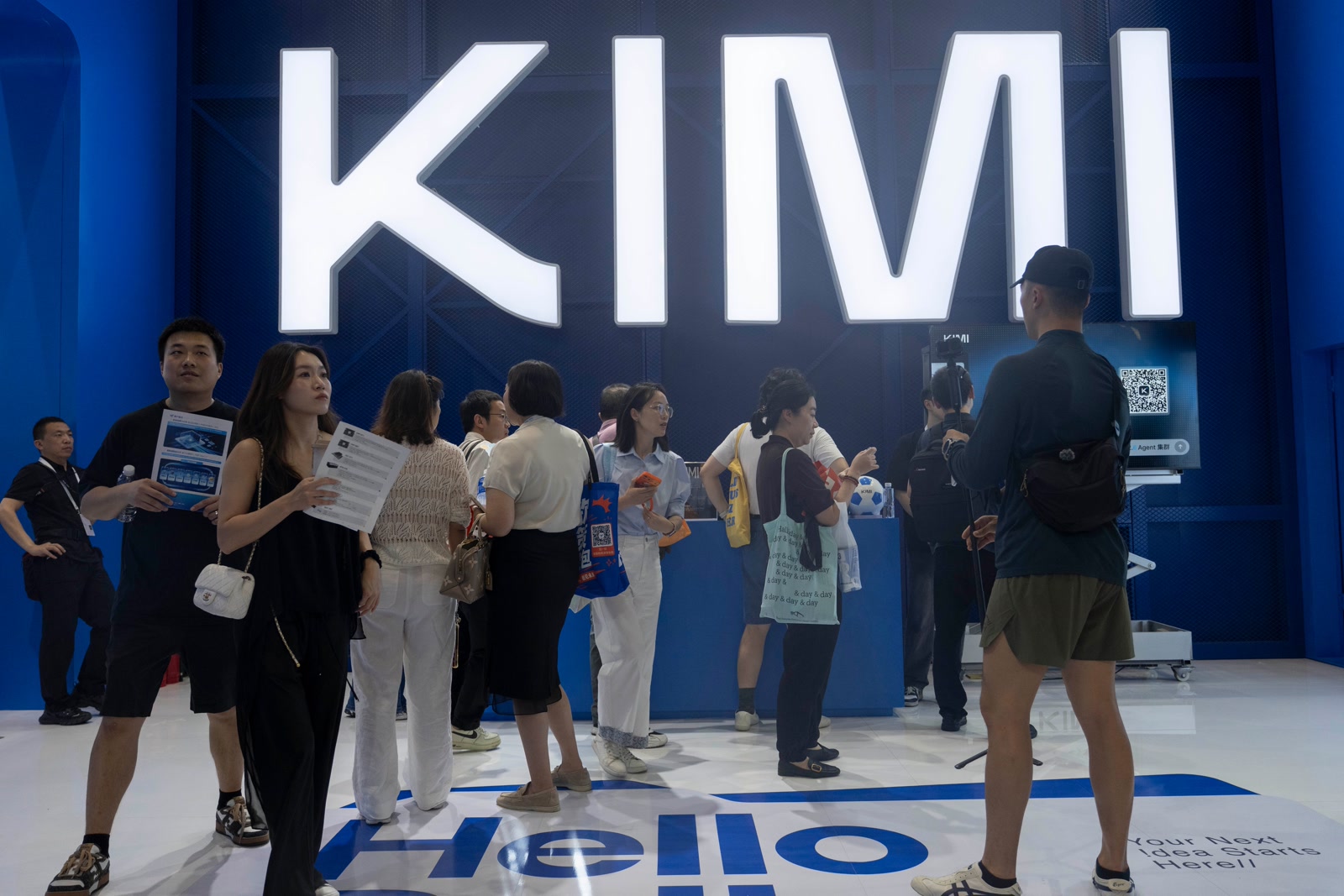
The hosted rollout supplied an immediate stress test. Within days of launch, demand pushed close to Moonshot's capacity and the company temporarily paused new subscriptions while prioritizing existing customers, according to the Associated Press.[6] That episode does not measure weight quality. It shows that serving capacity remains a separate product, even when the model artifact is public.
The license is permissive until scale changes the contract
The Kimi K3 License grants broad rights to use, copy, modify, distribute, sublicense, sell, deploy, and fine-tune the software and weights.[4] For researchers, internal enterprise users, smaller product teams, and many downstream builders, that is a substantial opening.
It is not a standard no-conditions permissive license. A licensee operating a “Model as a Service” business must reach a separate agreement with Moonshot before commercial use when the licensee and its affiliates exceed $20 million in aggregate revenue over any consecutive 12 months. Separately, a commercial product or service using K3 must display the name “Kimi K3” prominently if it exceeds 100 million monthly active users or $20 million in monthly revenue. The license exempts internal use and access through Moonshot's official products or certified inference partners from those two scale clauses.[4]
Those thresholds reveal the commercial design. Moonshot is opening research, inspection, modification, and a wide field of deployment, while reserving negotiation leverage over large model-service businesses and attribution on very large products. Calling the release merely “free” misses that structure. So does calling it closed. It is a custom open-weight bargain whose obligations change with the deployer's business model and scale.
The report also does not make training reproducible in the strongest sense. It documents architecture, curriculum, post-training, infrastructure, and evaluation in unusual depth, but it does not release the full pretraining corpus, every training artifact, or a recipe that an outside lab could execute to recreate K3 from scratch.[2] Public weights permit audit and derivative work; they do not reconstruct the factory that produced them.
The benchmark table needs its harness labels
Moonshot is more explicit than many launch posts about evaluation boundaries. K3 results use maximum reasoning effort and temperature 1.0. Coding comparisons span Kimi Code, Claude Code, and Codex rather than one universal harness. Its SWE-Marathon branch was recalibrated for NVIDIA H20 hardware before the final v1.1 release, and Claude Fable 5 encountered fallback behavior on 35% of those tasks. PostTrainBench used H20 rather than the official H100 setting for several models.[1][2]
That disclosure makes the numbers useful, but not interchangeable. K3 scored 88.3 on Moonshot's Terminal-Bench 2.1 table, close to GPT-5.6 Sol at 88.8 and Claude Fable 5 at 88.0. On FrontierSWE it scored 81.2, below Fable's 86.6 and above Sol's 71.3. Moonshot's report also says K3 ranked first on the WebDev Arena as of July 23, while only eighth on the Text Arena and fourth on the newer Agent Arena.[2] AP independently reported the front-end coding lead after launch.[6]
The responsible conclusion is narrower than “K3 wins.” The model appears competitive at frontier coding and agent work, particularly where long trajectories, tools, and visual feedback matter. The exact order changes with task, harness, effort, fallback, hardware, and date. A team evaluating the weights should pin all six before using a leaderboard result as a procurement claim.
What the release must prove next
Kimi K3 has already cleared one bar: Moonshot shipped the promised weights, report, configuration, and license. The next evidence should come from operators outside Moonshot.
First, independent deployments need to publish accelerator count, topology, throughput, time to first token, tail latency, power, and useful context length—not just whether the model booted. Second, benchmark replays should hold the agent harness and reasoning budget constant across models. Third, the ecosystem needs to show whether KDA and MXFP4 support spreads beyond a narrow set of optimized runtimes and accelerators. Finally, large commercial adopters will reveal whether the license thresholds encourage certified hosting, direct negotiation, or alternative models with simpler terms.
The release is consequential because its boundary is visible. Kimi K3 is not a hosted model wearing an “open” badge while its weights remain promised. Nor is it a frontier model that becomes ordinary infrastructure after one download. It is a 1.56 TB public artifact, a custom commercial compact, and a recommended 64-accelerator system. Moonshot has opened the model. The hard work now moves to the people who must operate it.
Sources
- Moonshot AI, “Kimi K3: Open Frontier Intelligence” (July 16, 2026)—official launch chronology, architecture overview, deployment recommendation, API pricing, benchmark settings, and weight-release commitment.
- Kimi Team, “Kimi K3: Open Frontier Intelligence,” arXiv:2607.24653 (submitted July 27, 2026)—full technical report covering architecture, training curriculum, post-training, systems design, evaluation configurations, third-party results, and limitations.
- Moonshot AI,
moonshotai/Kimi-K3official Hugging Face repository (snapshot inspected July 30, 2026)—96 weight shards, repository storage, configuration, one-million-token setting, model card, and downloadable artifacts. - Moonshot AI, “Kimi K3 License” (2026)—granted rights, Model-as-a-Service revenue threshold, large-product attribution requirement, internal-use exception, and certified-partner exception.
- Moonshot AI,
Kimi-K2official repository—original K2 architecture baseline, including total and activated parameters, layers, experts, attention mechanism, and context length. - Chan Ho-him, Associated Press, “China’s new AI model halts new subscriptions as demand swamps capacity” (July 20, 2026)—independent rollout reporting and source page for Ng Han Guan’s photograph of the Kimi K3 booth at WAIC.