A tea bush offers a robot far more green than it should pick. For delicate harvesting, the desired unit may be a single bud, a bud with one leaf, or a bud with two leaves just opening. A cutter sweeping across the canopy can bring older leaves and stems into the harvest. Selecting individual shoots preserves a different standard of raw material—and gives automation a much harder job.[1]
Researchers at Zhejiang Sci-Tech University have pursued that job through machine vision, picking mechanisms and coordinated arms. Their papers reveal a practical change in emphasis: once a machine can find a promising shoot, it must decide which arm can reach it, when that arm should move, and how the detached leaf will leave the machinery. Intelligence has to survive the entire journey to the collection basket.[3][4][5][6]
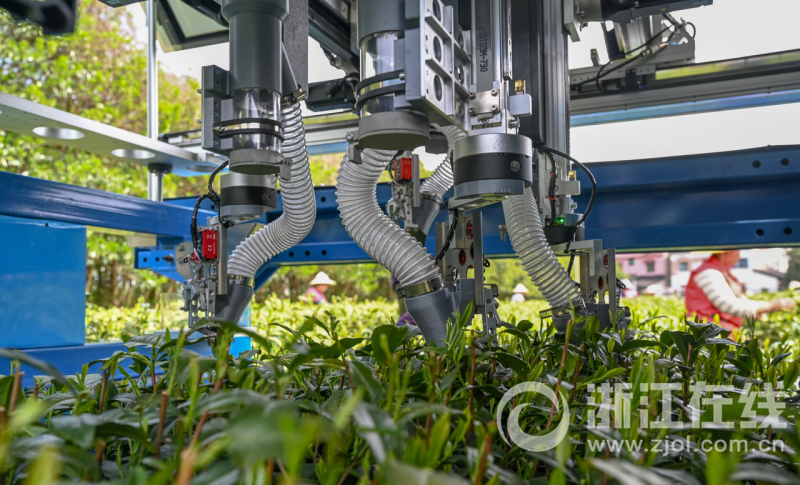
Finding the shoot beneath the green
The camera may recognize a bud while neighboring foliage conceals the stem where a tool needs to act.
A 2021 study by Yatao Li and colleagues addressed that mismatch with a YOLOv3 detector and an RGB-D camera, which records color and depth. After detecting one-bud-and-one-leaf targets, the system combined three-dimensional measurements, shoot growth characteristics and a cylindrical sleeve mechanism to locate the picking position despite concealment.[3]
Detection precision was 93.1%; field picking success was 83.18%.[3] These measure detections and physical attempts respectively. Subtracting them cannot assign all failures to the gripper.
The attraction is practical: enough reliable information to perform one suitable movement.
Two arms need more than two halves
Imagine dividing the bush down the middle. One side may contain many suitable shoots while the other has few. An easy boundary can leave an arm idle.
Jiangming Jia and colleagues' August 2025 dual-arm method changed that division dynamically. It combined picking-point priorities with ant-colony optimization and admitted newly observed targets while the camera and arms worked concurrently.[4]
In simulation, the allocation covered the full workspace, compared with 62.86% for the fixed division. Field experiments separately reported 1.52 seconds per shoot and 29.95% greater efficiency than the single-arm comparator.[4]
Coverage concerns the planner's targets. It cannot establish that every suitable shoot in the garden was detected and harvested. The improvement comes from coordinating observation and assignments.
Four arms make the route a shared resource
The team's March 2026 paper assigned targets by arm priority and arranged picking sequences with a genetic algorithm. Its AtRRT-Connect trajectory planner adapted its search around obstacles and smoothed the resulting movements.[5]
These planning techniques differ from the learned visual detector. Several kinds of computation share the work.
Experiments included Zhongcha 108 tea at a Hangzhou research site. Four-arm field trials recorded 1.22 seconds per shoot for arm operation alone and a broader mean of 1.37 seconds, a reported 20.9% improvement over the study's comparator.[5]
Comparing 1.37 directly with the earlier paper's 1.52 would not establish the benefit of two extra arms: that requires a common test. Here, the advance is a method for distributing reachable shoots without arms competing for space.
The harvest still has to leave the hand
Once a shoot separates, the impressive action appears finished. But a leaf caught inside a tube has not reached the basket.
A separate 2026 paper by Jia and colleagues addressed collection problems including wet leaves adhering inside suction systems. Its alternative combined a sensor, flexible moving belts and a cutter to grip, separate and convey shoots.[6]
Tea-garden validation after optimizing belt spacing and timing produced 96.7% transport success and 86.3% picking success.[6] Those component results do not describe either the photographed machine or the four-arm study.
My reading of these experiments is that assessment should follow the harvested batch. Count missed targets, damaged shoots, collection losses and interruptions alongside movement speed. That would connect the separate measurements to what a grower actually receives.
The group's 2025 mechanical review places selective tea robots across stages of theoretical work, experimental validation and prototype trials, and acknowledges a remaining gap to commercial application.[1] Its breadth is instructive: grippers, arms and travelling chassis all impose constraints on the vision system's apparent success.
For China's agricultural AI, the tea bush offers an unusually exacting assignment. A useful machine must recognize a small opportunity, give it to a free arm, and finish the delicate physical work. The achievement will be visible in the leaves it brings back.
Sources
- Jiangming Jia et al., “Research Progress and Prospects of Mechanical Technologies for High-Quality Tea-Picking Robots,” Transactions of the Chinese Society for Agricultural Machinery, 56(8), 2025 — Chinese research review, picking standards and prototype limitations.
- Dong Xuming and Zhang Ruoxian, “Robots Picking Tea,” Zhejiang Online, April 2, 2024 — photographs taken at Meijiawu on April 1 and identification of the sixth-generation experimental robot.
- Yatao Li et al., “In-field tea shoot detection and 3D localization using an RGB-D camera,” Computers and Electronics in Agriculture 185, 106149, 2021 — paper abstract and bibliographic record hosted by FAO AGRIS.
- Jiangming Jia et al., “Collaborative Picking Planning for A Dual-Arm Tea-Picking Robot,” Journal of Tea Science 45(4), 671–686, August 15, 2025 — Chinese and English abstracts distinguish simulation from field results.
- Jiangming Jia et al., “Collaborative motion planning for multi-arm tea-picking robots,” Computers and Electronics in Agriculture 244, 111470, March 2026 — publication record and DOI at DBLP, Schloss Dagstuhl.
- Jiangming Jia et al., “Design and Experiment of Picking and Collection Integrated End Effector for Famous Tea,” Transactions of the Chinese Society for Agricultural Machinery 57(7), 274–284, 2026; online April 1 — collection mechanism and separate picking and transport results.