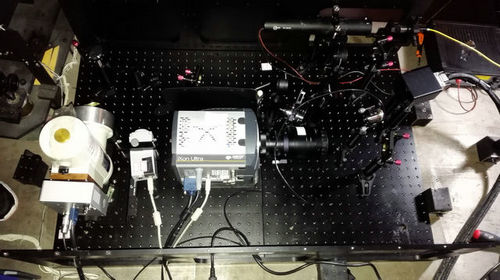
At Xinglong Observatory in August 2015, a portable adaptive-optics instrument had to fit its optical and mechanical assembly into a space less than a metre long. The team obtained sharper stellar images, but light lost along the telescope's optical path helped limit how faint a target it could correct. Even a successful demonstration had to answer to the machinery carrying the light.[1]
That practical constraint gives a useful perspective on newer Chinese AI research in optics. Studies from Nanjing, Changchun and Yunnan examine how neural networks can estimate distortions from imperfect measurements. Read together, their results suggest a common direction: build the sensor's physics into the learning, then test how much of that knowledge survives outside the model's training conditions.[3][4][5]
Before the photograph, a distorted wave
Atmospheric turbulence changes the light reaching a ground-based telescope. Adaptive optics measures that disturbance and commands a deformable mirror to compensate while observations continue. A bright reference star—or an artificial guide star produced with a laser—provides information about the atmosphere along the viewing direction.[2]
The quantity being estimated is the wavefront: the shape of a surface joining points of equal phase in the light wave. Errors in that shape spread light that should form a compact image. The reconstruction therefore has a physical job: provide a useful estimate of the distortion that an optical system needs to correct.
There are several ways to obtain the estimate. Their differences matter because a network trained to interpret one instrument's measurements does not automatically understand another instrument's view.
A light spot contains more than its centre
A Shack–Hartmann sensor uses an array of small lenses to form spots. Conventional reconstruction draws on their displacement to estimate local wavefront slopes. Increasing the number of sampled regions can reveal finer variation, but it also divides the available light more finely. Sampling and signal quality pull against each other.[3]
In January 2026, Nanjing Institute of Astronomical Optics and Technology reported FF-Net, a network designed to extract more information from the spot images. Its learnable Gabor filters respond to orientation and spatial frequency, incorporating the directional structure that the researchers identified in the spots' frequency content.[3]
One reported numerical comparison reconstructed 133 Zernike modes—the mathematical components used to describe aberrations—with an 8 × 8 lenslet array for the neural methods and a 16 × 16 array for the conventional slope method. FF-Net achieved better low-order reconstruction in that comparison. The institute also reported GPU-accelerated inference below one millisecond per frame.[3]
Those are simulation and inference results. The report does not establish a complete telescope correction cycle at that speed: exposure, data transfer, mirror response and feedback would all need their own accounting. The promising change is the information extracted from each measurement.
Changing focus supplies another kind of evidence
Changchun Institute of Optics, Fine Mechanics and Physics approached a different sampling problem in a September 2025 report. Compact imaging systems may sacrifice fine image sampling to preserve field of view or manage data volume. The resulting aliasing makes aberrations harder to infer from their images.[4]
The team's method uses several defocused images. It extracts low-frequency Fourier information, which remains useful despite the undersampling, and combines a convolutional network with a long short-term memory network. Together they learn image features and relationships across the focus positions.[4]
The validation moved beyond generated data. After simulation tests, the researchers introduced known misalignments into an off-axis three-mirror laboratory system and checked the network against an interferometer. The institutional report gives reconstruction errors of 0.0082 wavelengths in simulation and below 0.018 wavelengths in the experiment, expressed as root-mean-square error.[4]
These figures belong to that optical setup and test procedure. Their value here is the independent laboratory check: a physical measurement could challenge the network's answer. A future instrument would still need to show how the method behaves across its own operating conditions.
The telescope belongs in the training problem
A November 2024 paper from Yunnan Observatories tackles another source of mismatch: simplified training examples. Its simulated wavefronts include high-order turbulence and discontinuities associated with the secondary mirror and its supporting structure. The authors also examine how reconstruction changes with noise and the proportion of the aperture blocked at its centre.[5]
This makes the telescope's geometry part of the problem being learned. A model can perform well on smooth, convenient aberrations while struggling with the interrupted light path of an actual instrument. The Yunnan work strengthens the case for testing those interruptions explicitly. Its numerical experiments establish behavior within the modeled conditions; they are a different evidential step from observing a star through a running correction loop.[5]
What these signals add up to
The three approaches do not form a shared leaderboard. They use different measurements, reconstruction tasks and validation procedures. Comparing their headline errors would obscure the engineering choices that make each result interesting.
The stronger synthesis is about where useful information remains. Nanjing examines the structure inside sensor spots. Changchun combines frequency information with changes of focus. Yunnan makes the optical obstruction and turbulence harder to ignore. In each case, the learning problem becomes more closely tied to the instrument.[3][4][5]
The next persuasive evidence would connect that specificity to sustained operation: repeatable reconstruction under changed conditions, independent checks of the recovered wavefront, and a full correction cycle that keeps pace with the disturbance. Those are questions raised by the studies, rather than capabilities established across all three.
The earlier Xinglong installation offers a concrete reminder of why that last step matters. Its performance depended partly on how much light reached the instrument.[1] Better inference can make a measurement more useful. The observatory still has to deliver the light, execute the correction and show the resulting improvement in the sky.
Sources
- National Astronomical Observatories, Chinese Academy of Sciences, report on the first HPAO tests at the 2.16-metre telescope (September 15, 2015; Chinese)—instrument dimensions, observing results, throughput limits and archival photograph.
- European Southern Observatory, “Adaptive Optics”—atmospheric distortion, deformable mirrors and reference stars.
- Nanjing Institute of Astronomical Optics and Technology, report on FF-Net super-resolution wavefront reconstruction (January 28, 2026; Chinese)—physical priors, numerical comparisons and inference timing.
- Changchun Institute of Optics, Fine Mechanics and Physics, “Deep Learning Method Enables Wavefront Sensing in Undersampled Optical Systems” (September 28, 2025)—network inputs, simulated results and interferometer-checked laboratory experiment.
- Dongming Liu, Hui Liu and Zhenyu Jin, “High accuracy deep learning wavefront sensing under high-order turbulence,” Astronomical Techniques and Instruments 1(6), 316–324 (November 2, 2024)—simulated turbulence, optical obstructions and noise sensitivity.