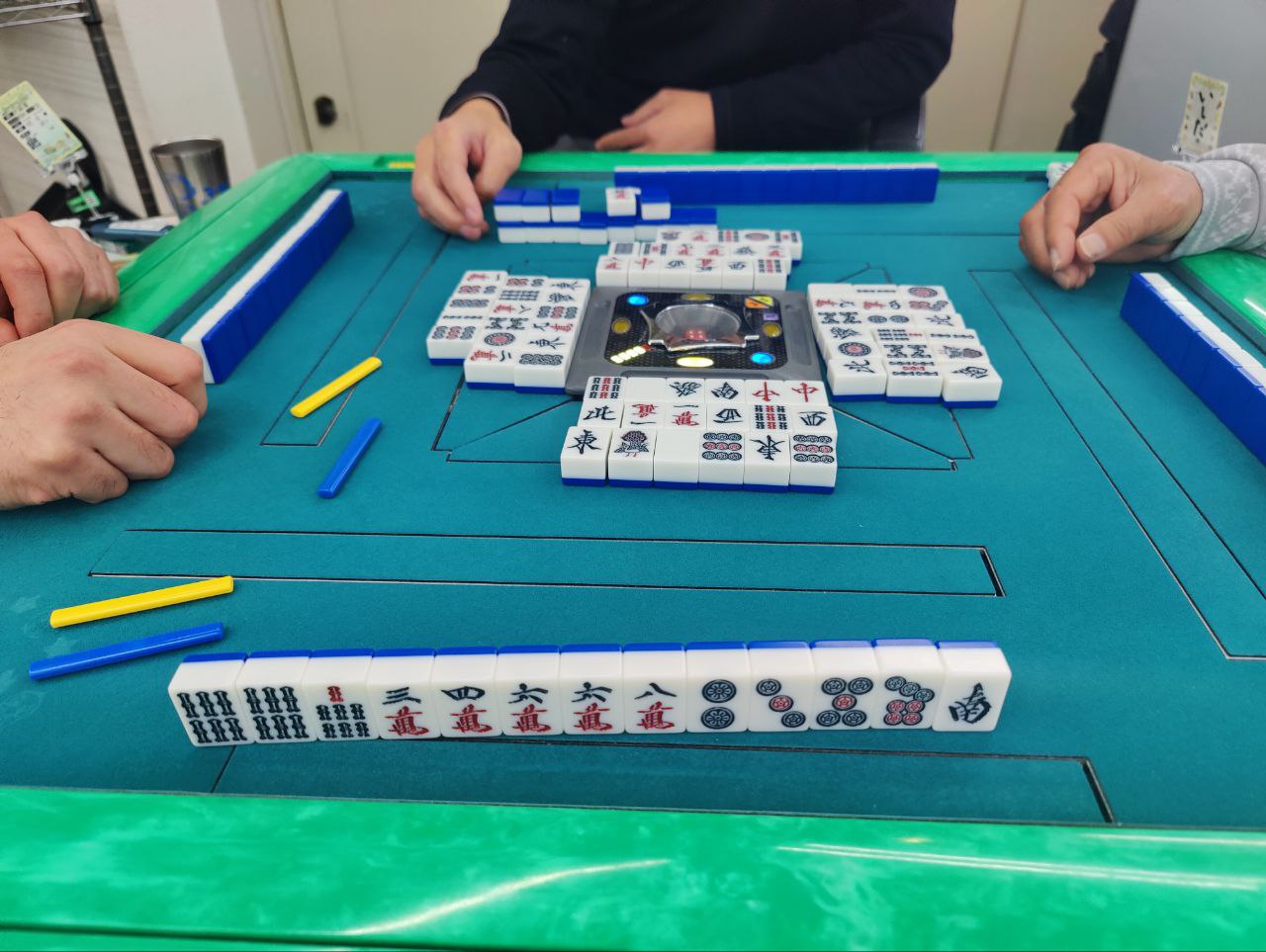

At a mahjong table, not knowing is part of the state. A player sees a private hand, exposed melds, discards, scores, and the shrinking wall. The other hands remain hidden, the next draw is random, and a sensible discard depends on more than the chance of winning the current hand. It also depends on the danger of finishing fourth several hands later.
That makes Microsoft Developer's nine-minute film about Suphx easy to misread. Its headline is a familiar one: an AI system from Microsoft Research Asia reached 10 dan on the online Japanese-riichi platform Tenhou in 2019. The more useful story is how the researchers divided uncertainty into three different problems: information the player may never see, a reward that arrives late, and a risk appetite that should change with the situation.[1][2]
Junjie Li, a member of the Suphx team, presents the system in English. At 0:00, start a four-column information ledger: visible, training-only, inferred, and proposed. Watch once for the research narrative, then watch again while assigning each claim to a column. That ledger prevents three very different mechanisms from collapsing into the vague claim that the machine developed “intuition.”[1][3]
First pass — keep an information ledger
Suphx played four-person Japanese riichi mahjong, not every game called mahjong. Its decision system had separate models for discarding, declaring riichi, and calling chow, pong, or kong; winning itself was handled by rules. The five learned models first imitated actions from strong human Tenhou logs. Self-play reinforcement learning then improved the discard model. In other words, Suphx did not discover the game from a blank slate: human play supplied its starting curriculum, and self-play refined the part of the system that makes the most frequent choice.[2]
The distinction matters when the film moves from the game's hidden tiles to “oracle guiding.” During reinforcement learning, an oracle version of the model could use information a normal player cannot see, including opponents' concealed hands and tiles in the wall. The researchers then progressively removed those perfect-information features. By the end, the ordinary policy had to act from legally observable information alone.[2][3]
This is better understood as temporary scaffolding than as permission to cheat. A teacher can expose the full answer while constructing a lesson, but the student still has to sit the exam without it. The technical gamble is that privileged training information creates a clearer learning signal before it disappears. The evidence in the paper supports a performance gain for the authors' system; it does not show that the deployed player recovered the exact hidden tiles or possessed a general faculty for reading opponents' minds.
The teacher disappears; uncertainty does not
Oracle guiding solves a training problem, not the uncertainty of live play. Once the extra inputs are gone, many hidden arrangements remain compatible with the same visible table. Suphx must choose an action that works well across that uncertainty. This is why the word “prediction” needs care. The system's global reward predictor was not a hidden-tile detector. It was designed to connect the final result of a multi-hand game back to earlier hands, where reinforcement learning otherwise receives a weak or misleading signal.[2]
Suppose a player enters the last hand with a large lead. Chasing the highest-scoring hand may create needless exposure; accepting a small local loss can preserve first place. Conversely, a player far behind may need variance rather than safety. A reward attached only to the current hand would teach the wrong lesson in both cases. Suphx's predictor estimated the eventual game reward from the sequence so that training could assign credit across hands. The object was final rank, not a collection of isolated wins.[2][3]
The film also introduces run-time policy adaptation: adjusting a policy to the particular private hand dealt in the current round. Treat that as a research mechanism, not as the explanation for the public Tenhou record. The paper says this adaptation was omitted from the online Tenhou agent because it was too slow for that setting. The celebrated result therefore came from the base system without this additional run-time procedure.[2]
Replay the scoreboard, not just the moves
Tenhou's incentives shaped what “strong” meant. Its ranking system punishes a last-place finish heavily, with the cost increasing at higher dan levels. Suphx consequently had reason to protect a good overall position, keep safer tiles, and avoid catastrophic deal-ins even when a more aggressive line offered a better chance of winning one hand. In the paper's logged games, Suphx finished fourth 18.7% of the time and dealt into another player's win 10.06% of the time. Those numbers help explain its defensive reputation, but they describe performance under Tenhou's rules rather than a universal optimum for all mahjong.[2][5]
This is the most transferable lesson in the viewing. An apparently humanlike “style” can emerge from an evaluation regime. Before crediting temperament or intuition, ask what the scoreboard rewards, what it penalizes asymmetrically, and over what horizon it settles the account. An AI trained to maximize hand wins, raw points, or tournament survival could rationally learn a different style from the same visible tiles.
Run-time adaptation, oracle guiding, and global reward prediction therefore belong in separate boxes. The first specializes to a particular dealt hand but was not used in the reported online run. The second borrows hidden state during training and removes it before deployment. The third carries the final-game objective backward across hands. Calling all three “reasoning under uncertainty” is not false, but it hides the engineering choices that make the claim testable.
A strong result inside a narrow room
The paper reports 5,760 Tenhou Expert-room games for Suphx, a record rank of 10 dan, and an estimated stable rank of 8.74. Its comparison set pooled 8,031 Expert-room games played by humans who had previously reached 10 dan; that group's stable rank was 7.46. The authors also placed Suphx above 99.99% of then-active ranked Tenhou users by record-rank distribution.[2]
Those are substantial historical results, but each noun is a boundary. “Stable rank” is an estimate derived from placement results under a particular scoring system. “Top human” is a pooled comparator, not a controlled match against a named champion. “Expert room” is not Tenhou's higher Phoenix room: AIs were barred there, and its scoring was different enough that the paper declined to compare the rooms directly.[2][5] The defensible conclusion is that Suphx became the first AI to reach 10 dan and outperformed the paper's pooled top-human Expert-room benchmark on stable rank—not that it settled every version of mahjong or defeated the world's single best player.
When the closing music returns around 9:03, do not let the film's broader implications outrun its evidence. Microsoft's English feature described Suphx as moving from novice to expert over more than 5,000 online games and suggested that its methods might eventually help with real decisions involving unknown factors and random events.[1][4] That is a research direction, not a result of this experiment. No logistics, finance, or traffic task appears in the Suphx evaluation. Transfer would require a new representation of legal observations, actions, delayed outcomes, changing risks, and the cost of a bad tail event.
Second pass — three questions to keep on screen
On a second viewing, replace the triumphal question—“Did the AI beat humans?”—with three narrower ones.
First, what information crosses the deployment boundary? Human logs and hidden tiles can teach a policy, but normal play must be evaluated with only normal observations. Second, when does the reward become meaningful? A locally losing move may protect the final placement, so the learning signal has to span hands. Third, which risk does the metric make expensive? Tenhou's severe fourth-place penalty makes avoiding disaster part of strength, not a secondary preference.
These questions make the video useful without leaning on its real-world analogies. Suphx is a compact case study in how a Beijing research team turned a culturally familiar game into a controlled experiment about partial observability and long-horizon decisions. Its achievement is not a mystical machine instinct. It is a carefully staged education: imitate people, learn with an all-seeing teacher, remove the teacher's forbidden view, and judge the resulting player by the exact scoreboard it was built to face.
Sources
- Microsoft Developer, “Developer Tech Minutes: Mastering Mahjong with AI,” presentation by Junjie Li, 2021.
- Junjie Li et al., “Suphx: Mastering Mahjong with Deep Reinforcement Learning,” Microsoft Research Asia technical paper, 2020.
- Microsoft Research Asia, “微软超级麻将AI Suphx,破解非完美信息游戏,” Chinese first-hand technical explainer, 2019.
- Microsoft Stories Asia, “More than a game: Mastering Mahjong with AI and machine learning,” 2019.
- Tenhou, official game manual: room access, AI participation, and ranking rules.
- Tairagi Makoto, “Riichi Mahjong real autotable session,” Wikimedia Commons photograph, CC0 1.0.