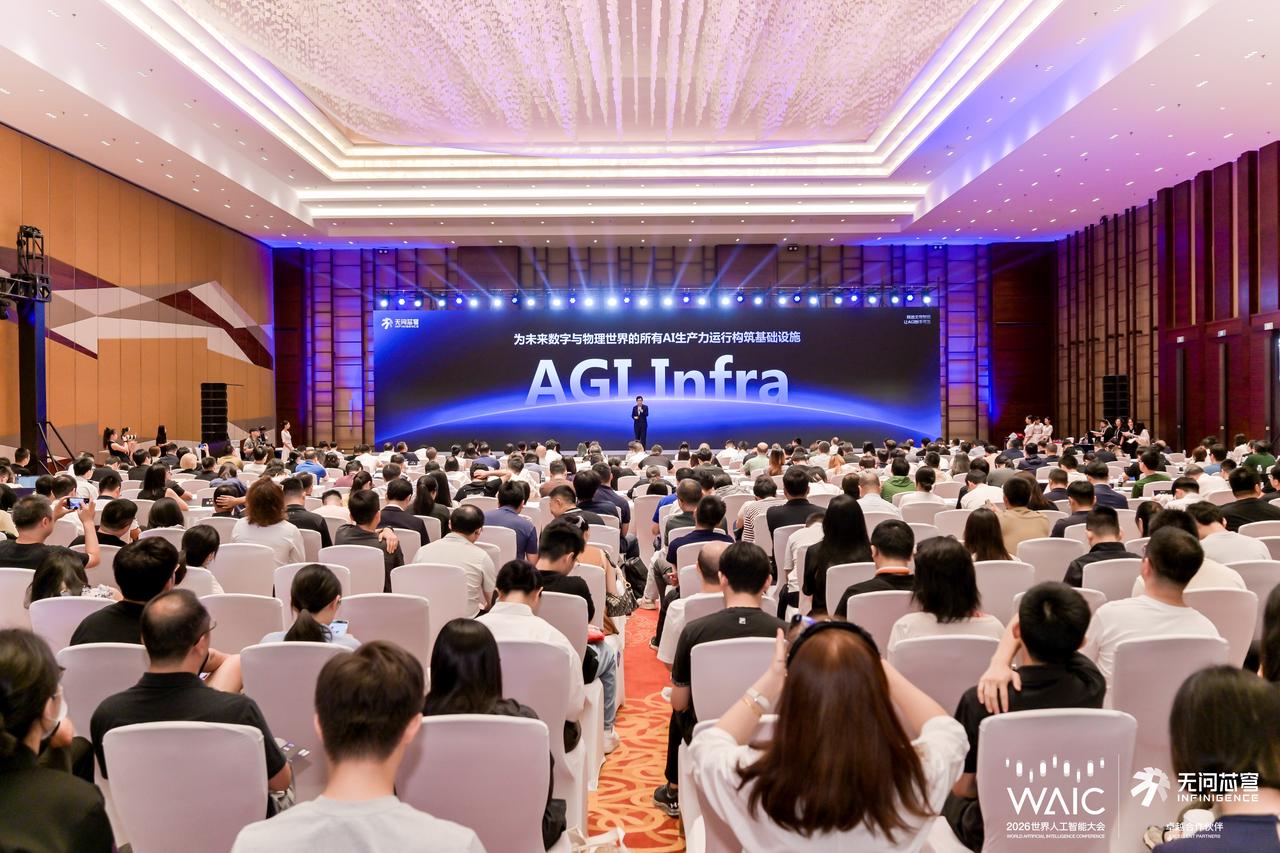
The view from the back of Infinigence AI's July 2026 forum in Shanghai is revealing. Hundreds of people face a stage carrying the words “AGI Infra.” There is no new accelerator under glass and no frontier model answering questions. The product being sold is the layer between those things: software and service that decide where a model should run, which hardware should do each kind of work, and how scattered capacity can behave like one supply.[4]
That position makes Infinigence—known in Chinese as Wuwen Xinqiong (无问芯穹)—an unusually clear test of China's heterogeneous-compute thesis. The company was formed in May 2023 with roots in Tsinghua University's Department of Electronic Engineering. Its public story began with optimizing models across unlike chips, expanded into mixed-accelerator training, and now reaches across data centers and into a managed model-service layer.[1][2][3]
As of August 16, 2026, the technical record contains more substance than a typical infrastructure slogan. A public system preprint describes a 768-accelerator mixed training run; a new technical report gives hardware counts, network links, workload assumptions, and latency results for cross-datacenter inference.[2][3] The commercial story is less inspectable. Claims about customer scale, daily token volume, and production reach come mainly from Infinigence and its investors. The most accurate dossier therefore holds two ideas at once: this is a serious systems team, and its advertised platform is larger than the independently testable evidence.
A company built for the space between inventories
Infinigence describes its architecture as M × N: many models mapped onto many chips. Its current product line places an “Agentic Infra” platform beneath an “Agentic MaaS” service, spanning training, inference, reinforcement learning, and managed model service. The company says the platform can support jobs at a 100,000-accelerator scale and that its services handle hundreds of billions of tokens per day.[1] Those verbs matter. “Can support” is a capacity claim, while token volume is an operating claim; neither is accompanied on the public page by an auditor's report, utilization series, or customer-level service data.
The live GenStudio documentation supplies a smaller, firmer product receipt. Its M × N endpoint encodes a model and chip type in an OpenAI-compatible API path, while the web interface lets a user compare two to four model-chip combinations. The documentation also says only some preloaded language models support this mode.[8] This is a usable selection and routing surface. It should not be confused with evidence that one inference request executes simultaneously across several chip brands.
The financing history explains why the company wants to own so much of the middle. In September 2024, Lenovo Capital reported a nearly RMB 500 million Series A and nearly RMB 1 billion raised in the company's first sixteen months.[6] In May 2026, The Paper reported another round exceeding RMB 700 million, led by Hangzhou High-Tech Investment and Huiyuan Capital with a long roster of financial, industrial, and state-linked participants.[5] Capital from chip, cloud, data-center, and local-government ecosystems can help an orchestration company obtain the hardware access that its product requires.
Funding, however, is not a throughput metric. Infinigence does not publish revenue, compute pass-through costs, customer concentration, or gross margin. The rounds establish that many backers value the aggregation thesis; they do not show whether heterogeneous service earns a durable premium after hardware rental, network transfer, adaptation engineering, and support are paid.
One stock-exchange filing does establish a material operating commitment. Dianguang Explosion-proof Technology's third-quarter 2024 report says its Zhejiang Dianguang Cloud subsidiary signed a RMB 553.5 million, five-year compute-services contract with Shanghai Infinigence, completed equipment installation, and delivered it for customer use on September 14, 2024.[9] Because Infinigence is the buyer in that filing, the contract confirms a large upstream capacity expense—not downstream revenue or utilization.
HETHUB made one training job cross the chip divide
The first strong technical receipt arrived with HETHUB, a distributed training system presented in a May 2024 paper. HETHUB combines a unified communicator, a performance predictor, and an automatic parallel planner. Instead of assuming identical workers, the planner searches for a partition that accounts for the different speeds and communication behavior of each accelerator group.[2]
The largest reported run trained a Llama-140B model on 768 accelerators: 128 AMD GPUs and 640 units identified in the paper only as “GPU-accelerator A.” In a separate Llama2-70B MFU analysis using AMD GPUs and an anonymous “GPU-accelerator C,” the observed 35.0% MFU reached 97.49% of the authors' calculated 35.9% theoretical upper bound. The paper evaluated six heterogeneous hardware combinations.[2] At the World Artificial Intelligence Conference two months later, the company promoted a thousand-card version and named pairings that joined AMD or Nvidia hardware with accelerators from Huawei Ascend, Iluvatar CoreX, MetaX, and Moore Threads.[6][7]
This result is valuable because it exposes the engineering mechanism. Different devices do not become interchangeable; HETHUB measures their asymmetry and plans around it. That is a more credible foundation than claiming that a compatibility layer erases every hardware distinction.
The experiments also have a narrow frame. They cover one model family, a documented 768-device layout, and an MFU comparison against the paper's own upper-bound model. They do not report months of job-completion rates, checkpoint recovery across vendor failures, convergence comparisons for many model architectures, or the staffing cost of keeping six toolchains aligned. The conference's thousand-card statement is wider than the paper's documented experimental description. HETHUB proves that mixed training can be engineered; it does not yet make mixed clusters a commodity.
PDD turns geography into a scheduling variable
In July 2026, Infinigence published a technical report for PDD, or cross-datacenter prefill-decode disaggregation. The design follows a useful property of language-model inference: reading a long prompt (“prefill”) is compute-heavy, while emitting tokens (“decode”) is often constrained by memory bandwidth. PDD assigns those phases to different resources in different locations.[3]
The primary data center hosts a Prefill instance and a small RelayDecode instance connected over fast local RDMA. A remote data center hosts the MainDecode instance. RelayDecode starts producing tokens while the much larger key-value cache travels over wide-area Ethernet; after the remote instance catches up, it takes over. For many high-cache-hit requests, the system skips the relay. For the difficult tail, it sends lightweight token IDs and recomputes recent cache state remotely instead of repeatedly moving a bulky incremental cache.[3]
The evaluation is unusually concrete for a company report. It uses aggregate characteristics from real agent workloads—an average 90% prefix-cache hit rate, with more than 70% of requests at very high hit rates—and tests DeepSeek-V4-pro. The PDD deployment uses 43 eight-GPU H100 nodes in the primary site, 32 eight-GPU H200 nodes remotely, two 10 Gbps wide-area links, and 400 Gbps RDMA inside the primary site. Against a cross-datacenter baseline without the relay, P90 time to first token fell from 18.3 seconds to 9.8 seconds. Against an intra-datacenter H100 baseline, the authors calculate 32.4% to 37.5% more SLA-compliant throughput per normalized unit of cost.[3]
Those numbers show the company's central design move maturing. HETHUB scheduled around different accelerator speeds inside a training cluster; PDD schedules around compute, memory, cache state, and distance during inference. Geography becomes another resource characteristic rather than a fixed wall around the cluster.
Yet PDD also marks the exact edge of the public proof. The report calls its evaluation preliminary, tests only Nvidia H100 and H200 hardware, disables multi-token prediction because of cache compatibility, and says broader accelerator adaptation and larger empirical studies remain future work. The repository currently publishes the report and its assets, not a runnable PDD implementation.[3] It supports the cross-datacenter method. It does not reproduce the company's full M × N promise across Chinese accelerators.
The 4,000-kilometer claim sits on a different evidence rung
At the same July forum shown in the cover photograph, Infinigence announced a broader “front shop, back factory, one center” strategy: an industry-solution storefront, a managed token factory, and a compute aggregation center. Its recap also says the company and China Telecom connected clusters in Hami, Xinjiang, and Shenzhen, Guangdong—more than 4,000 kilometers apart—and improved joint-training performance by 165%.[4]
That field claim is intriguing precisely because it is not the PDD experiment. One concerns cross-region training with China Telecom; the other evaluates cross-region inference on a defined H100/H200 setup. The forum recap does not publish the training model, accelerator mix, network baseline, definition of “performance,” run duration, or failure record behind the 165% figure.[3][4] Combining the two as if one validates the other would manufacture evidence that neither source supplies.
The same separation should govern the company's scale statements. Its official profile says it serves more than one hundred leading customers and research institutions and operates at a daily volume of hundreds of billions of tokens.[1] A 2024 investor account names users including Kimi, LiblibAI, Liepin, ShengShu Technology, and Zhipu AI and says the platform's compute footprint covered fifteen Chinese cities.[6] These accounts help map the intended market. Public customer case studies with workload duration, contracted capacity, before-and-after cost, uptime, or renewal data would establish how much of that map is recurring production.
The hard business is maintaining the middle
China's varied accelerator supply creates a plausible opening for an independent coordinator. A model developer may have access to capacity in several cities, purchased in different years, with different compilers and communication libraries. A layer that places training stages, serves inference, moves checkpoints, and presents one commercial interface can turn stranded allocations into useful work. Infinigence's research suggests that it understands this problem at the level of planners, caches, interconnects, and tail latency—not only at the level of cloud packaging.[2][3]
The same diversity creates the maintenance burden. Every new model architecture changes memory and communication shapes. Every accelerator software release can alter kernels, collective behavior, numerical results, and failure modes. Every cross-region route adds egress cost, data-governance questions, and a new source of latency variance. The orchestration layer earns its place only if it absorbs that change faster and more reliably than customers could by committing to one vendor.
Three disclosures would make the next version of this dossier much stronger. First, a versioned compatibility matrix should pair named models, accelerator firmware, compilers, collective libraries, and tested job recipes with reproducible results. Second, production service reports should show queue time, p50 and p99 latency, job completion, checkpoint recovery, utilization, and cost per accepted token over full quarters. Third, business reporting should separate software and managed-service revenue from resold compute, then show customer concentration and renewal.
Infinigence's most persuasive idea is already visible: hardware variety and physical distance can be inputs to placement, not merely obstacles to deployment. HETHUB and PDD give that idea two technically specific forms. The company now has to demonstrate that the scheduler, service operation, and economics remain coherent when the polished conference hall gives way to mixed firmware, failed workers, changing traffic, and a customer's monthly bill.
Sources
- Infinigence AI, “About Infinigence” (official company profile, product structure, timeline, team, and current self-reported operating scale; inspected August 16, 2026).
- Si Xu et al., “HETHUB: A Distributed Training System with Heterogeneous Cluster for Large-Scale Models” (May 2024; architecture, 768-accelerator Llama-140B experiment, hardware disclosure, and performance envelope).
- Infinigence AI,
pddrepository and “PDD: Unleashing Economical and Flexible Heterogeneous LLM Inference via Cross-Datacenter Prefill-Decode Disaggregation” technical report (July 2026; architecture, workload assumptions, hardware setup, results, and stated limitations). - Infinigence AI, “Agentic Infra Strategy Launch and Ecosystem Kickoff: Infinigence AI Infrastructure Forum at WAIC 2026” (July 22, 2026; official event recap, strategy and partnership claims, and source of the cover photograph).
- The Paper, “Domestic AI financing accelerates: Infinigence raises more than RMB 700 million for native infrastructure” (May 7, 2026; reported round size and investor roster).
- Lenovo Capital, “Infinigence reaches nearly RMB 1 billion in cumulative financing” (September 2, 2024; investor account of the Series A, product positioning, named users, city footprint, and HETHUB launch claims).
- China News Service Shanghai, “Infinigence releases a thousand-card heterogeneous-chip mixed-training platform” (July 4, 2024; contemporaneous independent report from the WAIC launch).
- Infinigence AI, “GenStudio M × N Inference Service Tutorial” (current product documentation; supported scope, comparison interface, model-chip endpoint structure, and OpenAI API compatibility; inspected August 16, 2026).
- Dianguang Explosion-proof Technology Co., Ltd., Third Quarter 2024 Report filed through CNINFO (October 31, 2024; Infinigence compute-services contract value, term, installation, delivery, and first-payment disclosure).