China's most consequential new AI user may not be a model lab or an app developer. It may be the official who has to compare hundreds of pages of bids, document why one supplier passed, and keep enough of a record for a losing bidder to challenge the result.
On February 6, 2026, eight central departments issued a plan to put AI across the full tendering cycle. By the end of 2026, the policy calls for selected provinces and cities to reach full coverage in three priority uses: checking tender documents, assisting bid evaluation, and detecting possible collusion. Broader national deployment is targeted for the end of 2027. The accompanying explanation divides the agenda into 20 scenarios, from drafting requirements and matching experts to checking evaluation reports, handling complaints, and supervising contract performance.[1][2]
That breadth can sound like a mandate for an automated procurement officer. The early evidence points somewhere more practical. The first systems with credible receipts are not deciding which bridge to build or which contractor deserves trust. They are finding licenses, comparing technical parameters, checking arithmetic, surfacing anomalies, and returning the relevant page to a human reviewer. China's bid-room AI market is therefore taking shape less like a chatbot subscription and more like regulated workflow infrastructure: models, rule libraries, document parsers, identity and credit data, secure rooms, video records, and appeal-ready logs joined to an existing public transaction platform.
A national market, but not a free-form software market
The national plan covers both sides of a transaction. An authority may use AI to draft measurable requirements, scan a tender for competition-limiting clauses, select an expert pool, or compare a final report with the underlying scores. A bidder may use it to find suitable projects, extract requirements, test whether a submission is complete, and flag a price that could be judged below cost. Regulators are asked to detect suspiciously similar technical language, unusual bidding relationships, anomalous win probabilities, or outlying expert scores.[1]
This creates demand at nearly every document handoff. It also creates a strategic tension: the same technology can lower the cost of checking bids and lower the cost of producing them. If AI-generated submissions converge on the same templates and phrases, a similarity detector could mistake common tooling for collusion. If a detector's signals become predictable, coordinated bidders can write around them. The durable product is therefore not a one-time model deployment. It is a maintained evidence system that updates rules, preserves the source passage behind every alert, and distinguishes a clue from a legal finding.
The policy itself sketches an unusually specific market structure. Efficiency-oriented services should cultivate commercial AI application providers, while uses tied to fairness and regulatory enforcement should remain government-led. Cities are expected to deploy under provincial coordination, and counties should generally reuse higher-level model resources rather than build their own.[1] The likely inference is a concentrated market: provincial platforms and established transaction-system integrators can spread fixed costs across many local authorities, while a stand-alone model vendor may struggle to own the workflow.
That design also limits the meaning of “national rollout.” Coverage does not necessarily imply one national model, one interface, or one evaluation standard. The center has set scenarios and dates; provinces still have to align data schemas, legal knowledge, sector rules, security reviews, and local systems. A construction qualification in one jurisdiction and a medical-device specification in another may both look like document matching, but they require different evidence and different consequences for error.
The beachhead is the objective part of the file
Shenzhen's framework-agreement pilot shows why structured checks are going first. In one April 2025 procurement for computer displays, five experts took seven hours to review 115 submissions across 13 packages. The AI pass took 9 minutes 46 seconds. Its assigned work was narrow: checking qualifications and product parameters such as screen size, resolution, interfaces, business licenses, authorization letters, and response commitments.[3]
The more informative numbers came after the showcase. Across ten pilot procurements, the Shenzhen case report gives separate accuracy rates: 95.8% for qualification review, 99.3% for technical-parameter compliance, and 91% for price deductions. AI review time was reported at 8% of expert review time. The workflow was “AI pre-review, expert review, consolidated comparison”; when human and machine disagreed, staff investigated, the expert retained the final say, and machine errors entered a correction set.[3]
Those figures are promising, not universal. They come from a case study supplied by the trading center, not an independent audit. “Accuracy” depends on the expert result or another internal adjudication serving as ground truth. Product-framework procurements also have unusually explicit fields and repeatable rules. A system that extracts a monitor's resolution correctly has not thereby proved that it can judge the feasibility of a novel engineering method.
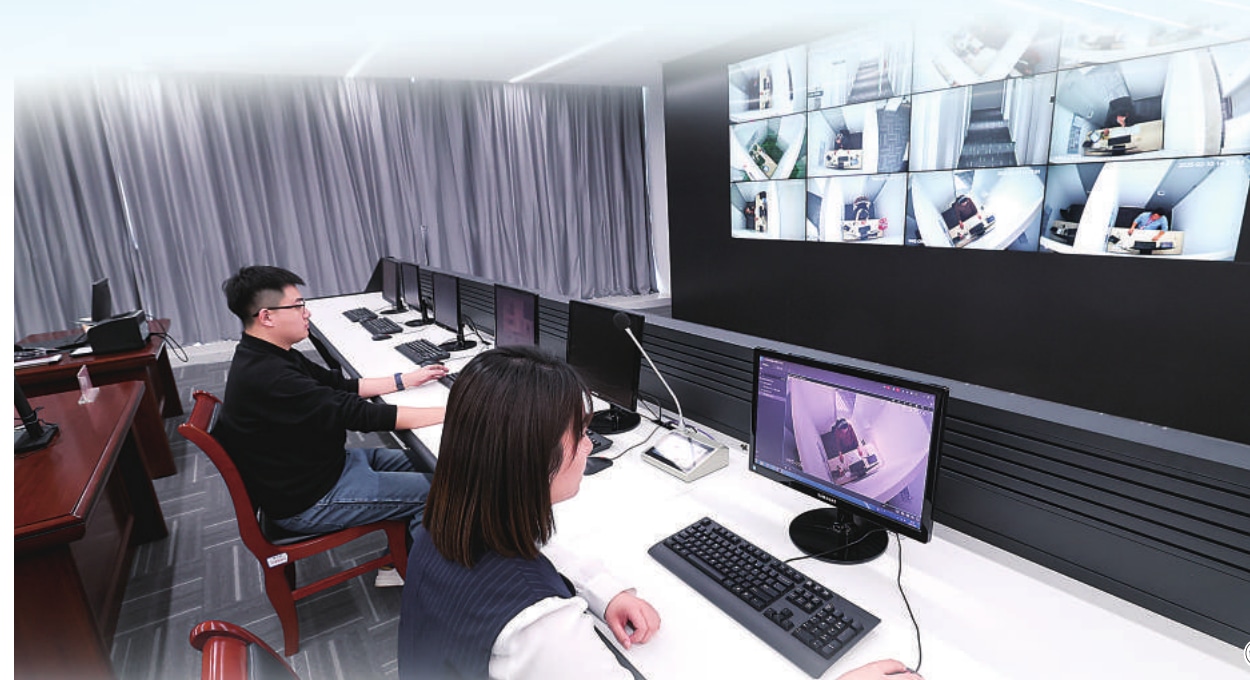
Shijiazhuang provides a newer version of the same pattern. A July 2026 report describes AI screening 18 objective items in engineering bids, linking each preliminary conclusion to the corresponding source page, while experts confirm or alter the result and every operation is logged. In a project with 29 bidders, the center said the business-qualification review fell from an estimated three hours of full manual review to under 1.5 hours. A separate pre-tender model uses 53 rules to look for exclusionary or unreasonable clauses and was reported at better than 95% accuracy.[4]
The common unit of value is not a generated answer. It is a reviewable pair: claim plus evidence location. That pair reduces search time without pretending that the model owns the decision. It is also what an auditor, supervisor, or disappointed bidder can interrogate later.
The contract is for a room, a record, and a workflow
Actual buying records show how much infrastructure sits around the model. A June 2026 award for an AI upgrade to the public-resources trading platform in Shihezi, Xinjiang, was worth RMB 1.9383 million. The listed package included 12 “intelligent evaluation cabins,” 44 distributed-evaluation video terminals, recording equipment, archive appliances, storage, and platform-management hardware. The winning supplier was Epoint, a public-resource transaction software company.[5]
One local contract is not a market-size estimate, and its equipment list does not reveal how much of the price belongs specifically to AI. It does reveal the procurement shape. Public buyers are paying for controlled access, remote review, audiovisual evidence, records retention, and integration—not just inference tokens. Model capability can improve rapidly while the slower moat remains compatibility with identity systems, bid formats, sector databases, retention rules, and the software through which a reviewer signs a result.
This favors vendors that can make heterogeneous public data usable and survive long operating cycles. It also raises lock-in risk. If a province cannot export its rule library, decision logs, error set, and evidence links into a replacement system, “continuous model improvement” can become dependence on one contractor. The national policy calls for shared platforms, common standards, higher-quality datasets, routine updates, user feedback, model filing, security review, and protection against black boxes, hallucinations, and algorithmic discrimination.[1] Whether contracts turn those principles into portable artifacts will decide how competitive the supplier market really is.
Human responsibility is the boundary—and the unresolved test
The plan states the limit plainly: model conclusions are auxiliary, do not replace the independent judgment of tendering authorities, agents, bidders, or evaluation experts, and do not change their statutory responsibility.[1] This is more than cautious phrasing. Procurement produces winners, losers, public spending, and grounds for complaint. Someone must be able to explain why a document failed, correct an error, and own the legal outcome.
Yet a human signature does not guarantee human judgment. The first system to summarize a thousand-page file can frame every later decision. A reviewer may technically be free to disagree but lack the time, source access, or confidence to do so. OECD work on AI in public procurement identifies skewed data, weak explainability, skills gaps, and data or vendor lock-in as central risks; it warns that a biased automated review can scale harm much faster than case-by-case human review.[6]
The meaningful measure of “human in the loop” is therefore disagreement handling. Systems should report how often they abstain, how often experts override them, which error types recur, whether small and large bidders receive different false-alert rates, and what happens after a bidder objects. A collusion model should be judged by investigated and substantiated leads, not by the volume of suspicious patterns it can generate. A tender-document checker should show whether removing a flagged clause actually widened competition, not merely whether an official clicked “accept.”
Those disclosures are mostly absent from the public pilot accounts. Shenzhen gives differentiated accuracy and a correction workflow, which is a useful start.[3] Shijiazhuang emphasizes source-page links and reversible expert review.[4] Neither report publishes a confusion matrix, subgroup analysis, appeal outcomes, or performance drift across document formats. The gap does not negate the pilots; it defines the next evidence standard.
What the 2027 rollout has to prove
The near-term commercial opportunity is real because the state has named the workflows, deadlines, deployment level, and data work. But the market will be healthier if “coverage” comes to mean more than switching on a feature. By the end of 2026, the strongest provincial reports would disclose the share and types of projects processed, the checks actually automated, abstention and override rates, and the path from an alert to a documented human finding. By the end of 2027, portability between suppliers, cross-region consistency, and complaint outcomes should matter as much as review speed.
The biggest transformation may be quieter than an autonomous award. Procurement has long buried public-market rules in thousands of semi-structured files and in the practiced memory of specialists. Turning those rules into versioned checks, linked evidence, and replayable decisions can make the market more legible. It can also hard-code yesterday's preferences and scale them behind a neutral-looking score.
China's early pilots suggest the right starting point: let the machine carry the search burden, make it point to the page, record every disagreement, and leave the accountable decision with a person. The test is whether the person remains a genuine reviewer—or becomes the final signature on a conclusion the system framed before anyone else entered the room.
Sources
- National Development and Reform Commission and seven other departments, “Implementation Opinions on Accelerating the Promotion and Application of Artificial Intelligence in Tendering and Bidding” (issued February 6, 2026; national targets, 20 application scenarios, deployment structure, data requirements, human-responsibility boundary, and security controls).
- National Development and Reform Commission, spokesperson Q&A on the 2026 AI-in-tendering implementation opinions (February 10, 2026; policy background, scenario grouping, rollout dates, and stated rationale).
- China Government Procurement News, “Setting a New Benchmark for Intelligent Government Procurement Evaluation” (May 11, 2026; Shenzhen pilot design, timing, task-level accuracy, disagreement workflow, and reported operating scope).
- Hebei Daily via Huanbohai News, “AI + double-blind review: companies praise a more transparent process” (July 30, 2026; Shijiazhuang workflow, objective checks, evidence linking, review timing, and pre-tender screening claims).
- China Government Procurement portal, “Public Resources Trading Platform AI Technology Upgrade Project—Package One award result” (June 19, 2026; Shihezi contract value, supplier, hardware, remote-evaluation, recording, and archive components).
- OECD, “AI in public procurement,” in Governing with Artificial Intelligence (2025; comparative use cases and risks involving data quality, bias, explainability, skills, audit, and vendor lock-in).
- People's Daily, “Tendering reform: 9,000 projects use double-blind evaluation” (March 14, 2025, page 13; operational context and source page for Liang Zidong's archival photograph of the Shijiazhuang supervision room).