The more revealing ByteDance signal in 2026Q2 is not another model headline by itself. It is the way Volcengine LAS is being positioned as an operating layer underneath those models. The LAS overview page describes the product as a new-generation multimodal data lake service incubated in ByteDance's large-model training scenarios, with unified multimodal metadata management, AI operator processing, enterprise-grade permissions, and seamless connection to Volcano Ark for machine learning, model training, and fine-tuning workloads.[1] That product framing matters. It places ByteDance's AI story one layer below the familiar benchmark and chatbot surface, in the place where enterprise teams actually route data, tools, and execution.
That is why LAS is worth reading as a stack-and-supply-chain update rather than as a storage product note. The same overview page lays out a learning path that puts open-source libraries, an operator plaza, dev machines, workflows, and task management in the same visible product surface.[1] Read literally, Volcengine is not presenting LAS as passive storage with a thin inference hook. It is presenting a workbench where data assets, operators, and execution paths live close enough together to become one governed lane.
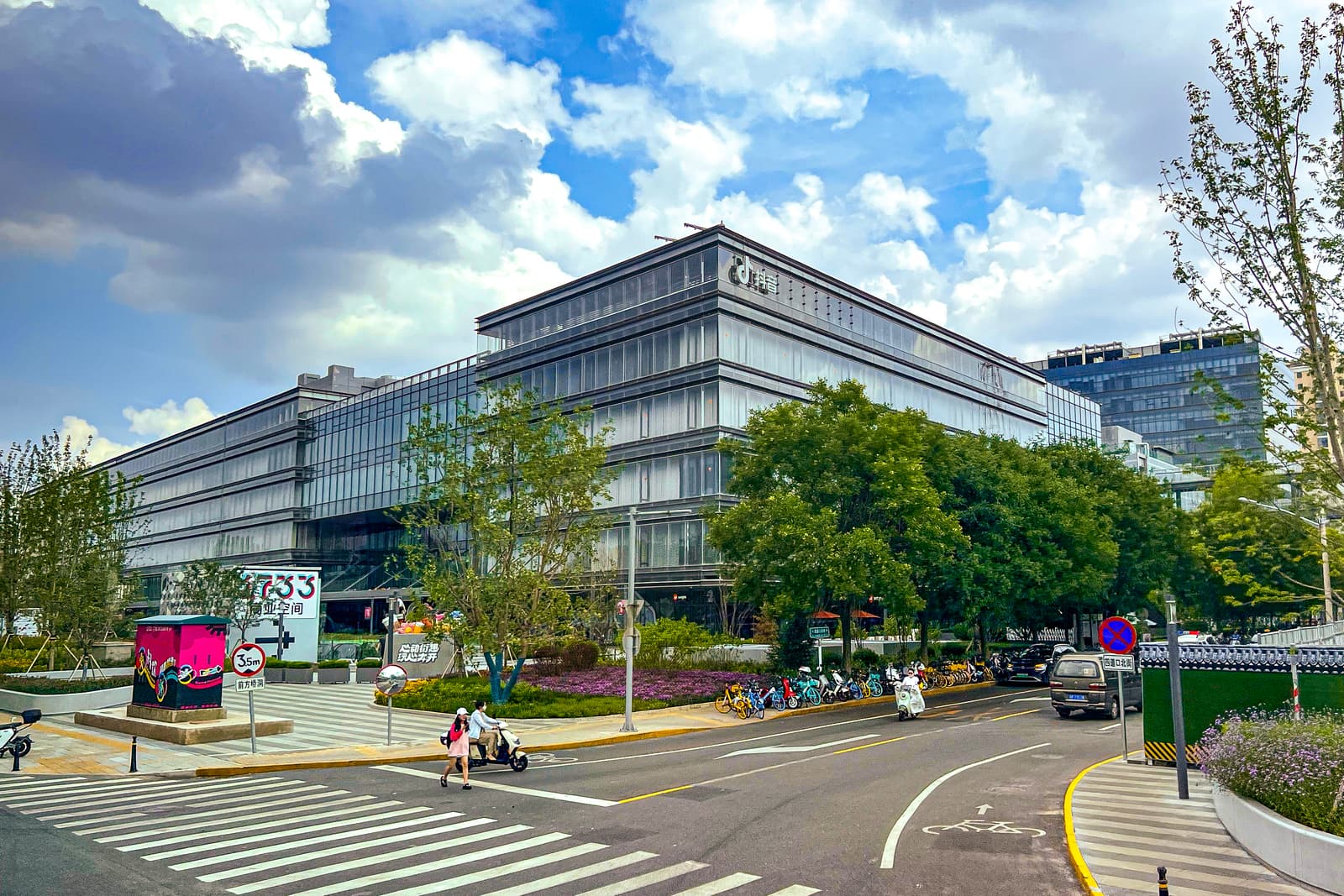
Image context: the cover uses a real Wikimedia Commons photograph of ByteDance's 1733 Commercial Space in Beijing rather than a logo or generated cloud graphic. That is the right visual register for this piece because the argument is about productized infrastructure and operational control, not about a floating model abstraction.[6]
The important shift is from model access to operator access
The clearest evidence sits in the LAS tutorial for calling Ark models. That page says LAS supports registering and accessing large models provided by Volcano Ark through the API Key management module, and it names the workload categories explicitly: text generation, video understanding, deep thinking, and image-text vectorization.[2] It also says users can invoke those model operators through either a dev machine path or task management path inside LAS.[2] In other words, the interesting move is not merely that Ark models are available. The move is that they are available as operators inside a larger execution environment that already assumes jobs, datasets, and repeatable workflows.
One small line in the same tutorial says even more about supply-chain intent. When a Doubao model call does not specify an exact version, LAS defaults to the latest model version released by Volcano Ark.[2] That means ByteDance is reducing the operational distance between model release cadence and enterprise tooling. A customer using LAS is not being asked to rebuild an application shell every time the underlying model line advances. The product is being designed so model upgrades can propagate downward through a managed operator interface.
The data-lake layer now has its own operational endpoint
The LAS data-plane API docs make that operational surface concrete. They publish region-specific base URLs such as https://operator.las.cn-beijing.volces.com, describe API Key authentication, and show a chat-completions call that runs against the LAS operator endpoint with a Bearer token and an explicit model field.[3] That is not the language of a quiet storage backend. It is the language of a regioned operator service. The naming choice matters: not just lake, but operator.las.
This is where the stack starts to look more deliberate. If a data-lake product exposes regional operator endpoints, model-facing authentication, and job-oriented invocation patterns, then ByteDance is shaping a lane where model capability can be consumed as governed infrastructure instead of as a detached demo surface.[2][3] That is useful for enterprise buyers because it moves the conversation from "Which model should we try?" toward "Which controlled execution surface should we standardize on?"
MCP matters here because it normalizes how the lane can widen
Volcano Ark's own MCP introduction strengthens that reading. The page defines MCP as a standard protocol for connecting models to external tools and data, calls it an AI "Type-C interface," and says the client-server architecture supports JSON-RPC with transports including stdio and Streamable HTTP.[4] More importantly for this article, the usage section says Ark's experience center already supports multiple MCP applications, including object storage and data lake services from Volcengine.[4] That does not mean LAS has suddenly become "the MCP platform." It does mean ByteDance is normalizing a world in which model access, tool access, and data access can be packaged under compatible operational surfaces.
Seen together, the documents describe a stack that is flattening several formerly separate layers. LAS handles data organization and permissions.[1] Ark-backed operators bring in model invocation across multiple modalities.[2] The operator endpoint turns that capability into a regioned service surface.[3] MCP gives ByteDance a standardized story for how external tools and data systems can plug into the same model-facing environment.[4] The result is not yet a grand unified platform in one page, but the product grammar already points in that direction.
Seed1.8 matters because it feeds this lane, not because it replaces it
The Seed1.8 release note helps show why this matters. ByteDance describes Seed1.8 as a generalized agentic model, highlights strong video understanding, and says the model integrates the VideoCut tool for long-video reasoning while future work will focus on long-term task execution and agentic memory.[5] Those are model-level advances, but their enterprise leverage depends on where they land operationally. LAS is the place in the public docs where ByteDance is turning that sort of capability into a governed execution surface with operators, workflows, datasets, and authenticated regional endpoints.[1][2][3]
My read is that this is the more important competitive lane to watch. Plenty of vendors can announce another multimodal model. Fewer can compress data-lake control, model operators, execution paths, and tool-connection standards into one service grammar that enterprise teams can actually adopt. If ByteDance keeps pushing new Seed capability down into LAS rather than leaving it only in release pages, the center of gravity shifts from model theater to infrastructure capture. In AI-China terms, that is a stronger and more durable signal than a single leaderboard cycle.
Sources
- Volcengine documentation, "AI Data Lake Service (LAS)" product overview.
- Volcengine documentation, "Tutorial for calling Volcano Ark model series" in LAS.
- Volcengine documentation, "Invocation methods" for the LAS data-plane API.
- Volcengine documentation, "Introduction to MCP" on Volcano Ark.
- ByteDance Seed Team, "Official release of Seed1.8, a generalized agentic model."
- Wikimedia Commons, "File:ByteDance 1733 Commercial Space (20240731145554).jpg" source page for the article image.