As of 2026-05-03 UTC, the most useful way to read Alibaba Cloud's current AI position is to stop treating it as a simple place to rent Qwen endpoints. The sharper view is that Alibaba Cloud is building a distribution operating system. The core product is not one model by itself. It is the route through which a developer reaches a model: region, base URL, API compatibility layer, quota plan, tool integration, and billing identity.[1][2][4][5]
That distinction matters because Alibaba is no longer selling only "use Qwen." Model Studio now integrates the full Qwen line and mainstream third-party LLMs, exposes both official Qwen APIs and OpenAI-compatible APIs, and splits access across multiple deployment modes with different endpoints, data-storage locations, supported models, and price ladders.[1][2] At the same time, Alibaba's public roadmap says the company has already open-sourced more than 300 AI models, passed 600 million downloads, produced 170,000+ derivative models, brought over 1 million corporates and individuals onto Model Studio, enabled 800,000+ agents, and multiplied Model Studio model calls 15 times over the prior twelve months.[3] Read together with Coding Plan and Qwen Code support, the company looks less like a model vendor and more like a firm trying to own the metered path through which AI work gets done.[3][4][5]
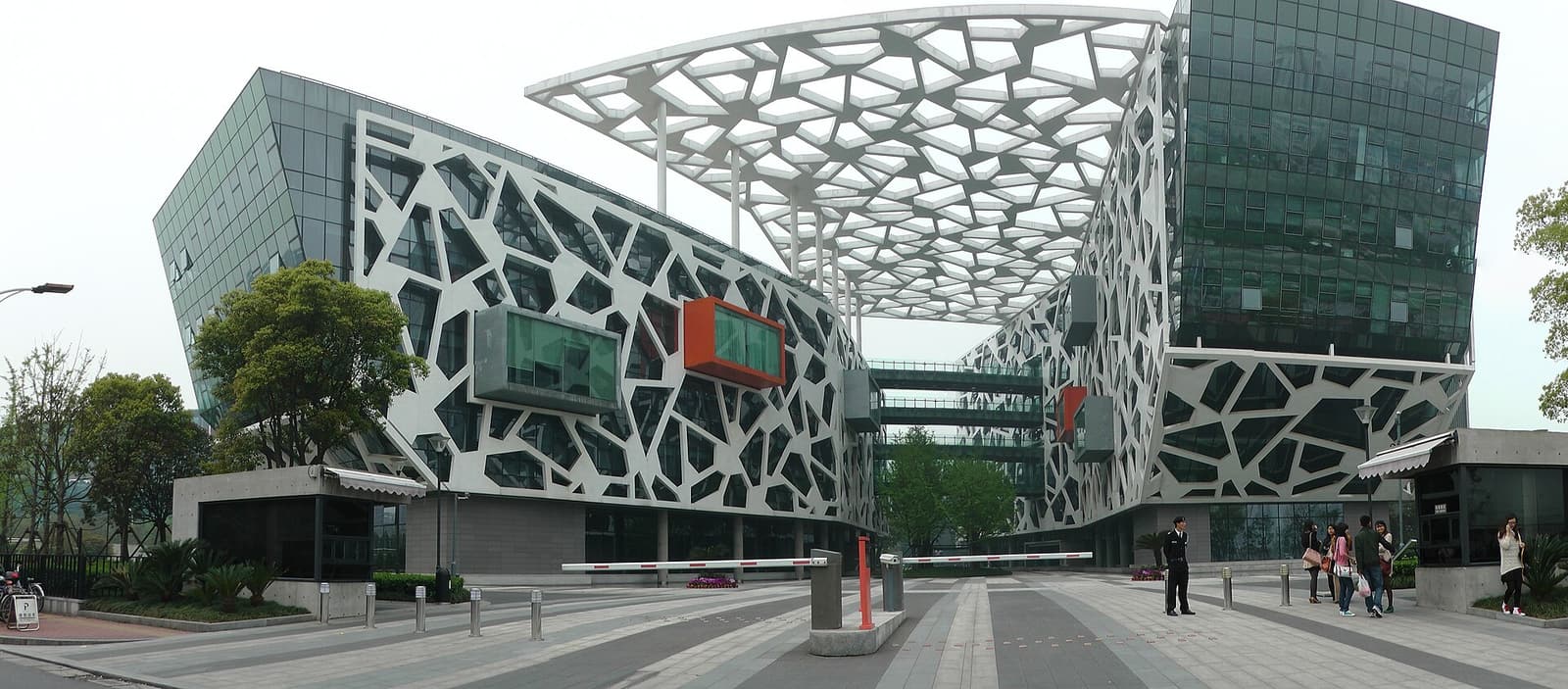
Image context: the cover uses a real Wikimedia Commons photograph of Alibaba's Hangzhou headquarters. That is the right anchor here because the claim is about company-level distribution architecture. A real campus says more than a synthetic "AI interface" visual about where this control plane is actually being built.[6]
Model Studio turns geography into product structure
The strongest evidence sits in Model Studio's own product description. Alibaba says the platform is a one-stop model service layer that integrates the full Qwen series and mainstream third-party LLMs, including names such as DeepSeek and Kimi, while giving developers both official Qwen APIs and OpenAI-compatible APIs.[1] That already tells you something important about the company's posture. Alibaba is not trying to win only by forcing every builder into a single proprietary invocation path. It is trying to become the control point that can absorb both its own models and rival models under one account, one console, and one compatibility story.[1]
The model-list page pushes this further by turning geography into an explicit product primitive.[2] International mode places endpoints and data storage in Singapore while scheduling inference globally outside the Chinese mainland; Global mode routes storage through Virginia or Frankfurt with globally scheduled inference; US mode keeps both storage and compute in Virginia; Chinese mainland mode keeps both in Beijing; China (Hong Kong) and EU modes add their own bounded routes.[2] These are not small implementation details. Once regions carry different endpoints, key domains, supported models, and pricing surfaces, Alibaba is no longer only selling model quality. It is selling jurisdiction-shaped access lanes.[1][2]
That is why I think "distribution operating system" is the right frame. In a normal model marketplace, the model is the star and the route is secondary. In Alibaba Cloud's current stack, the route is becoming the product.
Open Qwen supply feeds a managed control plane
Alibaba's September 2025 Apsara Conference roadmap makes the second layer visible. The company says it has open-sourced over 300 AI models built on Qwen and Wan, generated more than 600 million downloads, and produced 170,000+ derivative models.[3] Those numbers matter because they describe a supply engine. Open models widen developer familiarity, fine-tuning activity, downstream packaging, and mindshare. They make Qwen harder to ignore even when developers are not yet paying Alibaba directly.[3]
But Alibaba does not leave that energy in the open ecosystem alone. The same roadmap says over 1 million corporates and individuals have used Qwen on Model Studio, that users can access over 200 industry-leading models there, that more than 800,000 agents have been created on the platform, and that model calls through Model Studio rose 15 times over the previous year.[3] This is why the company dossier matters. Alibaba is not only opening models; it is using open models to pull demand toward a managed platform where usage becomes legible, billable, and governable.[1][2][3]
This is also where Alibaba looks different from a company that merely posts open weights and hopes the ecosystem does the rest. The open-model layer and the managed-platform layer are not opposites here. They are a funnel.
Coding Plan shows Alibaba wants to own the meter even in outside tools
The clearest sign that Alibaba Cloud wants to own the path rather than only the model appears in Coding Plan. The Coding Plan overview describes a $50/month subscription for AI coding tools, with fixed request quotas and a recommended model set that includes not just qwen3.5-plus but also kimi-k2.5, glm-5, and MiniMax-M2.5.[4] That is an unusually revealing detail. Alibaba is willing to make the billing and quota surface valuable even when some of the models inside that surface are not Alibaba's own.
The same document says Coding Plan has its own plan-specific API key format, sk-sp-xxxxx, and its own base URLs so quota is deducted from the subscription correctly.[4] Once that happens, the commercial center of gravity moves. The decisive question is no longer only which model a developer likes most in the abstract. It becomes which account, quota regime, and base URL they normalize around in their day-to-day workflow.[4]
The Qwen Code setup page confirms that this logic reaches all the way into the client surface.[5] In the CLI, the user is told to select Alibaba Cloud Coding Plan, after which Qwen Code automatically sets the Coding Plan base URL.[5] The docs also show that the same plan can flow into IDE extensions through ~/.qwen/settings.json, and that users can switch among Coding Plan-supported models inside the same session with /model.[5] That matters because it means Alibaba is trying to make its commercial control plane feel native inside the tool, not external to it.
This is the deeper company signal. Alibaba Cloud wants to be the surface where developers authenticate, meter usage, swap models, and keep working, even when the visible interface is a coding agent or an IDE plugin rather than the Model Studio console itself.[4][5]
Why this matters in AI-China
In ai-china, a lot of coverage still gets trapped at the benchmark or launch-note layer. Alibaba Cloud's stronger move is happening one layer lower. The company is arranging open-model supply, managed regional lanes, OpenAI-compatible migration, and tool-native subscriptions so that the hard thing for a developer to change later is not only the model name.[1][2][3][4][5]
If this reading is right, Alibaba's moat in 2026Q2 is becoming less about proving that one Qwen release beat one rival on one chart. The more durable moat sits in the installed route: the base URLs teams standardize on, the regions their data is pinned to, the quota logic embedded in their coding tools, and the operational habit of treating Model Studio as the place where both Qwen and selected rivals can be reached.[1][2][4][5]
That is a company-level advantage, not a model-level one.
The boundary is still real
This dossier should stay narrow about what is not yet proven.
First, distribution control is not the same thing as universal lock-in. The docs themselves emphasize that API keys are not interchangeable across regions, that regions differ in supported models and pricing, and that developers still need to pick the right base URL for the route they want.[1][2] That means portability is being managed, not erased.
Second, Coding Plan is strongest where developers are willing to accept Alibaba as the identity and quota layer for their tools.[4][5] The plan may make external clients easier to onboard, but it also makes the subscription surface more central. That is a strategic strength for Alibaba, yet it is also a limit on how "neutral" the platform really is.
Third, open-model reach does not guarantee that every downstream builder converts into durable paid usage.[3] The article's claim is therefore not that Alibaba Cloud has settled the monetization question. The claim is that the company has built a notably coherent route from open supply to managed usage.
Bottom line
Alibaba Cloud now looks most interesting when read as a distribution operating system. Model Studio integrates Qwen and rival models under an OpenAI-compatible, region-specific control plane; Qwen's open-model scale feeds builder attention into that platform; and Coding Plan extends Alibaba's billing and routing logic directly into coding tools and IDEs.[1][2][3][4][5]
That is why the important ai-china question is no longer only "How good is the latest Qwen model?" The harder and more durable question is: whose route did the developer adopt? Right now, Alibaba Cloud is working to make the answer its own.
Sources
- Alibaba Cloud Model Studio, "What is Alibaba Cloud Model Studio" (updated March 26, 2026; one-stop platform integrating the full Qwen series and third-party LLMs, official Qwen APIs, OpenAI-compatible APIs, regional base URLs, and Coding Plan links).
- Alibaba Cloud Model Studio, "Supported Models and Capabilities Overview" (updated April 1, 2026; deployment modes across International, Global, US, Chinese mainland, China Hong Kong, and EU, with route-specific endpoints, storage locations, model catalogs, context windows, and price ladders).
- Alibaba Cloud, "Alibaba Cloud Unveils Strategic Roadmaps for the Next Generation AI Innovations" (September 24, 2025; 300+ open-sourced AI models, 600 million downloads, 170,000+ derivative models, 1 million+ users on Model Studio, 800,000+ agents, and 15x model-call growth).
- Alibaba Cloud Model Studio, "Coding Plan overview" (updated March 30, 2026; $50/month fixed pricing, plan-specific API keys and base URLs, quota structure, and a coding-tool model roster spanning Qwen plus third-party models).
- Alibaba Cloud Model Studio, "Qwen Code" (updated March 16, 2026; Coding Plan setup in Qwen Code CLI and IDE extensions, automatic base-URL configuration, and in-session model switching).
- Wikimedia Commons, "File:Alibaba group Headquarters.jpg" (source page for the real campus photograph used as this article's cover image).