As of 2026-05-03 UTC, the useful way to read Tencent's Hunyuan-A13B release is not as one more Chinese open-model headline and not as one more benchmark sheet asking to be admired from a distance. The important change happened on 2025-06-26/27, when Tencent open-sourced not only one model checkpoint but a usable package: Hunyuan-A13B-Pretrain, Hunyuan-A13B-Instruct, FP8, and GPTQ-Int4 variants, plus a technical report and a training-and-inference manual.[1][2][3] That bundle matters because it tells builders more than "here are some weights." It tells them what Tencent thinks the model is for, how it should be run, which tradeoffs are meant to be adjustable, and where the commercial boundary still sits.
That is why I think Hunyuan-A13B is best understood as a deployment contract. The contract is not legal language alone. It is the combined signal from the model card, the repo, the runtime instructions, and the license. Tencent is saying: here is an 80B-parameter fine-grained MoE model with 13B active parameters, 256K native context, dual reasoning behavior, multiple serving formats, and explicit routes into standard inference stacks.[1][2][3] In other words, this is an open model meant to move, not a ceremonial release meant only to decorate a product page.
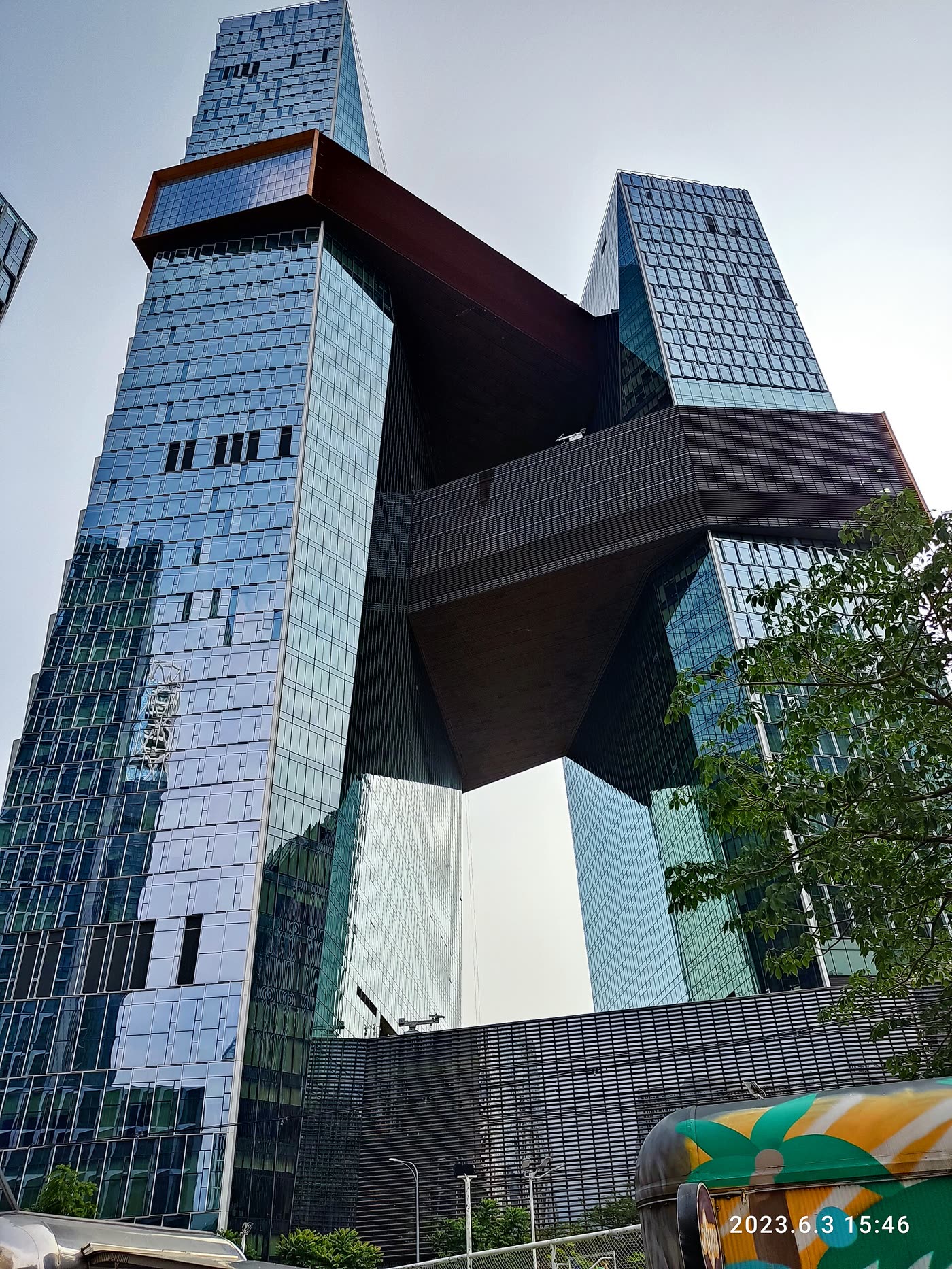
Image context: the cover uses a real Wikimedia Commons photograph of Tencent Seafront Towers in Shenzhen. That is the right visual anchor because this article is about Tencent's packaging and distribution posture around Hunyuan-A13B, not about a synthetic AI illustration detached from the company making the release.[7]
Tencent bundled the model with operating choices
The first thing worth noticing is how much operating detail Tencent shipped alongside the release. The Hugging Face model card and the technical-report links emphasize the same core package: 80B total parameters, 13B activated parameters, 256K context, grouped-query attention, quantization support, and a model family that already includes lighter deployment formats instead of leaving quantization as a downstream community job.[1][2] The GitHub repo carries the same logic into deployment instructions, with prebuilt vLLM and SGLang Docker images, explicit tensor-parallel-size examples, ModelScope download paths, and tool-parsing guidance for agent-style use.[3]
That is a different release shape from the older pattern where an open model arrives as a single flagship checkpoint plus a vague promise that the ecosystem will figure out the rest. Tencent published a family and a manual. The release note worth retaining is therefore not "Tencent joined open source." It is that Tencent made operational choices legible at launch.
The reasoning interface is a good example. Tencent's Chinese README says the instruct model defaults to a slower reasoning mode and can be forced into different behavior either by disabling thinking at template time or by prefixing prompts with /no_think and /think.[1] That matters because many model launches talk about "reasoning" as an aura. Tencent exposed it as a switch. Once a model's thinking behavior becomes an explicit control surface, the model stops being only a benchmark object and starts looking like something that can be routed by latency budget and task depth.
The benchmark table is directional; the serving math is the real message
Tencent of course wants the benchmark table to do part of the selling. On the Hugging Face card, Hunyuan-A13B posts 88.17 on MMLU, 83.86 on MBPP, and 49.12 on GPQA in the pretrain comparison table, while the instruct section claims competitive math, science, coding, and agent performance against larger or more established models.[1] Those numbers are useful, but only within a boundary. The public card does not provide the full evaluation setup for every comparison, so the safest way to read the table is as directional evidence, not as a settled market verdict.[1]
The deeper signal sits elsewhere anyway. Tencent is trying to compress the cost-performance story into one sentence: 13B active parameters out of 80B total.[1][2] In practical terms, that is Tencent's answer to an increasingly crowded China-model market where some releases are too large to travel easily and others are easy to serve but too weak to matter. The company wants Hunyuan-A13B to land in the middle: large enough to remain serious, but structured enough to fit standard deployment budgets more cleanly than a dense model of similar ambition.
The technical report strengthens that reading. Tencent describes a 32-layer fine-grained MoE with 64 routed experts, top-8 routing, and training on more than 20T tokens.[2] Those details matter less as architectural trivia than as evidence that Tencent is optimizing for a model that can still advertise scale while making the active path comparatively smaller. In ai-china, that is an ecosystem signal. It says Tencent wants an open model builders can actually place inside their serving plans, not only admire as a lab artifact.
Mainstream inference support is what made the release travel
The strongest part of the Hunyuan-A13B story is what happened after launch. Tencent's own repo already carried runnable deployment paths, including Docker images built around vLLM 0.8.5 and SGLang, plus examples for standard API-server startup and tool-calling support.[3] That alone made the release more actionable than many model drops.
But the more revealing change is that support later appeared in the inference ecosystem outside Tencent's own repository. By 2026-04-21, vLLM Recipes had a dedicated Hunyuan-A13B Instruct usage guide, including a concrete vllm serve tencent/Hunyuan-A13B-Instruct path for AMD hardware.[5] Separate vLLM reasoning-output documentation also listed a dedicated hunyuan_a13b parser family with reasoning-output support.[6] Once a model gains named support in a mainstream inference project, the model's status changes. It is no longer merely "Tencent's open model." It becomes part of the shared serving vocabulary.
That is why the release still matters months later. Open models do not become ecosystem-relevant at the moment the weights appear. They become ecosystem-relevant when the runtime stack stops treating them as special cases. Hunyuan-A13B crossed that line. Tencent did the first half of the work by publishing deployment scaffolding; the wider inference stack did the second half by absorbing the model into ordinary documentation and parser support.[3][5][6]
The license explains what kind of openness Tencent wants
The final piece of the contract is the license, and it is important not to blur it away with generic "open-source" language. Tencent's community license for Hunyuan-A13B says the agreement does not apply in the European Union, the United Kingdom, and South Korea, treats use outside the defined territory as unlicensed, requires a separate license if the licensee's products exceeded 100 million monthly active users on the release date, and bars using the model or its outputs to improve other AI models outside Tencent Hunyuan derivatives.[4]
This is not a contradiction of the release. It is part of the release's real meaning. Tencent wants Hunyuan-A13B to circulate through developer channels, inference stacks, and deployment experiments, but inside a strategically bounded perimeter.[4] The model is open enough to seed adoption and tooling, yet not open in the neutral commodity sense that would erase Tencent's leverage over geography, scale, and downstream model improvement.
That boundary matters in ai-china because it shows the current equilibrium many large Chinese model builders are testing. They want ecosystem spread, but they do not want to give away the whole bargaining position that comes with model distribution. Hunyuan-A13B captures that compromise clearly.
Why this release still matters
The narrow conclusion is strong enough. Hunyuan-A13B matters because Tencent turned an open-model launch into a deployment contract: active-parameter efficiency, reasoning controls, multiple precision paths, runtime guidance, and later third-party inference support all arrived in a shape builders could operationalize.[1][2][3][5][6] The benchmark table helped the story travel, but the more durable value sits in the packaging.
The limitation is equally clear. This is not a frictionless global commodity release. The license remains bounded, and some of Tencent's strongest performance claims still need to be read with evaluation caution.[1][4] Even so, Hunyuan-A13B changed Tencent's open-model posture. It gave the company a release that can live inside the real workflow of model selection, serving, and tool integration rather than only inside the theater of launch-day comparison tables.
That is the durable signal worth keeping from this release note.
Sources
- Tencent,
tencent/Hunyuan-A13B-InstructHugging Face model card (June 27, 2025 release note, 80B total / 13B active parameters, 256K context, benchmark tables, reasoning-mode controls, and quantized variants). - Tencent Hunyuan, Hunyuan A13B Technical Report (GitHub PDF covering architecture, routed experts, training scale beyond 20T tokens, and design goals for efficient deployment).
- Tencent-Hunyuan,
Hunyuan-A13BGitHub repository (deployment manual, Docker images for vLLM and SGLang, ModelScope path, API-server examples, and tool-calling support). - Tencent-Hunyuan,
LICENSEfor Hunyuan-A13B (territorial scope, 100M-MAU clause, and restriction on using outputs to improve other AI models). - vLLM Recipes, "Hunyuan-A13B Instruct Usage Guide" (April 21, 2026; evidence that Hunyuan-A13B moved into mainstream inference documentation with a standard
vllm servepath). - vLLM docs, "Reasoning Outputs" (lists dedicated
hunyuan_a13breasoning-parser support in the vLLM feature set). - Wikimedia Commons, "File:SZ 深圳 Shenzhen 南山区 Nanshan Haitian 2nd Road Binhai Blvd Road Haixue Road Houhai Blvd 騰訊海濱大廈 Tencent Binhai Towers June 2023 Px3 01.jpg" (source page for the documentary cover photograph used in this article).