As of 2026-04-21 UTC, Kunlunxin's useful AI-China signal is not a single accelerator-card headline. The stronger signal is the cluster contract forming around the P800: a domestic chip has to arrive with a node shape, an interconnect story, a model-adaptation claim, and a software path that lets operators run recognizable large-model workloads without rebuilding the whole stack by hand.[1][2][3][5]
That distinction matters because China's compute bottleneck has moved beyond the question of whether non-NVIDIA accelerators can be announced. The harder question is whether they can be made boring enough for production. A model team does not buy "sovereign compute" as an abstraction. It buys a way to train, fine-tune, serve, monitor, and troubleshoot large models under real cost and supply constraints. Kunlunxin's recent public materials are interesting because they keep pointing away from the card alone and toward the whole operating envelope around it.
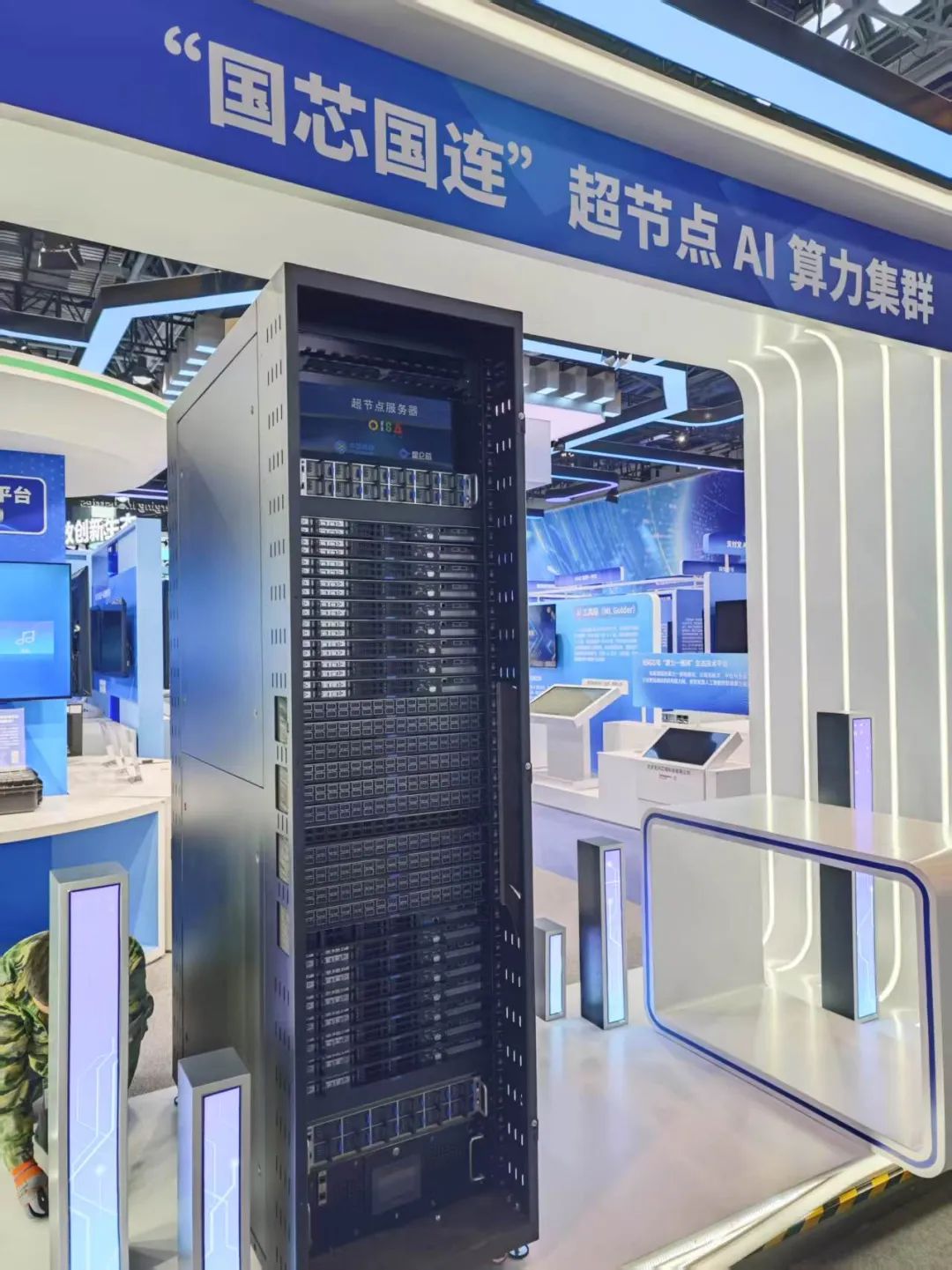
Image context: the cover photo is Kunlunxin's own exhibition photograph of a 64-card supernode server at the 2025 Zhongguancun Forum. It is a real event/server photo, not a diagram or generated visual, and it is directly relevant because the article is about packaged domestic AI compute rather than abstract chip ambition.[1]
The supernode is the product shape
Kunlunxin's March 2025 Zhongguancun Forum post says the company and China Mobile publicly displayed a 64-card supernode AI computing server built on the P800, using OISA, short for Omni-directional Intelligent Sensing Express Architecture, to support full interconnection inside one cabinet.[1] That is the right place to start because it reframes the product. The claim is not simply "here is a chip." The claim is "here is a denser unit of compute with its own communication assumptions."
The company describes the supernode as breaking past the traditional single-machine eight-card form factor by putting dozens or hundreds of AI chips inside one server node, using high-bandwidth and low-latency interconnect to reduce communication loss in multi-chip parallel computation.[1] Treat those descriptions as vendor claims, but the direction is important. Large-model training and inference are increasingly communication problems as much as arithmetic problems. Once models, context windows, and mixture-of-experts routing push traffic across cards, a domestic accelerator cannot win by TOPS or memory size alone. It has to make the links between accelerators part of the product.
That also explains the "one cabinet equals many machines" language in Kunlunxin's post.[1] The phrase is promotional, but it points to a real deployment desire: operators want a unit they can plan around. If a cabinet can be bought, cooled, networked, and scheduled as a coherent AI-compute block, the domestic chip story becomes easier to operationalize. If every deployment is a bespoke integration exercise, procurement success will not automatically become model throughput.
OISA moves the argument from silicon to fabric
The August 2025 China Computing Power Conference materials make the interconnect layer more explicit. Kunlunxin says it joined China Mobile, Zhejiang Lab, and server partners in launching OISA ecosystem cooperation and publishing the OISA 2.0 protocol. The same source says Kunlunxin's self-developed XPU Link used in its supernode product is compatible with OISA.[2]
The technical numbers are the anchor: Kunlunxin says OISA 2.0 raises support to 1,024 AI chips, pushes bandwidth into the TB/s class, and lowers interconnect latency to the hundreds-of-nanoseconds level.[2] These are company-stated protocol claims, not independently reproduced benchmarks, but they make the strategic point clear. The domestic-compute fight is becoming a fabric fight.
That is a more mature stage than the first wave of AI-chip announcements. In the early phase, a chip vendor could attract attention by proving that a domestic accelerator existed and could run known frameworks. In the current phase, the relevant question is whether many accelerators can behave like one useful system. OISA is important in that sense because it tries to give the cluster layer a common language. Without that layer, every hardware vendor remains trapped inside its own island of drivers, communication libraries, and operational surprises.
Kunlunxin's role here is also politically and commercially legible. It is not only selling P800 cards into a vacuum. It is trying to place P800 inside a broader Chinese compute-networking effort, with carriers, labs, and server makers around it.[2] That does not guarantee adoption, but it changes the adoption surface from "trust this chip" to "trust this stack of chip, interconnect, server, and national compute infrastructure."
DeepSeek adaptation is a boundary test, not a victory lap
The most useful Kunlunxin DeepSeek claim is not that P800 is suddenly equivalent to every imported GPU cluster. The useful claim is narrower. In April 2025, Kunlunxin said its P800 single-machine eight-card all-in-one became the first product to pass the China Academy of Information and Communications Technology's DeepSeek adaptation test for the full DeepSeek-V3/R1 671B version, with accuracy aligned to the DeepSeek technical report and support for long-context inference.[3]
The testing context matters. The same post says CAICT's AISHPerf system looks across chips, computing equipment, clusters, networks, frameworks, system software, capability platforms, and applications, and that the DeepSeek test methodology considered concurrency, batch size, context length, online/offline scenarios, and product function.[3] In other words, this was not merely a logo-compatibility badge. It was aimed at the system-level question that buyers care about: can a product support the model under practical serving conditions?
The DeepSeek-V3 technical report provides the scale reference: V3 is a mixture-of-experts model with 671B total parameters and 37B activated per token.[6] That makes the adaptation claim meaningful while also defining its boundary. Passing support testing does not prove that every enterprise workload will be cheap, fast, or easy on P800. It does show that domestic accelerator vendors are now being evaluated against large, recognizable model families rather than against toy demos.
That is the right standard for AI-China in 2026. The market has enough model headlines. What it needs is evidence about the surfaces where models meet hardware: context length, batching, concurrency, precision, memory movement, and failure recovery. Kunlunxin's DeepSeek material is best read as one data point in that larger transition.[3][6]
Large clusters turn the proof into operations
Kunlunxin's later 2025 North Bund Forum post pushes the story from node to installed base. The company says P800 uses a fully self-developed XPU-P architecture, had achieved a 10,000-card cluster milestone, had cumulative deployment above tens of thousands of cards, and had a largest cluster size above 30,000 cards.[4] It also says that in April 2025 Kunlunxin reached a 32,000-card deployment at a national computing hub, able to support multiple hundred-billion-parameter model training jobs and fine-tuning for many customers.[4]
Those are vendor-reported deployment claims and should be treated that way. Still, they matter because domestic AI compute is no longer judged only by the peak demo. The operational proof is whether a cluster can be installed, kept busy, and exposed to enough customers that software problems surface and get fixed. A few impressive boxes in a booth do not create an ecosystem. Repeated deployments do.
This is where Kunlunxin's story intersects with China's broader AI supply chain. Domestic accelerators have to carry both strategic and practical burdens. Strategically, they reduce dependence on restricted supply. Practically, they have to absorb workloads from model labs, cloud vendors, banks, carriers, and industrial users with different reliability and data-locality requirements. A 30,000-card claim, if it holds under real usage, is less about one heroic cluster than about whether scheduling, interconnect, cooling, fault handling, framework support, and customer onboarding can be repeated.
That is also why the financial and carrier references around the sources matter. Kunlunxin's materials mention China Mobile in the supernode and OISA context, and separate company materials point to financial and national-hub deployments.[1][2][4] These are the customers most likely to care about controlled supply chains and local deployment boundaries. They are also the customers least likely to tolerate experimental infrastructure that needs constant handholding.
FastDeploy is the missing software bridge
The strongest external confirmation of the stack logic comes from Baidu's FastDeploy 2.0 documentation. Baidu describes FastDeploy 2.0 as a PaddlePaddle-based large-model inference and deployment toolkit with OpenAI-compatible API service, vLLM-aligned interfaces, quantization down to 8-bit, 4-bit, and 2-bit, prefill/decode disaggregation, load-aware scheduling, and heterogeneous-hardware support across NVIDIA GPUs, KUNLUNXIN P800, Iluvatar BI-V150, Hygon K100AI, and Enflame S60.[5]
That list is important because it translates the P800 from hardware into a developer-operable path. The FastDeploy post even gives a concrete example for deploying ERNIE-4.5-300B-A47B-Paddle on KUNLUNXIN P800 hardware through a precompiled fastdeploy-xpu container, XPU_VISIBLE_DEVICES, tensor parallel size, quantization settings, and an OpenAI-compatible chat-completions endpoint.[5] This is the kind of detail that decides whether a domestic accelerator enters real engineering workflows.
Without that bridge, P800 adoption would depend too heavily on custom vendor support. With it, at least part of the path becomes recognizable to teams already used to API servers, tensor parallelism, quantized serving, and vLLM-style deployment expectations. The important claim is not that FastDeploy eliminates hardware differences. It is that the software layer is trying to hide fewer differences behind slogans and expose more differences as configuration.
What to watch
Three signals will determine whether Kunlunxin's P800 lane becomes durable.
First, watch whether OISA compatibility turns into multi-vendor operational proof. Protocol numbers are useful only if server makers, carriers, and model platforms can use them without one-off integration projects.[2]
Second, watch whether DeepSeek and ERNIE adaptation claims keep moving from support tests into public throughput, latency, context-length, and reliability evidence under comparable setups.[3][5][6] The next useful disclosures would show serving envelopes, failure rates, and cost per sustained workload rather than only "model X runs."
Third, watch whether software paths such as FastDeploy remain first-class. Domestic chips become easier to adopt when model teams can use familiar serving abstractions while still understanding the hardware-specific constraints.[5]
Kunlunxin's P800 story is therefore bigger than the card and smaller than a full victory narrative. The real signal is that China AI compute is being packaged as a cluster contract: accelerator, interconnect, server shape, model adaptation, deployment toolkit, and customer environment all have to hold together.[1][2][3][5]
Sources
- Kunlunxin, "Kunlunxin inside: Supernode AI computing server appears at the 2025 Zhongguancun Forum" (March 31, 2025), source page for the cover photo and 64-card P800 supernode/OISA description.
- Kunlunxin, "2025 China Computing Power Conference x Kunlunxin: jointly starting OISA ecosystem construction" (September 25, 2025), covering OISA 2.0, XPU Link compatibility, 1,024-chip support, TB/s-class bandwidth, and hundreds-of-nanoseconds latency claims.
- Kunlunxin, "Kunlunxin P800 eight-card all-in-one passes CAICT DeepSeek adaptation test" (April 17, 2025), covering AISHPerf, DeepSeek-V3/R1 671B support testing, concurrency, batch size, and context-length evaluation framing.
- Kunlunxin, "Driving AI compute innovation through technical breakthroughs: Kunlunxin appears at the North Bund Forum" (September 25, 2025), covering P800 XPU-P architecture, 10,000-card and 32,000-card deployment claims, and industry deployment scope.
- Baidu ERNIE Blog, "FastDeploy 2.0: A Large-Scale Model Inference and Deployment Toolkit with Native Support for ERNIE 4.5" (August 14, 2025), covering OpenAI-compatible serving, quantization, heterogeneous hardware, and a P800 deployment example.
- DeepSeek AI, "DeepSeek-V3 Technical Report" (arXiv, December 2024), scale reference for the 671B-total / 37B-activated mixture-of-experts model family used in adaptation discussions.