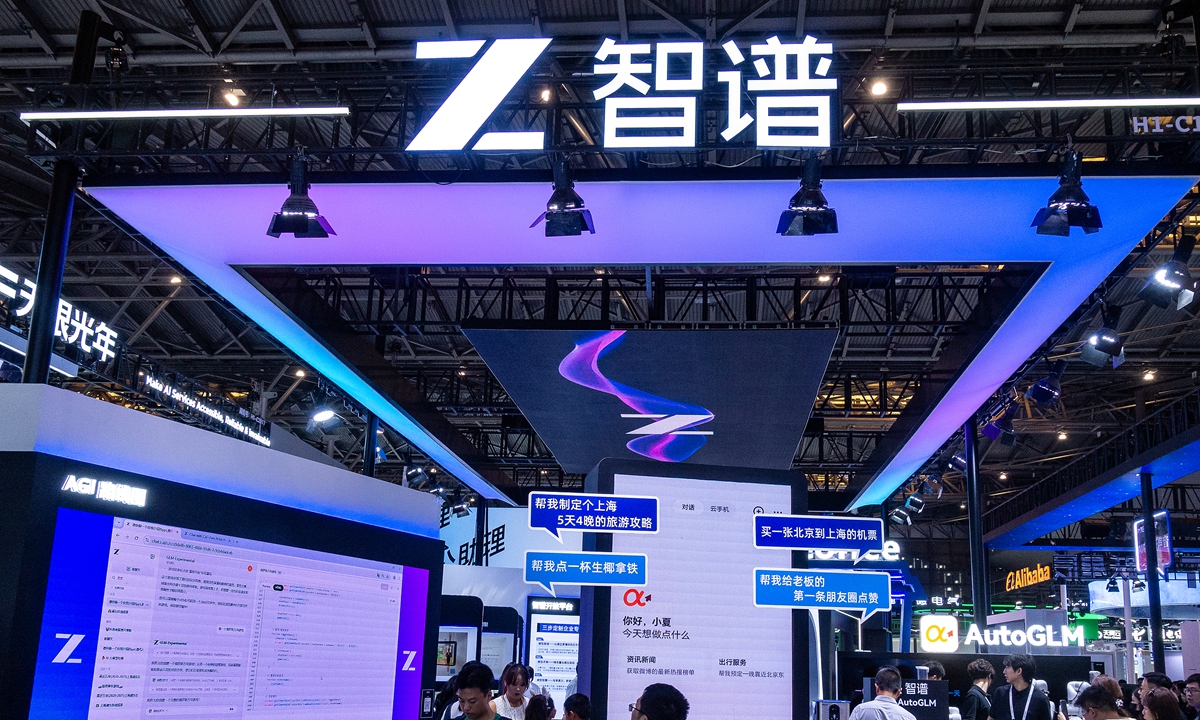
As of 2026-04-21 UTC, Zhipu's most useful AutoClaw signal is not that China has one more agent product. The stronger signal is where the product tries to land. AutoClaw presents itself as a way to put agent execution inside an IM entry point, with Feishu as the visible handoff surface, local tools doing real work, and task progress returning to the same conversation thread.[1] That choice matters because enterprise agents usually fail less from a lack of model ambition than from a bad handoff between the model, the worker, the local machine, and the system where the next human has to pick up the result.
The product page makes that work-chat posture explicit. AutoClaw says the user starts from a conversation, the agent breaks down the goal, executes downward through tools, and returns context and progress into Feishu.[1] It also offers Mac and Windows downloads rather than only an API console.[1] Read against Zhipu's model-release trail, this looks like a concrete use-case wedge: the company is trying to turn "agent" from an impressive browser demo into a repeatable office lane where a worker can delegate, watch state, and re-enter the task without leaving the collaboration surface.[1][2][4]
Image context: the cover uses a real Global Times / VCG photograph of Zhipu's booth at WAIC 2025 in Shanghai. The booth and AutoGLM signage are relevant because this article is about how Zhipu is packaging agent capability for public adoption, not about an abstract model architecture diagram.[5]
The entry point is the product thesis
The important design decision is not Feishu by itself. The important decision is to treat work chat as the control surface.
Most agent demos ask users to move into a new environment: a browser-automation console, a code terminal, a research workspace, or a cloud dashboard. AutoClaw's page instead describes a pattern in which the request begins in a conversation, execution happens through a local agent workspace, and the intermediate state flows back into Feishu.[1] That turns the collaboration thread into a lightweight operations log. The agent is not only producing an answer; it is preserving enough process and context for the next person to understand what has happened.
That is a practical wedge for China AI because enterprise deployment often depends on ordinary workflow fit. If a sales analyst, operations lead, or founder has to open a separate agent product and then manually paste status back into the team channel, the agent remains a sidecar. If the agent can sit near the chat where the task was assigned and report back there, the adoption cost drops. Zhipu's own GLM-5 writeup makes the same pattern visible from the model side: it describes an AutoGLM version of OpenClaw that can complete OpenClaw and Feishu bot configuration in minutes rather than hours, so users can deploy a long-running assistant faster.[2]
That does not prove AutoClaw has solved enterprise adoption. It does show the adoption problem Zhipu is attacking: not "can a model reason," but "can an agent become a handoff object inside office work."
Local execution changes the trust boundary
The second clue is the local-machine posture. AutoClaw's page emphasizes local execution with Feishu synchronization, while Zhipu's GLM-5 materials frame OpenClaw integration as a way to run a personal assistant that searches, schedules information collection, publishes content, and programs.[1][2] Those are not purely textual tasks. They involve local files, logged-in tools, browser sessions, application state, and sometimes credentials.
That shifts the trust boundary. A cloud chatbot can stay mostly inside a text interface. A desktop agent touches the user's machine, and therefore has to answer a different set of questions: which tools can it call, which files can it see, what happens when a task runs for a long time, and how does a user inspect or interrupt the chain? AutoClaw's work-chat handoff is useful only if the underlying execution lane is legible enough for people to trust.
Zhipu's own model strategy is aligned with that problem. The GLM-5 release positioned the model around "Agentic Engineering" and long-horizon tasks, while the BigModel release page later said GLM-5.1 strengthens long tasks, tool use, consistency, and end-to-end planning-to-delivery loops.[2][3] The GLM-5-Turbo page narrows the claim further for OpenClaw-style work: it says the model was tuned for tool calling, instruction following, timed and persistent tasks, and high-throughput long chains.[4] In other words, the public model story is being pulled toward the messy parts of agent execution, not just toward chat quality.
The benchmark is no longer only the model
AutoClaw also shows why AI-China agent competition is becoming harder to read from model cards alone.
Zhipu's GLM-5-Turbo page says OpenClaw tasks cover setup, code development, information gathering, data analysis, and content creation, with user groups extending from developers to office-productivity users, finance workers, operations engineers, creators, and researchers.[4] It also says skill use rose from 26% to 45% in a short period and that GLM-5-Turbo was evaluated through a ZClawBench built from real OpenClaw use cases.[4] Treat those numbers as company-reported, but the category shift is important: the object being measured is no longer only a response in isolation. It is an agent chain with skills, tools, continuity, and local side effects.
That is why AutoClaw's Feishu loop deserves attention. A useful office agent has to survive at least four transitions. It has to convert a chat request into a plan; convert the plan into tool actions; convert tool actions into inspectable state; and then convert that state back into a handoff that people can continue. A model can be strong and still lose the thread across those transitions. A weaker model with better handoff discipline can sometimes feel more useful in a real workflow.
The Reuters photo record of a March 13, 2026 AutoClaw setup session in Beijing points to the same operational reality from outside Zhipu's own pages: agent adoption includes installation, onboarding, and assistance, not only model release notes.[6] That is a mundane detail, but it is the mundane layer where many agent products either become habits or vanish after a demo.
Enterprise controls are the missing half
The enterprise version of this story is governance. Zhipu's GLM-5-Turbo page says the company built a Claw enterprise security-management system around OpenClaw, with unified scheduling, permission orchestration, visual monitoring of task paths, tool-call chains, and resource consumption, plus role-based access, audit logs, encryption, localization boundaries, and human approval at key business nodes.[4]
Those controls matter more than the marketing phrase "AI employee." Once agents can operate across local tools, office documents, research tabs, and business systems, an enterprise buyer will ask for evidence of bounded authority. Who authorized this action? Which tool was called? Was sensitive data exposed? Did the task cross a data boundary? Can a human pause the workflow before a consequential step?
This is where the AutoClaw pattern becomes strategically interesting. The consumer-facing wedge is convenience: open the work chat, delegate, watch the return flow. The enterprise wedge is auditability: keep the agent close to the workflow, but wrap it with permission, logs, and approval. Zhipu's public materials now point to both sides.[1][2][4]
What to watch
Three signals will show whether AutoClaw is becoming a durable product lane or remaining a lively launch surface.
First, watch whether Feishu remains the main return channel or whether Zhipu adds equally explicit connectors into other Chinese collaboration suites. The work-chat thesis gets stronger if AutoClaw becomes portable across the places where tasks already arrive.
Second, watch whether Zhipu keeps publishing evaluations based on real OpenClaw traces rather than only broad model benchmarks. The agent category needs measurements that include setup, tool success, recovery from partial failure, handoff quality, and human intervention points.[4]
Third, watch the enterprise-control layer. If Claw security management becomes more concrete in product documentation, pricing, and deployment stories, AutoClaw will read less like a personal productivity helper and more like a managed execution lane for Chinese office work.[4]
The narrow claim is enough: AutoClaw is interesting because it treats the office inbox as the place where agent work should start and return. In AI-China terms, that is a more durable signal than another standalone agent demo.
Sources
- Zhipu AutoGLM, "AutoClaw By AutoGLM" product page, covering the IM entry point, Feishu return flow, local execution, and Mac/Windows downloads.
- Zhipu AI, "GLM-5 open-source: from code to engineering, the best open-source model of the Agentic Engineering era" (February 11, 2026), including OpenClaw and Feishu-bot configuration references.
- BigModel / Zhipu open documentation, "New releases," including GLM-5.1, GLM-5V-Turbo, and GLM-5-Turbo release notes for long-task, tool-use, and multimodal agent capabilities.
- Zhipu AI, "GLM-5-Turbo: a Claw-enhanced foundation model" (March 15, 2026), covering OpenClaw tuning, ZClawBench, skill-use shares, Claw packages, and enterprise security management.
- Global Times, "Zhipu AI open-sources advanced multimodal model trained on Huawei Ascend chips" (January 14, 2026), source page for the WAIC 2025 Zhipu booth photograph used as the cover image.
- Reuters Connect, "Setup session for AutoClaw, a local version of the AI agent OpenClaw developed by Zhipu, in Beijing" (March 13, 2026), documenting hands-on AutoClaw installation and onboarding.