As of 2026-04-21T20:32:19Z UTC, the interesting thing about ModelScope is not that China has its own model hub. That description is true, but too thin. The stronger reading is that ModelScope is becoming the distribution layer that Alibaba Cloud needs between three surfaces that often drift apart: open model weights, repeatable model snapshots, and managed deployment through Model Studio.[1][3][5] In China's AI stack, that middle layer matters because model release velocity has already become table stakes. What is harder is keeping discovery, download, dataset access, fine-tuning, evaluation, and hosted deployment close enough that developers do not treat every new model as a one-off integration project.[1][2][3][6]
The platform's own public history already points in this direction. Alibaba Cloud described ModelScope's English-language rollout in 2024 as the global face of a community that had passed 5 million developers, offered more than 5,000 ready-to-use models, and hosted more than 1,500 high-quality Chinese-language datasets.[1] Those numbers are not just promotional scale markers. They explain why ModelScope is strategically different from a static download page. If the platform is doing its job, it reduces the friction between a research release, a usable snapshot, a local experiment, and a managed service path.[1][3][5]
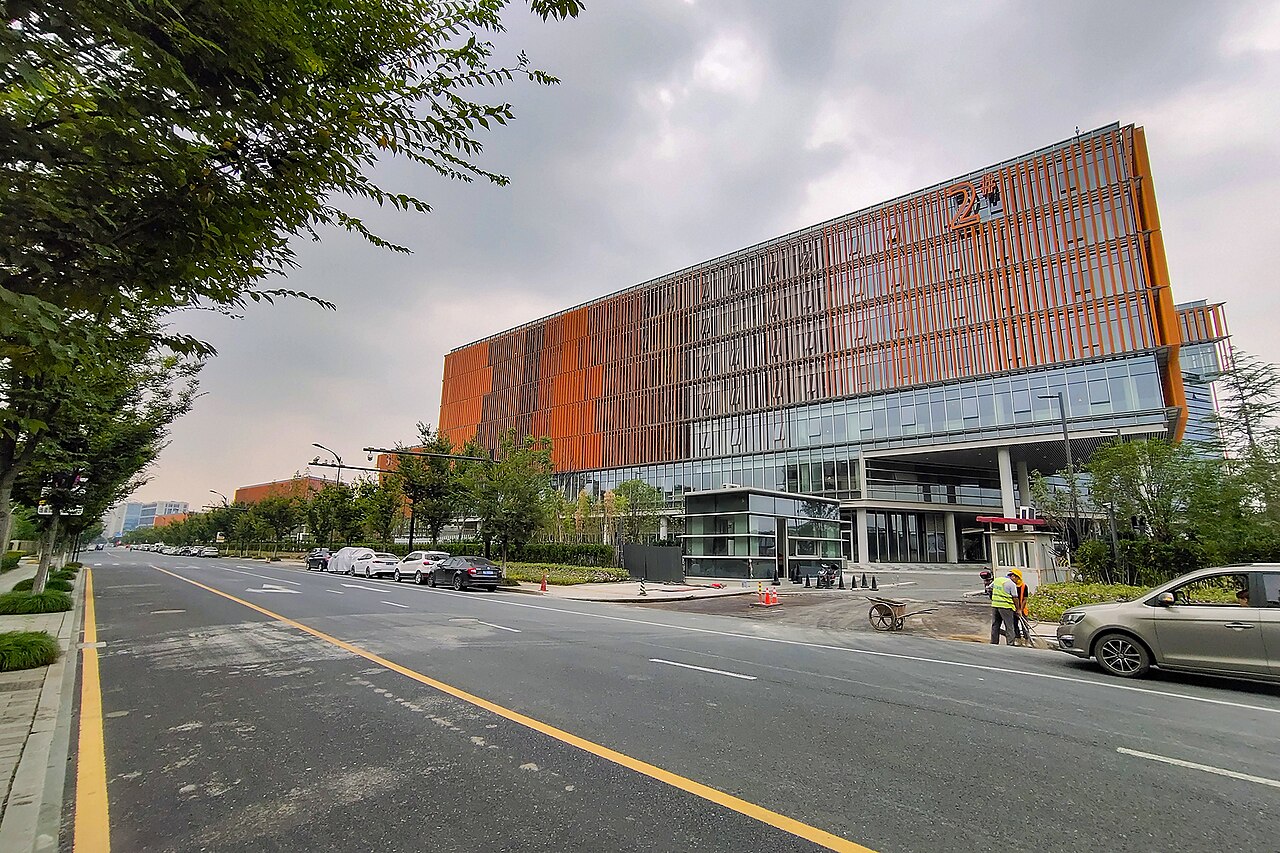
Image context: the cover uses a real photograph of Alibaba Xixi Park in Hangzhou. It is not a picture of a model card, but that is the point. ModelScope is best understood as a campus-scale infrastructure story: a platform company using community distribution, cloud hosting, and developer tooling to make Chinese open-model releases easier to operationalize.[8]
The hub is only the front door
ModelScope's GitHub README still gives the cleanest technical description of the product. The library is built around "Model-as-a-Service" and provides interfaces for model inference, training, and evaluation across computer vision, NLP, speech, multimodality, and scientific-computing tasks.[3] More concretely, it exposes hub interactions for models and datasets, a pipeline interface for inference, dataset loading through MsDataset, and training through a Trainer abstraction.[3]
That shape matters because China AI competition is no longer just a model-weight publishing contest. A model family such as Qwen can release dense and MoE variants, list multiple parameter sizes, and publish to Hugging Face, GitHub, and ModelScope at the same time.[4] But a working builder still has to answer duller questions: how does the snapshot download, where does the cache live, which dataset object feeds the finetune, how do I evaluate a variant, and when should I stop self-hosting and move to a managed endpoint?[2][3][5][6]
This is why ModelScope's April 2026 release notes are more revealing than a splashy model announcement. Version 1.36.1, published on 2026-04-21, is largely a download-module refactor: producer-consumer pipeline, server-side prefix filtering, paginated listing, retry behavior for hash validation, larger hash buffers, and more precise file-download errors.[2] Version 1.36.0, published one day earlier, added folder-upload concurrency, compatibility work for ms-swift 4.0, and an Ascend-oriented Dockerfile change.[2] These are unglamorous changes, but they hit the exact place where a model hub becomes infrastructure: moving large artifacts reliably and making the surrounding toolchain less brittle.[2]
Qwen gives ModelScope demand; ModelScope gives Qwen a route
Alibaba's Qwen3 announcement makes the complement clear. Qwen3 arrived with six dense models and two MoE models, including listed dense sizes from 0.6B through 32B and MoE configurations such as 30B with 3B active and 235B with 22B active.[4] The same release put availability on Hugging Face, GitHub, and ModelScope in one sentence, while pointing API access toward Alibaba's Model Studio.[4]
That sentence is the stack map. Hugging Face gives global open-model reach. GitHub gives code and community gravity. ModelScope gives Alibaba a native model-community surface with Chinese-language datasets and local developer familiarity. Model Studio then turns the successful open-model funnel into managed deployment for Qwen, Wan, and other models.[1][4][5]
The business signal has kept reinforcing the technical one. Alibaba Group said that by October 31, 2025, more than 180,000 derivative models had been built from the Qwen family on Hugging Face, while Alibaba Cloud's AI-related product revenue had recorded its ninth consecutive quarter of triple-digit growth.[7] Those two facts belong together. Open-weight distribution builds developer mindshare; managed cloud surfaces turn some of that mindshare into workload, support, and billing relationships.[5][7]
This does not mean ModelScope is simply a capture funnel. Its more durable value is compatibility. If a model can be downloaded through ModelScope, evaluated through EvalScope, fine-tuned with adjacent tooling, and deployed through Model Studio when needed, the platform gives teams a staged adoption path. They can start local, test the model under their own prompts, run benchmark and stress work, and only then decide whether a hosted service is worth the control tradeoff.[2][3][5][6]
EvalScope is the missing operational layer
The evaluation piece is easy to overlook because model hubs tend to market discovery first. EvalScope shows a different priority. Its repository describes a framework for LLM, VLM, and AIGC evaluation and performance benchmarking, and its recent changelog is full of operational work: API refactors, model-service stress testing, benchmark support, HTML report generation, agent-skill usage, and compatibility with external APIs.[6]
That matters for AI-China because many teams are no longer asking whether a Chinese model can produce a good demo. They are asking whether the model can survive a specific workload: long-document extraction, OCR-heavy multimodal tasks, function calling, coding-agent loops, embedding and rerank traffic, or service-level latency under concurrency.[6] ModelScope as a distribution layer becomes more credible when it can pair model availability with an evaluation lane that tests those real constraints.[6]
There is also a localization advantage. The 2024 ModelScope rollout emphasized Chinese-language datasets as part of the platform's inventory.[1] In practice, that gives Chinese builders a shorter path from domestic corpora and domestic model families to evaluation and deployment. For non-China teams, the same fact is a warning: benchmark results that look portable may hide data, language, endpoint, and platform assumptions. The useful question is not whether ModelScope is "China's Hugging Face." The useful question is which parts of the Chinese model supply chain ModelScope can make repeatable, measurable, and movable across self-hosted and managed lanes.[1][3][6]
The control surface is still fragmented
The boundary is that ModelScope does not erase fragmentation. Alibaba Cloud's Model Studio homepage frames itself as the managed platform for deploying and scaling Qwen, Wan, and other leading models.[5] That is a different product surface from the open community hub. The engineering tradeoff remains: local weights give portability and inspection; managed endpoints give speed, security features, region control, and platform support, but they also move runtime behavior into a vendor-controlled service.[4][5]
The Qwen3 announcement already shows this split. The open models are available for download, while API access runs through Model Studio.[4] That two-lane pattern is sensible, but it means builders need to keep separate checklists: license and weight access, snapshot reproducibility, hardware fit, evaluation harness, endpoint geography, pricing, and feature parity between local and hosted variants.[2][4][5][6]
ModelScope's April release work is therefore a small but important signal. Download reliability, pagination, upload concurrency, and tool compatibility sound like plumbing, yet they decide whether the open lane is operational or performative.[2] A model that cannot be moved, cached, checked, evaluated, and updated cleanly becomes a press release with a repository attached. A model that flows through those steps becomes part of a stack.
What to watch next
The first watch item is whether ModelScope keeps investing in artifact movement rather than only in model-page polish. The April 1.36.x releases are a positive signal because they improve the mechanics of large snapshots, folders, datasets, and compatible tooling.[2]
The second is whether ModelScope, EvalScope, ms-swift, and Model Studio keep converging or remain adjacent brands. The strategic prize is not a prettier catalog. It is a repeatable path from open model discovery to local trial, evaluation, fine-tuning, and managed deployment.[2][3][5][6]
The third is how Qwen's open and hosted lanes diverge. If open releases stay materially useful while Model Studio adds enterprise controls, Alibaba can keep goodwill and monetization in the same ecosystem.[4][5][7] If the hosted lane pulls too far ahead, ModelScope risks becoming a community wrapper around a mostly managed product strategy.
For now, ModelScope's role in AI-China is clearer than it looks from the outside. It is not just a warehouse for model files. It is the distribution layer trying to make Chinese open models operational: downloadable, cacheable, evaluable, fine-tunable, and eventually deployable through Alibaba's cloud.[1][2][3][5][6] In a market where every lab can announce a model, the more durable contest is who owns the path from model release to working system.
Sources
- Alibaba Cloud Community, "Alibaba Cloud Launches English-language Version of Open-Source AI Model Hub ModelScope" (2024 rollout context, developer count, model count, dataset count, and Model-as-a-Service framing).
- ModelScope GitHub releases page (April 2026
v1.36.xrelease notes covering download-module refactor, upload concurrency,ms-swiftcompatibility, and Ascend Dockerfile work). - ModelScope GitHub repository README (library scope, hub interfaces,
pipeline,MsDataset,Trainer, and Model-as-a-Service architecture). - Alibaba Group, "Alibaba Introduces Qwen3, Setting New Benchmark in Open-Source AI with Hybrid Reasoning" (Qwen3 model lineup, download locations, Model Studio API path, and derivative-model adoption context).
- Alibaba Cloud Model Studio homepage (managed deployment and scaling surface for Qwen, Wan, ModelScope, and Alibaba Cloud community models).
- ModelScope EvalScope GitHub repository (evaluation, benchmark, stress-testing, agent-skill, and report-generation tooling around large models).
- Alibaba Group, "Alibaba's Investments in AI and Comprehensive Consumption Underpin Solid Q2 Results" (Alibaba Cloud AI revenue growth and Qwen derivative-model adoption as of October 31, 2025).
- Wikimedia Commons, "Phase 4 of Alibaba Xixi Park 20200913.jpg" by Windmemories (source page for the real photograph used as this article's cover image).