As of 2026-05-31 UTC, Beijing's compute-voucher story is easiest to underrate because the headline unit is small. A 50,000 yuan innovation voucher does not look like much beside frontier-model training budgets, hyperscale capex, or national cluster announcements.[1] But that is exactly why it matters. The voucher is not trying to fund the next DeepSeek-scale pretraining run. It is a demand-side access layer for the firms and startup teams that need enough compute to test, adapt, evaluate, or demonstrate a model before they can justify larger spending.
That makes it a supply-chain signal. China's AI stack is usually described from the top down: model labs, accelerator substitution, cloud vendors, industrial agents, and national policy. Beijing's 2026 voucher notices show the bottom-up route: make small users legible, give them an official claim on shared facilities and compute resources, route them through approved open institutions, then connect that local access lane to a wider national push for integrated compute, high-quality data, and energy coordination.[1][2][4][5]
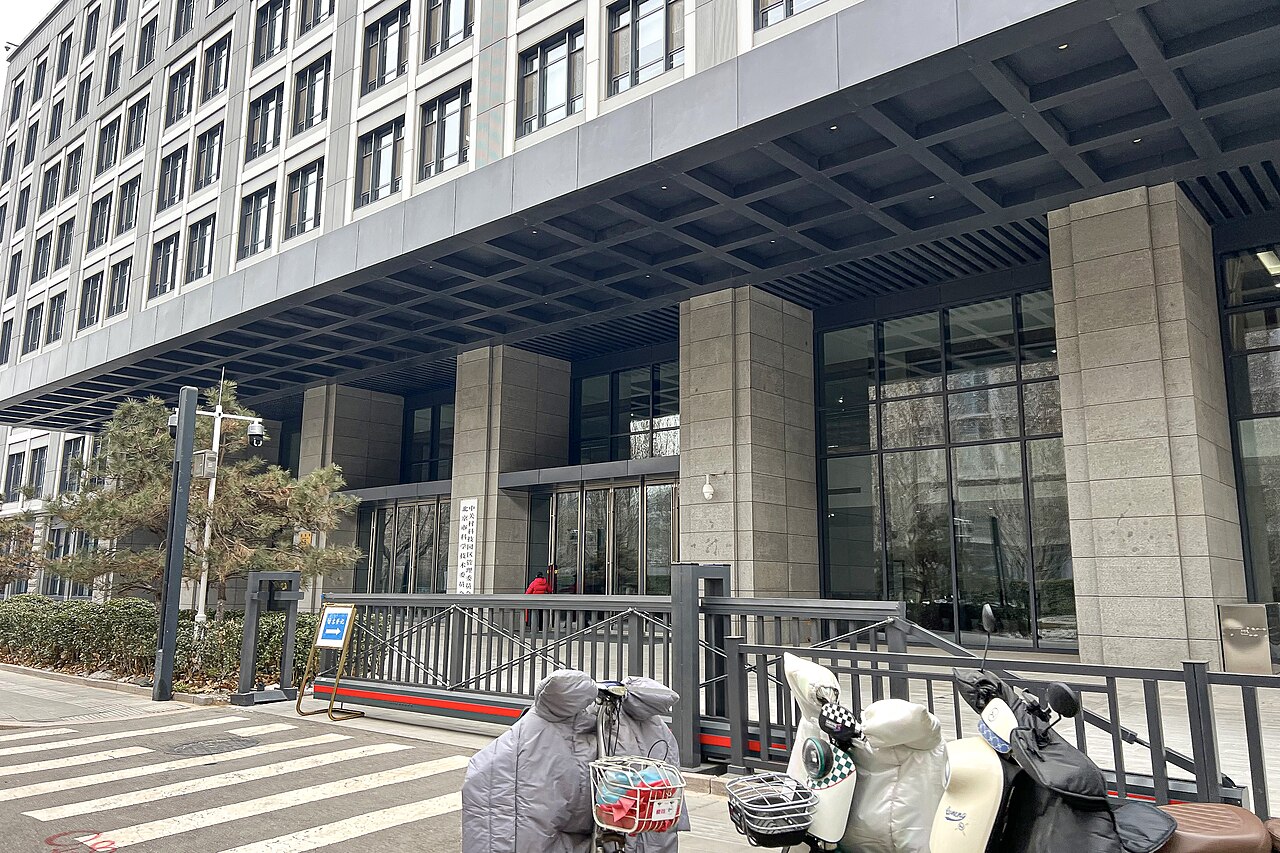
Image context: the cover uses a real Wikimedia Commons photograph of the Beijing Municipal Science and Technology Commission. The building is a better visual than an abstract server graphic because the important move here is administrative: compute is being turned into a public-facing support instrument for firms that cannot buy their way into the AI race alone.[6]
The voucher is a routing mechanism, not a gift card
The April 13 notice from the Beijing Municipal Science and Technology Commission and Zhongguancun Administrative Commission says the first 2026 batch of Capital Technological Innovation Vouchers is aimed at technology-based micro, small, and medium enterprises plus startup teams.[1] Eligible firms can log in through Beijing's government-services system, have eligibility checked automatically, and claim vouchers as needed; startup teams submit materials and claim on their own credibility statement.[1]
The important detail is what the voucher can buy. It covers analysis, testing, inspection, and R&D services based on research facilities and instruments held by universities, research institutes, enterprises, and other open institutions in Beijing. It also explicitly covers renting computing-power resources from open institutions for AI large model training during R&D.[1][2] That phrasing moves compute from a private cloud procurement line into the same family as shared scientific instruments.
The operating design is deliberately narrow. The official English summary says vouchers are electronic, issued periodically, and capped at 50,000 yuan per voucher; after claiming, applicants must register their scientific-research activity within 15 days, and registered activities stay valid for up to three months.[2] Those limits keep the instrument from becoming a blank subsidy. It is meant to create a short, auditable bridge between a specific R&D need and an approved service provider.
That bridge matters because small model companies often fail before the technical question is even clean. They need a few rounds of fine-tuning, data cleaning, distillation, evaluation, or domain adaptation before they know whether a product has a credible path. A voucher does not solve the whole problem, but it lowers the cost of finding out.
Beijing is layering vouchers, public capacity, and provider lists
The voucher lane sits inside a larger Beijing capacity program. On May 11, Beijing's Development and Reform Commission published a notice on 2026 national artificial-intelligence vouchers, also described as compute-power vouchers, after public solicitation and qualification review for proposed projects.[3] The notice itself is procedural, but it shows that Beijing is now handling more than one voucher surface: the science-and-technology innovation voucher for small R&D users, and the AI compute-voucher process tied to the national development-and-reform system.[1][3]
Two weeks later, on May 29, the science commission opened public comment on the first 2026 batch of newly added open institutions for the Capital Science and Technology Conditions Platform.[4] This is easy to skip, but it is operationally important. A voucher is only useful if there is a trusted supplier side. Publishing and updating open-provider lists is how Beijing keeps the subsidy attached to institutions that can actually deliver facilities, instruments, or compute services under the platform's rules.[1][4]
The city-level capacity numbers explain why this is more than administrative housekeeping. In March, Beijing officials said the city added 38,000P of intelligent computing capacity in 2025, bringing total compute scale to 60,000P, and planned to add more than 70,000P in 2026 while building a "super-node + industry-node" intelligent-compute support belt.[5] The same announcement set a 2026 goal of pushing Beijing's AI industry scale past 550 billion yuan and landing 20 public-social data-fusion innovation scenarios.[5]
Read together, the pieces form a stack. The city is expanding compute, naming access providers, subsidizing approved users, and pairing the compute story with data and application scenarios.[1][3][4][5] That is much more concrete than simply saying Beijing wants more AI.
The national layer is about scheduling, data, and power
The local voucher story also matches the national direction. The National Data Administration's May 19 digital-economy work plan says China will accelerate construction of a national integrated computing-power network, coordinate data, network, compute, and energy resources, and build benchmark high-quality datasets that meet "AI-readiness" requirements, train advanced models effectively, and solve practical industry problems.[7]
This matters because compute vouchers are only one side of an AI-access problem. Cheap compute is not enough if model teams lack usable data, scheduling capacity, power reliability, or a way to place workloads where resources are available. The national plan's language suggests a broader architecture: route compute across regions, coordinate it with energy and networks, and improve the data inputs that make model training and adaptation worth running in the first place.[7]
The energy-policy link is not decorative. On May 8, Chinese authorities announced an AI-and-energy action plan that aims by 2030 to significantly increase clean-energy supply capacity for AI computing infrastructure and improve efficient, economical coordination between computing power and electricity.[8] That adds another supply-chain layer beneath the voucher. A local startup may experience the policy as a small subsidy, but the system behind it has to solve far bigger questions about power, scheduling, and cluster utilization.[7][8]
Why this matters in AI-China
The ai-china signal is not that Beijing has found a magic way to make compute abundant. The source documents do not support that claim. The sharper reading is that China is turning compute access into a governed ladder. At the top are large clusters, domestic accelerator programs, cloud platforms, and national compute-network plans. At the bottom are vouchers, provider lists, eligibility checks, short validity windows, and small R&D teams trying to prove a domain model or agent workflow can work.[1][3][4][5][7]
That ladder is strategically useful because it addresses a different bottleneck from the one frontier labs face. A major lab needs vast contiguous capacity and first-class systems engineering. A small firm needs predictable access to enough compute, data services, and testing infrastructure to move from demo to evidence. Beijing's voucher mechanism is aimed at the second problem.
It also creates observability for the state. Once users apply through official portals, register R&D activities, rent from open institutions, and enter public voucher programs, policymakers can see where demand is forming and where service capacity is thin.[1][3][4] That feedback loop can influence future provider lists, data-set priorities, industry-node planning, and subsidy design.
The boundary is just as important. A 50,000 yuan voucher cannot replace a serious seed round, a durable cloud contract, or a full model-training budget.[2] It will matter most for evaluation, adaptation, small-batch training, and proof-of-concept work. If the open institutions are slow, expensive, poorly matched to modern AI workloads, or hard to access, the policy becomes paperwork. If they are usable, the voucher becomes a small but meaningful on-ramp into China's broader compute stack.
That is why this is a supply-chain update rather than a subsidy note. Beijing is not only handing out credits. It is defining how small AI builders enter the compute economy: through a verified user, an approved provider, a registered R&D task, a short execution window, and a wider national system trying to coordinate compute, data, and power. In 2026, that access layer may matter as much as another model launch.
Sources
- Beijing Municipal Science and Technology Commission and Administrative Commission of Zhongguancun Science Park, "关于开展2026年第一批首都科技创新券发放工作的通知" (April 13, 2026; official Chinese notice on the first 2026 innovation-voucher batch, eligibility, claiming process, and permitted use for AI large-model training compute).
- Beijing Municipal Government English Portal, "First Batch of 2026 Capital Technological Innovation Vouchers Now Open for Application" (April 17, 2026; English summary of voucher scope, 50,000 yuan cap, 15-day registration rule, and three-month validity).
- Beijing Municipal Government Portal, "北京市发展和改革委员会关于公示拟申请2026年人工智能券(算力券)项目情况的通知" (May 11, 2026; public notice for 2026 national artificial-intelligence/computing-power voucher project qualification review in Beijing).
- Beijing Municipal Science and Technology Commission and Administrative Commission of Zhongguancun Science Park, "关于公示2026年第一批首都科技条件平台新增开放单位的通知" (May 29, 2026; public notice on the first 2026 batch of newly added open institutions for the Capital Science and Technology Conditions Platform).
- Beijing Municipal Science and Technology Commission and Administrative Commission of Zhongguancun Science Park, "2026年北京力争推动人工智能产业规模突破5500亿元" (March 2, 2026; Beijing AI industry goals, 2025/2026 intelligent-compute capacity numbers, data-fusion scenarios, and intelligent-compute support-belt plan).
- Wikimedia Commons, "File:Beijing Municipal Science and Technology Commission (20240116142053).jpg" by N509FZ (source page for the real photograph used as the article image).
- National Data Administration, "国家数据局印发2026年数字经济发展工作要点" (May 19, 2026; national integrated computing-power network, data/network/compute/energy coordination, and high-quality AI-ready dataset actions).
- The State Council of the People's Republic of China, "China to boost mutual empowerment of AI, energy" (May 8, 2026; official English summary of the AI-and-energy action plan through 2030).