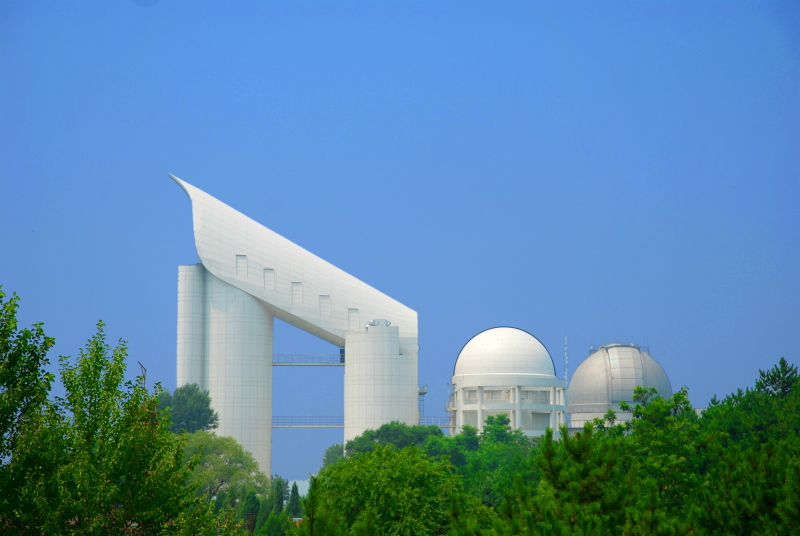
A telescope archive becomes more interesting when another telescope can help search it. On September 14, 2026, the Chinese Academy of Sciences announced the worldwide release of LAMOST DR12 version 2.0: 28.07 million spectra, collected between October 2011 and June 2024.[1] Each spectrum records how an object's light varies across wavelength. The scientific challenge is to turn that accumulating record into comparisons astronomers can trust.
SpecCLIP addresses one part of that challenge. Publicized by China's National Astronomical Observatories on February 24, 2026, the model connects stellar spectra from LAMOST with those from the European Space Agency's Gaia mission.[2] Read alongside the archive release and a separate experiment adapting the model to DESI, it offers a useful signal about scientific AI: progress can mean making existing observations work together.
The same sky arrives in different forms
LAMOST's new public release contains 12.60 million low-resolution spectra and 15.47 million medium-resolution spectra.[1] Those are counts of spectra, not necessarily distinct stars. They also describe an archive's contents, not SpecCLIP's training set.
Gaia supplies a different view. Its DR3 release includes low-resolution spectra from the blue and red photometers, commonly called BP/RP or XP. ESA describes these as averages over the observations collected for each source, available for roughly 220 million objects across the sky.[3] Even the word “spectrum” therefore conceals choices about instruments and how observations are combined.
The National Astronomical Observatories identifies the practical obstacle: surveys differ in wavelength coverage, resolution, and observing methods. A common representation could help scientists estimate stellar properties and search for unusual objects across those differences.[2] In everyday terms, astronomers need a way to compare records that describe the same kind of physical object but do not arrive on the same measuring scale.
Teach the comparison, preserve the detail
SpecCLIP first learns representations of the two spectral types separately. It then uses 820,568 paired LAMOST and Gaia spectra for contrastive alignment: representations of matched observations are encouraged to resemble one another, while mismatched pairs are separated.[4]
Agreement alone has a cost. Features that matter to one instrument can be lost when a model concentrates on what both share. SpecCLIP therefore adds decoders that reconstruct the input spectra, alongside decoders that predict one spectral type from the other. These extra tasks encourage the representation to retain information beyond the common pattern.[4]
The result supports a concrete workflow. The public repository demonstrates loading a LAMOST spectrum, building a searchable database of representations, retrieving similar Gaia spectra, and predicting the corresponding Gaia-style spectrum.[5] A researcher can begin with an observed example and ask the archive for candidates resembling it.
Imagine a scholar assembling a comparison sample around an unusual star. A ranked list could narrow the next round of inspection. The researcher would still need to examine the observations, establish what makes each candidate interesting, and decide whether further measurements are justified. That is an inference about how retrieval could help research, rather than a claim that this particular search has discovered a new stellar population.
The predicted spectrum needs its own label. It is a model output, whereas a retrieved spectrum comes from an observation in the searched collection.[5] Treating both as interchangeable would erase the distinction the research workflow most needs to preserve: what the telescope measured and what the model expects.
A third telescope exposes the harder test
A separate July 2025 study explored adapting SpecCLIP to DESI Early Data Release spectra using low-rank adaptation, or LoRA. This technique trains small weight updates while keeping the original model weights fixed. The experiment estimated stellar iron abundance against APOGEE reference measurements, with 89 labeled stars for training, nine for validation, and 396 for testing.[6]
Its overall results improved with some adaptations, but the 60 test stars in the metal-poor subset told a less encouraging story. Every tested method struggled there, and the LoRA variants increased scatter relative to the strongest unadapted baseline. The experiment used filtered DESI data and resampled spectra onto the LAMOST wavelength grid; it does not establish automatic transfer to arbitrary telescope data.[6]
That unevenness matters to the proposed science. The Chinese institutional announcement highlights searches for extremely metal-poor stars as a promising application.[2] Yet a model can improve on the dominant population while becoming less useful in the sparse region a specialist cares about. My reading is that the next convincing result would measure the success of the rare-object search itself: how many candidates survive follow-up, and which kinds of stars are missed.
What an archive model has to earn
The original SpecCLIP paper illustrates retrieval on a test collection of 82,057 spectra, excluding the query itself. It also acknowledges that spurious correlations may influence parameter estimates and that interpretability needs further testing.[4] These are useful boundaries around the demonstration.
There is a practical release boundary too. As checked on September 23, the repository offers pretrained models and worked retrieval and spectral-prediction examples, while its parameter-prediction tutorial remains marked as forthcoming.[5] Readers can distinguish a published research capability from the particular workflow currently documented for reuse.
Taken together, the developments suggest a demanding but productive direction. Larger public archives supply observations; shared representations make new comparisons possible; transfer experiments reveal where those comparisons break down. A useful measure of success would be the scientific work completed after retrieval: a better comparison sample, a confirmed unusual star, or a reproducible estimate with an honest uncertainty.
The attraction of SpecCLIP is that one observatory's accumulated work can help another archive yield better questions. Its next achievement will be earned in the answers astronomers can verify.
Sources
- Chinese Academy of Sciences, “LAMOST DR12 dataset released worldwide,” September 14, 2026; version 2.0, observation period, and low- and medium-resolution spectrum counts.
- National Astronomical Observatories, Chinese Academy of Sciences, “Research team releases SpecCLIP to support Galactic archaeology,” February 24, 2026; first-hand Chinese account of cross-survey analysis and proposed scientific applications.
- European Space Agency, “What colour do they have? Gaia's blue and red photometer data in DR3”; scope and averaging of the released BP/RP spectra.
- Xiaosheng Zhao et al., “SpecCLIP: Aligning and Translating Spectroscopic Measurements for Stars,” arXiv version 4, December 19, 2025, accepted for The Astrophysical Journal; alignment data, reconstruction, retrieval setup, and interpretability discussion.
- Xiaosheng Zhao and collaborators, SpecCLIP official repository; pretrained models, retrieval and spectral-prediction examples, and tutorial status, accessed September 23, 2026.
- Xiaosheng Zhao et al., “Finetuning Stellar Spectra Foundation Models with LoRA,” July 28, 2025; DESI adaptation experiment, sample selection, labeled split, and metal-poor subset results.
- Paul Hilscher (Sheliak), “LAMOST telescope org.jpg,” July 2008, Wikimedia Commons; original 800 × 536 photograph, attribution, and CC BY-SA 3.0 license.