A table-tennis robot has to find the ball while moving to meet it. Put the cameras on the robot and the view moves too: a turn of the torso changes where the table appears, just as the incoming ball demands a precisely timed stroke. The machine has to keep track of its own movement to make sense of what it sees.
That is the useful question behind SMASH, a humanoid table-tennis system from the University of Hong Kong and Kinetix AI. Its project materials describe outdoor rallies using cameras carried on the robot, without external cameras or motion-capture equipment during deployment.[2] The achievement makes the surroundings part of the story. How much preparation does a place need before an intelligent machine can work there?
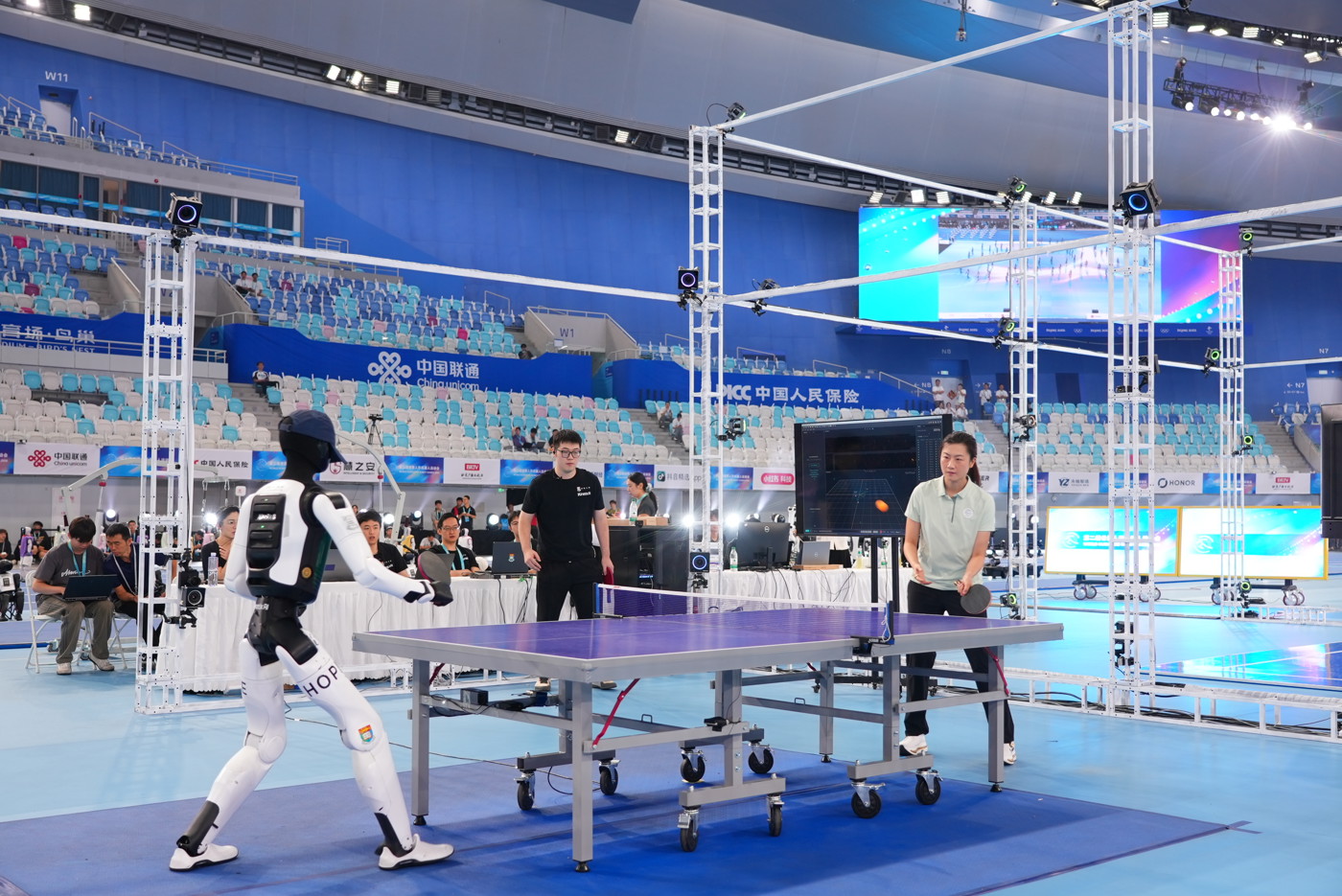
A rally leaves the laboratory
SMASH gained a public milestone at the second World Humanoid Robot Games in Beijing. HKU's September 2, 2026 account says the team reached the August 25 final and won silver in the autonomous table-tennis event. The university also describes a demonstration with Olympic champion Ding Ning and reports the team's claim of exchanges exceeding 100 consecutive shots with human players.[1]
Those are different kinds of evidence. A medal records a result within a competition. A sustained rally demonstrates repeated perception and movement. Neither, by itself, tells us how reliably a robot will play at an unfamiliar table. The interesting engineering question survives the applause.
There was already a strong rally baseline. The HITTER preprint, first submitted in August 2025 and revised that September, reported up to 106 consecutive shots with a human. It combined a planner that selected the striking position, velocity, and timing with a learned controller coordinating the robot's movements. Human motion references helped shape the strokes.[4] Long exchanges therefore predate SMASH; the newer project's emphasis on carrying its own perception deserves separate attention.
The table still provides a reference
The April 1, 2026 SMASH preprint specifies two onboard cameras: a head-mounted ZED X tracks the ball at 60 Hz, while a downward-tilted ZED X Mini supports localization at 120 Hz. Seven AprilTags at known positions on the table anchor that localization. Calibration is still required.[3]
AprilTags are printable visual markers whose software estimates their identity, position, and orientation relative to a camera. Their purpose is to give a machine a measurable reference in the scene.[5] For a moving player, this provides a way to relate a changing camera view to a fixed playing surface.
That arrangement makes portability a matter of degree. Moving cameras onto a robot can reduce the equipment that must surround it, while a marked table preserves a dependable reference. The appropriate follow-up question is how much setup, calibration, and maintenance the remaining aids require. A robot can become easier to relocate before it becomes ready for an entirely unprepared environment.
Learning the stroke around the target
Seeing the ball solves only part of the task. SMASH's project description explains that recorded human movements are expanded with a motion-generation model to build a larger library of strikes. During learning, motion references are matched to the desired hitting target, helping the controller coordinate the whole body while placing the racket.[2]
The distinction is practical. Copying a graceful swing is useful only if the racket arrives where the ball will be. A library organized around reachable strike targets gives imitation a task to satisfy. In my reading, SMASH's appeal lies in this coupling: human movement supplies useful structure, and the contact target determines which movement is relevant.
The project presents smashes, low crouching shots, and outdoor play as parts of its repertoire.[2] Each illustrates a question a deployment team should ask separately: which skill was tested, with which sensing arrangement, and under what conditions?
Contact is one result; a return is another
Table V of the April preprint gives a particularly useful comparison on real hardware. With motion-capture perception, the robot contacted 20 of 20 balls and returned 18. With onboard cameras, it contacted 19 of 20 and returned 12. These small experimental samples describe that setup, not a universal success rate.[3]
Touching the ball can coexist with an unsuccessful stroke. Counting contact alone would miss a failure the person across the table immediately understands.
The April paper also places its most dynamic hardware demonstrations under motion-capture perception and describes a separate policy for smashes.[3] Those details prevent the project's capabilities from being casually bundled into a claim that every movement works equally well with every sensor configuration. The later medal report does not provide a comparable experimental table.[1]
My next test would keep the controller fixed, move the marked table between locations, and record setup time, attempted returns, successful returns, and recovery after losing sight of the ball. That would make portability measurable without requiring a new match-winning headline.
For China's embodied-AI research, SMASH offers a concrete way to discuss progress: count the successful interactions, then account for the equipment that made them possible. The camera has moved onto the player. The table remains a useful part of its intelligence.
Sources
- The University of Hong Kong, “HKU SMASH Table Tennis Team Takes Silver in World Humanoid Robot Games,” September 2, 2026; Chinese-language institutional account and event photographs.
- HKU MMLab and Kinetix AI, SMASH project page; onboard-perception deployment, motion-generation approach, and demonstrated movement repertoire, accessed October 22, 2026.
- Junli Ren and colleagues, SMASH preprint, v1, April 1, 2026; sections V–VI and Table V.
- Zhi Su and colleagues, “HITTER: A HumanoId Table TEnnis Robot via Hierarchical Planning and Learning,” arXiv:2508.21043v2, September 4, 2025; prior rally demonstration and planning/control approach.
- University of Michigan APRIL Robotics Laboratory, “AprilTag”; official description of printable visual markers and camera-relative localization.