A silkworm pupa can arrive beneath a camera with the features needed for a decision facing away. In a sorting prototype described by Southwest University researchers in February 2024, the equipment turns the pupa before deciding where it belongs. Feeding, photography and physical separation form one continuous job.[1]
The destination is a breeding operation. Correctly separating males and females helps breeders arrange the intended crosses; the work also has to fit inside the pupal stage. A Southwest University study published in November 2023 identifies seasonal demand, limited time and labor costs as pressures on manual sorting.[3] This is a small, demanding application of Chinese AI research: inspect a living object, reach a useful decision and deliver it intact.
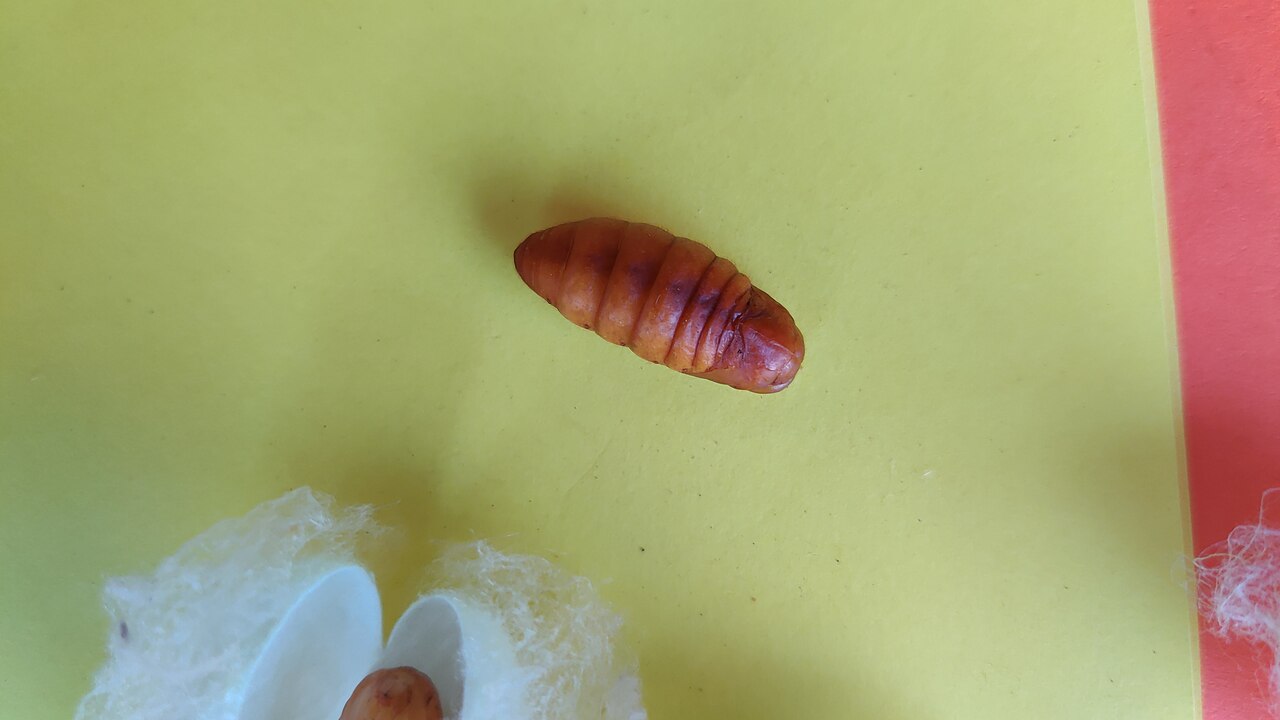
Turning the insect into a readable subject
The associated device patent makes the handling sequence unusually tangible. Two parallel cylindrical rods turn in the same direction, rolling the pupa between them while the camera records its changing orientation. After classification, a receiving mechanism moves the appropriate bucket into position and a soft brush pushes the pupa toward it. Sensors coordinate the movements and reset the apparatus for the next arrival.[2]
The camera seeks external features near the underside of the tail. The patent describes a line in the female's abdominal region and small paired protrusions in the male's. These are particular anatomical clues, so merely detecting a pupa somewhere in the frame would leave the decisive work undone.[2]
The engineering implication is that the machine partly creates its own evidence. A roller, a light and a camera position determine what the model can inspect. Handling belongs inside any account of the system's intelligence: a correctly timed photograph can make an otherwise difficult classification much easier.
The 2024 study therefore adjusted mechanical settings while holding the recognition method and computer hardware constant. Its verification used 1,250 pupae and averaged three repeated trials under the optimized prototype conditions, reporting 5.03 seconds per pupa, 96.47% sorting accuracy and 0.09% breakage.[1] Those measures describe different obligations. A breeder needs the right animal in the right container, at a workable pace, without the equipment damaging it.
Learning which photograph deserves a decision
There is more than one way to deal with an awkward pose. The 2023 study tried learning from the whole animal across several views. Its dataset contained 3,600 photographs of five breeding lines, with back, abdominal and side views taken using a tripod-mounted camera. Skilled workers supplied the sex labels. The learning problem was built around recognizing variation across those photographed poses.[3]
That approach and the rotating sorter place effort in different parts of the process. One asks a model to cope with varied observations; the other helps the camera obtain a useful observation. Their practical balance depends on how consistently the machinery can present each pupa.
A February 2026 paper by researchers at Xihua University, Southwest University and China's National Engineering Research Center for Information Technology in Agriculture made photograph selection a distinct task. Their SPNet-GS model chooses the frontal view that exposes the relevant tail region. Its reported 98.41% accuracy concerns selecting one correct view per pupa, tested on 6,544 online images from 16 additional varieties, with eight images per animal.[4]
The same paper separately trains ResNet50 classifiers and reports sex-identification accuracy of 84.68% using the selected whole frontal image and 94.58% using the gonad-region image, compared with 74.68% using mixed-pose images.[4] The tighter view helped the downstream decision. These are comparisons within the authors' experimental setup, rather than a ranking against the earlier prototype's physical sorting result.
The distinction changes how a reader should interpret progress. Finding the right photograph is an intermediate achievement. It improves the evidence available for the next decision, but it does not automatically establish how many animals will reach the correct bucket.
A useful view can still be imperfect
A March 2026 study from East China Jiaotong University, Ji'an Vocational and Technical College and Southwest University examined the remaining difficulty: pupae can tilt or curl, leaving the characteristic region only partly visible. Its Fast-SCNN-mp model uses semantic segmentation, assigning labels to image regions so it can focus on the anatomical evidence.[5]
The study used 875 laboratory images from five varieties across four roll-angle bands. Its conclusion also names an unresolved case: pupae lying with their backs upward and the relevant underside features completely hidden. Those views remained outside the work's coverage.[5] Learning to interpret a partial view still leaves a reason to turn the animal when the evidence disappears altogether.
The practical attraction is tolerance. If modest presentation errors can be handled reliably, the machine may need fewer corrective movements. That is an engineering implication to test on an operating sorter: the paper's image results alone cannot tell us how much handling time would disappear.
What the next trial should follow
Taken together, these studies suggest a useful way to evaluate the application: follow individual pupae all the way through. Record which animals need another turn, which images leave the model uncertain, which sorting decisions are wrong and whether handling causes damage. Keep those records connected to the same animals.
Such a trial would reveal whether a model improvement saves work or simply moves it elsewhere. Faster image processing helps only when the feeder, camera and receiving mechanism can use the saved time. Greater tolerance of tilted views matters most if it reduces retries while preserving sorting quality. Neither conclusion follows from a recognition percentage by itself.
The promise here is concrete. A breeding worker's repeated act of turning and inspecting an insect becomes a task shared by mechanics, optics and learned recognition. The most revealing unit of progress is the pupa that completes that journey: correctly identified, gently handled and ready for the next stage of breeding.
Sources
- Guanglin Li and colleagues, “Design and optimization of the online gonad images acquisition and automatic gender classification device for silkworm pupae,” Transactions of the Chinese Society of Agricultural Engineering 40(4), February 2024 — Chinese firsthand report of the prototype, mechanical optimization and sorting outcomes.
- Southwest University, “Silkworm chrysalis image intelligent identification and automatic sorting device,” patent CN220716797U, 2024 — rollers, camera, sensing and receiving mechanisms.
- Haibo He and colleagues, “Integrated Analysis of Machine Learning and Deep Learning in Silkworm Pupae (Bombyx mori) Species and Sex Identification,” Animals 13(23), November 22, 2023 — breeding context and controlled photography of five breeding lines.
- Feng Guo and colleagues, “Model for the online frontal image selection of silkworm pupae using machine vision,” International Journal of Agricultural and Biological Engineering 19(1), February 2026 — SPNet-GS image selection and separate downstream classification experiment.
- Dan Tao and colleagues, “Online real-time gender identification method for silkworm chrysalises based on Fast-SCNN-mp model,” Transactions of the Chinese Society of Agricultural Engineering 42(5), March 2026 — Chinese firsthand study of partially visible features at different roll angles.
- Krishna satya 333, “Pupa of silkworm,” March 9, 2020, Wikimedia Commons — original photograph and attribution, CC BY-SA 4.0.