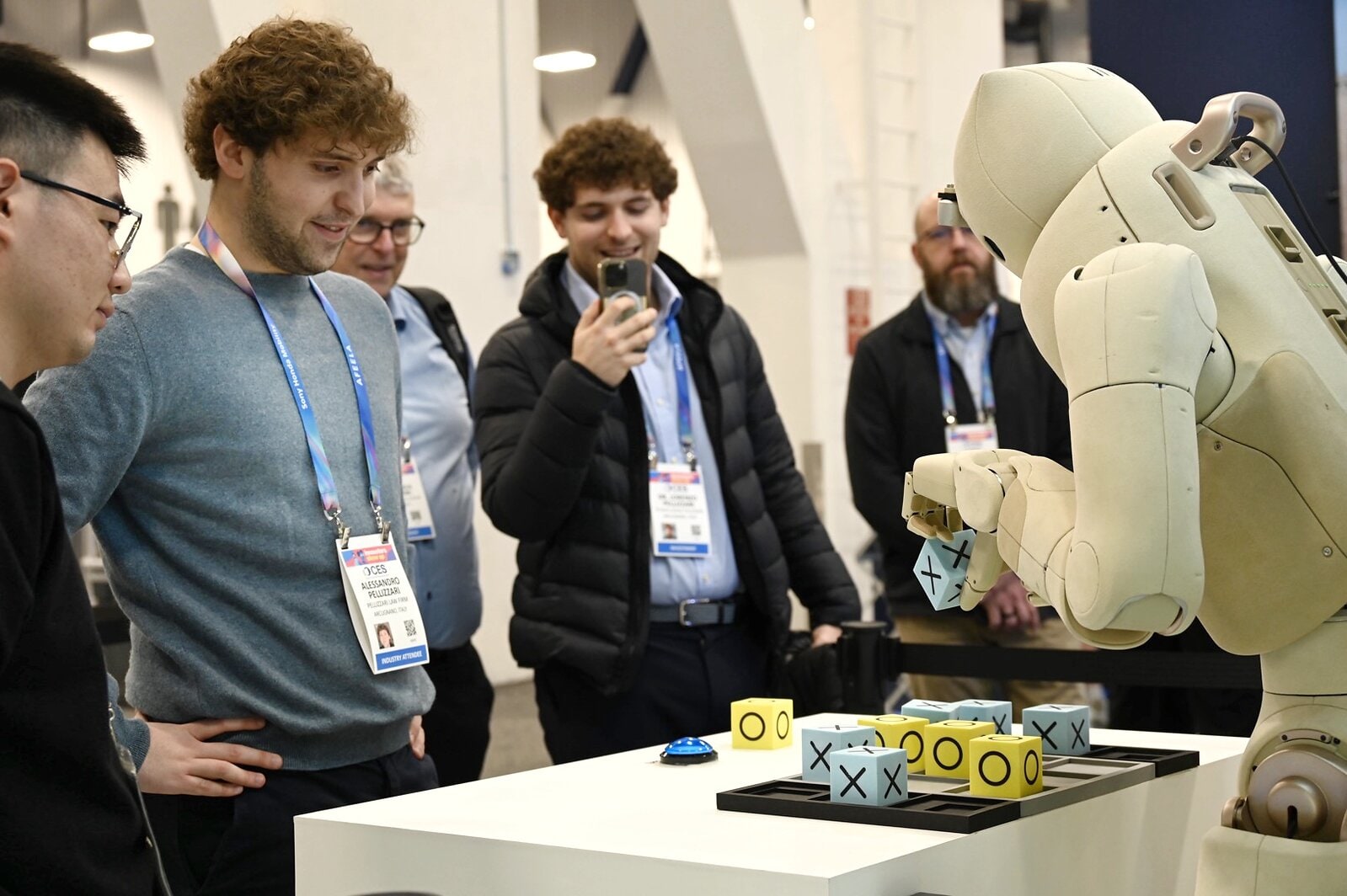
At CES in January 2026, visitors gathered around Fourier's GR-3 humanoid and a tabletop game. A company photograph shows people watching the robot handle blocks marked with crosses and circles. The company's account also describes conversations, touch-based interactions and scheduled dances: a collection of ways to make a large moving machine feel approachable.[1] The interesting question begins when someone reaches toward it. What should the robot sense, and what should it do next?
For Fourier, that question has a history. The Shanghai company began in rehabilitation robotics, and founder Gu Jie describes shared engineering foundations with its later humanoids.[2] Its newer machines make that continuity visible: in the GR-2 release, touch helps handle objects; with GR-3, it also becomes a way to address a person.
The inheritance beneath the new body
In a May 8, 2025 interview with 21st Century Business Herald, Gu said Fourier initially chose rehabilitation because it lacked the resources for a full humanoid. Founded in 2015, it could develop a narrower application deeply. By 2019, maturing products and advances in electric actuators encouraged it to begin the humanoid project.[2]
Gu's most useful comparison is anatomical. An exoskeleton, he observed, resembles a humanoid's lower body; technical modules can be reused even when the finished products serve different needs. He also identified experience working with people and understanding care settings as part of the company's accumulated knowledge. This is the founder's explanation of the strategy, rather than an independent measurement of its advantage.[2]
A university collaboration gives that account a tangible engineering counterpart. CANopen Robot Controller, or CORC, is an open C++ software project initiated at the University of Melbourne in partnership with Fourier. It began with the ExoMotus X2 exoskeleton and includes examples for several ArmMotus rehabilitation devices. Its architecture separates common robot-control functions, hardware-specific drivers and application behavior.[3]
That separation makes reuse concrete: changing the machine need not mean rebuilding every layer beneath an application. The repository also says its demonstrations are starting points for development and that the software alone does not establish safe operation.[3] CORC documents a collaborative approach to reusable controls; it does not establish that GR-3 runs this software. The broader connection is a habit of engineering different bodies around shared foundations.
Touch moves beyond the fingertips
Fourier's September 30, 2024 GR-2 release emphasized a platform that other developers could teach and extend. The company described revised joints, concealed power and communication wiring, a development kit and support for simulation environments. It also advertised 12-degree-of-freedom hands equipped with tactile sensor arrays.[4]
The purpose of touch in that account was principally manipulation: sensing contact and adjusting a grip. Teaching methods included VR remote control, physically guiding movements and direct commands, with recorded data extending from motion paths to tactile responses.[4] This was a proposal for learning physical tasks through a body that could supply more than images. A camera might show where an object is; contact adds information about what happens when the hand reaches it.
The August 6, 2025 GR-3 announcement shifted the emphasis toward the person standing nearby. Fourier described cushioned surfaces and an animated face, with hearing, vision and touch feeding an attention-management system. The release specified 31 distributed pressure sensors and two response paths: rapid rule-based actions and language-model-based dialogue.[5]
The design distinction is useful. A brief response to contact and a context-sensitive conversation have different demands. Fourier's architecture assigns them different mechanisms. That helps explain how a robot might acknowledge a touch while sustaining an interaction, although the announcement does not measure how reliably it resolves ambiguous intent.[5] The manufacturer's language about emotional understanding should therefore be read as a capability claim awaiting appropriate evaluation.
Softness still has a specification
The GR-3 support page, updated September 22, 2026, supplies a useful counterweight to the friendly presentation. It lists a robot weighing approximately 71 kilograms, with a single-arm payload of about 3 kilograms. Its advertised total of up to 55 actuators depends on the optional 12-degree-of-freedom hands; the base hands have fewer independently controlled movements. Tactile sensors are listed on the head and torso.[6]
These details change how to read the design. Soft coverings affect the surface someone meets, while mass, motion and control remain consequential. A stated arm payload describes one mechanical capability; it does not establish that the machine can support a person's balance. Likewise, an expressive face can make a response easier to interpret without demonstrating that the robot correctly understood a vulnerable user's request.
This is where Fourier's rehabilitation background becomes an interesting asset to investigate. Familiarity with bodily interaction could help define useful tasks and expose awkward assumptions. Its value would become clearer through evidence about a specific task, the assistance required from staff and the machine's behavior when the interaction goes wrong.
What the care ambition still has to show
Fourier's own GR-3 launch text draws a consequential distinction. It presents social companionship as an intended role, while placing mobility support, health monitoring and physical rehabilitation among future assistive-care applications.[5] Those are different promises, requiring different demonstrations.
The January 2026 CES account makes the public-facing side easy to picture: games, conversation, touch and movement. It gives readers a record of what Fourier chose to exhibit, but no comparison of staff workload, sustained use in a care setting or patient outcomes.[1] A successful booth interaction cannot supply those missing measurements.
For this company, the next persuasive step would be a clearly described activity in a real setting: who uses the robot, what it completes, when a person intervenes and how performance holds up over repeated sessions. Rehabilitation gave Fourier a starting point for building machines around human bodies. GR-3 extends that interest to the signals people exchange around those bodies. Whether that becomes useful care will depend on the work the robot can reliably share with the person beside it.
Sources
- Fourier, “Fourier Makes CES Debut With GR-3, a Next-Generation Care-Focused Humanoid Robot,” January 7, 2026. Company announcement and source of the CES tabletop-game photograph.
- Deng Hao, interview with Fourier founder Gu Jie, 21st Century Business Herald / Southern Finance, May 8, 2025. Chinese-language first-hand account of the move from rehabilitation to humanoids.
- University of Melbourne Human Robotics Lab, CANOpenRobotController repository README. Collaboration history, supported rehabilitation devices, software architecture and development limitations; accessed November 11, 2026.
- Fourier, “Fourier Unveils the Next-Generation Humanoid Robot GR-2,” September 30, 2024. Manufacturer's account of hardware, tactile hands and developer tools.
- Fourier, “Meet GR-3: Beyond Function, Designed to Care,” August 6, 2025. Launch description of sensory interaction, response architecture and future assistive-care ambitions.
- Fourier, “Robot Overview,” GR-3 support documentation, updated September 22, 2026. Mechanical specifications, hand options and sensor placement; accessed November 11, 2026.