A shared observing night begins with a practical problem: which telescope should look where? An intriguing target is only the beginning. Someone must fit it into a night of other observations, arrange the equipment, recover the images and decide whether the result deserves another look. Each handoff creates work, even when individual instruments already know how to move and expose a camera.
At China's National Astronomical Observatories, StarWhisper brings that coordination problem into an AI research program. The project joins the observatory's Galactic Three-Dimensional Structure Group with Xinglong Observatory, combining scientific priorities, weather and instrument information in an observing assistant.[1] Following the collaboration reveals a laboratory whose experimental apparatus includes the people and procedures between telescopes.
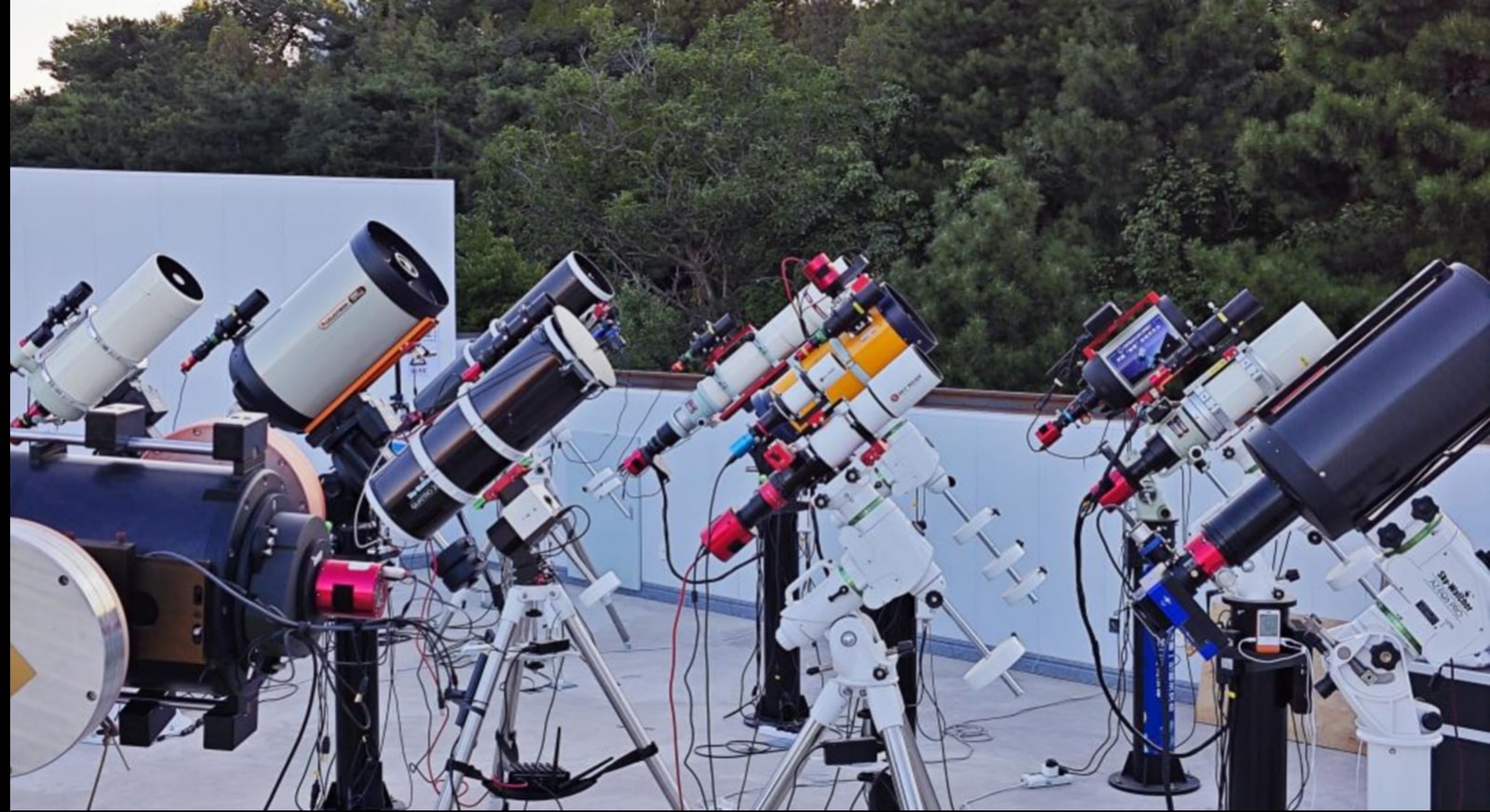
A research group with a distributed instrument
The University of Chinese Academy of Sciences' November 27, 2025 account describes a network spanning Hebei, Xinjiang, Gansu and Yunnan. Small and amateur telescopes contribute to the Nearby Galaxy Supernovae Survey, or NGSS. Its software must account for location, weather, moonlight and target visibility while coordinating observations. The university also describes natural-language interaction as a way for amateur observers to participate in the research.[2]
This makes participation an engineering question. Adding a telescope creates potential collecting capacity, but somebody must make its observations useful to the rest of the group. A common scientific purpose needs a common way to describe targets, request exposures and interpret what comes back. An accessible interface matters most when it reduces that coordination burden without hiding the particulars of the instrument.
Xinglong brings a much older observing tradition to the partnership. Its domestically developed 2.16-metre telescope entered service in 1989; the observatory's equipment account describes both imaging and spectroscopic capabilities.[5] The StarWhisper paper identifies that telescope as a destination for follow-up spectroscopy, with those observations still performed manually because the instrument was outside the system's direct connection.[3]
That division of work gives the project its character. A small telescope's promising detection can become a request for a different kind of measurement on a larger instrument. The research organization has to carry the question between them. Making the first request easier is valuable even when the receiving astronomer retains responsibility for the next observation.
The planning gain and the unfinished handoff
The paper's October 2025 revision reports a planning comparison at Xinglong: roughly 1–1.5 hours per telescope for a PhD student's manual work, versus under a minute for the system. Galaxy-coverage counts refer to the combined ten-telescope array. This is a particular planning comparison, not a measurement of time saved across an entire observatory.[3]
The same paper reports about 70.5% successful tool calls in a two-day interaction test. Loading an observation plan performed much worse than generating or querying one; the authors attribute failures mainly to network-related timeouts. Programs that would start or stop observations were disabled during this test.[3]
Read together, those results locate two different kinds of progress. Producing a schedule quickly can remove substantial preparation work. Delivering it reliably requires the surrounding services to cooperate. A fluent answer in the control interface cannot settle whether the receiving program obtained the right file.
For the laboratory, that is a productive distinction. It suggests where another experiment belongs: trace a request from the planning service to the receiving instrument, record the failed handoffs, and measure the recovery work. Such a test would connect the attractive planning result to the workload of a real observing shift.
Learning before spending a clear night
By September 18, 2026, the Chinese Academy of Sciences reported a simulated telescope environment for testing plans and control strategies. It models equipment states, sensor information and environmental changes. The same account says StarWhisper had been connected to the Sitian Pathfinder and prototype, with execution results and expert feedback informing later plans.[1]
Simulation gives the collaboration somewhere to rehearse. Its value depends on which difficulties it preserves: a model of pointing geometry answers different questions from a model that also reproduces delayed responses or changing equipment status. Success in either environment should be described in terms of what was actually tested.
The September report also credits the system with alerts for eight very early supernova candidates from public survey data, with two receiving follow-up observations when weather allowed.[1] These are reported candidates and follow-ups. They do not establish eight confirmed discoveries, or a general success rate: the account does not provide a denominator of all objects screened.
That small weather qualification belongs in the story. The point of an observing assistant is to improve the use of an opportunity. It cannot supply a clear sky, and an unobserved candidate does not by itself reveal whether the planning decision was poor.
What can travel beyond Xinglong
The public NGSS documentation makes the portability problem unusually concrete. In the repository version checked on November 10, 2026, readers can inspect the supplied configuration locally. Running the full service requires additional calculation code, station tables, catalogues, communication settings and a prepared image-processing environment. The documentation explicitly identifies an omitted visibility-calculation module and deployment-specific paths.[4]
This is useful disclosure. Public code can reveal the structure of a scientific workflow while still depending on knowledge and infrastructure held at the originating station. For another observatory, those missing pieces define the work of adaptation. Installing software is only one part of joining the experiment.
The documents leave a consistent picture of StarWhisper's contribution: the team is making an observing program easier to coordinate, while learning which parts can be shared. The next revealing evidence would follow a new telescope joining that program—how its configuration is established, which failures require local help, and whether its observations reliably reach the astronomers who need them. A shared night becomes more valuable when the collaboration can absorb another instrument without adding an equal amount of coordination work.
Sources
- Chinese Academy of Sciences, “NAOC Tests AI Agents for Telescope Observation,” September 18, 2026 — collaboration, simulation environment and reported candidate follow-ups.
- University of Chinese Academy of Sciences, StarWhisper observing-system announcement, November 27, 2025 — Chinese firsthand account of the network and participation; photograph source.
- Cunshi Wang and colleagues, “StarWhisper Telescope: An AI framework for automating end-to-end astronomical observations,” revision 3, October 19, 2025 — sections 3.4 and 4.
- StarWhisper team, NGSS project documentation, repository commit ac08bad03f26, accessed November 10, 2026 — Chinese deployment notes and reproducibility requirements.
- National Astronomical Observatories, “2.16-metre Telescope,” July 12, 2017 — instrument history and observational capabilities.