
As of 2026-04-07 UTC, the useful way to watch ShanghaiEye's 2-minute, 23-second clip on SenseNova V6 is to stop hearing it as one more generic claim that China now has a stronger multimodal model.[1] The report does repeat the expected launch language: advanced reasoning, stronger interaction, long-term memory, and a large new model line from SenseTime.[1][2] But the video's actual staging is more revealing than the slogans. It keeps moving between a humanoid robot, a handheld phone, a paper document, and an on-camera spokesperson. That sequence turns the launch into a deployment story. My inference from the clip and the surrounding written material is that SenseTime is trying to sell one multimodal core that can circulate across devices and interaction surfaces, not just a lab win.[1][2][3][4]
That distinction matters in ai-china because a lot of launch coverage still treats model progress as a leaderboard event. This clip does something narrower and more commercial. It shows V6 less as a single chatbot and more as an operating layer for mixed-input environments: cameras, microphones, screens, handheld assistants, and robot bodies.[1] The April 18 Shanghai government summary, drawing on China Daily's reporting, makes that reading more concrete by stressing multimodal long chain-of-thought, global memory, reinforcement-learning-backed reasoning, and SenseNova V6 Omni as a full-modal interaction model that can analyze 10-minute videos.[2]
Later SenseTime materials make the same logic easier to see in retrospect. The company's NEO architecture post says SenseNova 6.0 marked a shift from older "data fusion" toward native architecture, with support for intelligent-terminal multimodal response, video understanding, robotic embodied interaction, and end-to-end integration across modalities.[3] The Wu Neng embodied-intelligence announcement then extends the same thesis into robots and smart devices, explicitly tying SenseTime's world-model and foundation-model layers to real-world interaction, long-term memory, and multimodal response.[4] By the time SenseTime published its March 25, 2026 results, the company was already framing the next foundational release around second-generation NEO efficiency and large-scale deployment, backed by 40,400 PetaFLOPS of SenseCore operating scale.[5] Read together, these sources make the video's real message look less like "here is our newest model" and more like "here is the interface fabric we want to ship everywhere."[2][3][4][5]
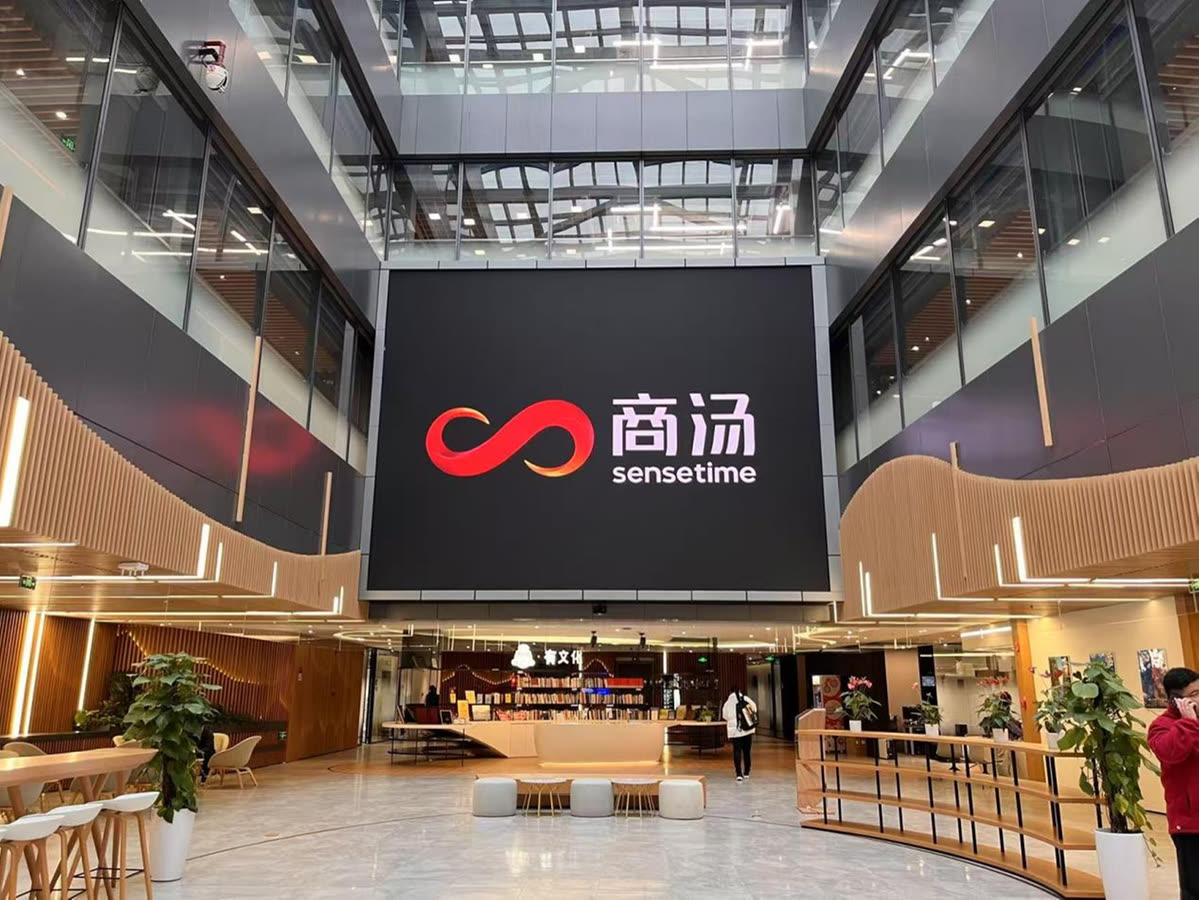
Image context: the cover uses a real photograph of a SenseTime advertisement on an office tower in Shanghai's Xuhui district, published with China Daily coverage via the Shanghai municipal site. That is the right visual here because the video is ultimately about public deployment surface: how a model family moves from corporate launch stage into city-scale visibility, mobile devices, and embodied hardware.[2]
Around 0:00 to 0:20, the opening slide and the robot say the point is coverage across surfaces
The first frames do not open on a benchmark table. They open on launch graphics for V6 / V6 Reasoner and then cut immediately to a humanoid robot on the floor.[1] That is a strong editorial signal. SenseTime wants the viewer to connect reasoning and memory claims to a visible endpoint, not leave them floating as abstract model attributes. The video description itself pushes the same frame by saying the multimodal fusion model lets humanoid robots not only "see" and "hear" but also "think," with environmental recognition and real-time decisions.[1]
The Shanghai government summary supports that reading with more technical language: long CoT, global memory, reinforcement learning, and the claim that V6 has pushed past prior multimodal boundaries.[2] Later SenseTime writing makes the same move from research term to surface deployment more explicit. The NEO architecture note says the point of native integration is not just cleaner model design, but support for video understanding, intelligent terminals, 3D interaction, and robotic embodied interaction inside one architecture.[3] So even in the opening seconds, the clip is already telling viewers that the product story is broader than a chat window.
Around 0:20 to 0:55, the phone demo shifts the pitch from frontier branding to handheld workflow
The next important scene is the handheld demo, where a phone is asked to describe the environment and even compose a poem on the spot.[1] That moment matters less because of the poetry itself than because of the form of the interaction. The camera, the microphone, and the screen are all in play at once. SenseTime is using the phone to show that V6 is supposed to live inside a mixed-input consumer or prosumer workflow where seeing, hearing, speaking, and recalling context happen in the same loop.
That aligns neatly with the written launch framing. The April 18 summary says the newly launched SenseNova V6 natively integrates image, text, and video processing, while V6 Omni is positioned as a lightweight full-modal interaction model.[2] My inference is that this is the real commercial center of gravity. SenseTime is not only asking buyers to believe that the model is smart. It is asking them to believe the model can stay coherent while moving across modalities and devices without feeling like several stitched systems.
Around 0:55 to 1:20, the paper-and-phone sequence is really a memory and tutoring demo
The most revealing middle section is the jump from the robot to a paper document and then back to a phone-style assistant response.[1] The clip frames the system almost like a human tutor, correcting or explaining based on what it can inspect in front of the camera. That is a more useful demo than it first appears to be. It turns "memory" from a vague capability word into an interface promise: the system should retain context long enough to guide, compare, and answer within a concrete task, not just emit a one-shot response.
This is where the later Wu Neng announcement becomes helpful as supporting context. SenseTime describes that embodied platform as giving robots and intelligent devices advanced perception, visual navigation, multimodal interaction, and long-term memory for more natural real-world communication.[4] I am inferring from that later source, not quoting the launch video itself, but the direction lines up cleanly. The V6 clip is already selling the same behavioral contract in miniature: remember the visual scene, stay inside the task, and answer in a form that feels directly usable on a device.
Around 1:20 to the end, the spokesperson and the subsidy announcement make the commercialization logic explicit
The closing interview shots are where the launch message becomes fully legible.[1] The spokesperson highlights real-time interaction ability, extended video memory, and the model's capacity to process video, image, and text inputs together.[1] The description and coverage also mention the RMB 100 million "Fuyao Plan" meant to accelerate adoption across industries.[1][2] Those two elements belong together. SenseTime is not closing on one heroic benchmark boast. It is closing on the question every model company eventually faces: how do you turn a multimodal stack into repeatable industry uptake?
The broader company material fills in why this matters. The NEO architecture post argues that native multimodal integration improves cost-performance and creates a better foundation for intelligent terminals and embodied systems.[3] The March 2026 results add the supply-side half of the picture: a second-generation NEO model coming in Q2 2026, explicit agentic-AI deployment language, and a large SenseCore compute base already in operation.[5] Put plainly, the video is a front-end narrative for a back-end ambition. SenseTime wants V6 to be seen as the model family that can move through robots, phones, service workflows, and eventually broader agentic deployment without breaking the interaction loop.
That is why this short clip is worth embedding. Its surface message is that SenseNova V6 is stronger at reasoning, interaction, and memory.[1][2] Its deeper message is that SenseTime does not want to compete only at the level of one AI assistant. It wants to compete at the level of deployment continuity: one multimodal core, many interfaces, and a path from launch-stage spectacle to physical, mobile, and enterprise surfaces.[2][3][4][5]
Sources
- ShanghaiEye魔都眼, "SenseTime launches latest AI multimodal large model 'SenseNova' in Shanghai," official YouTube news video, published April 11, 2025.
- Shanghai Municipal People's Government / China Daily, "SenseTime unveils large model SenseNova V6" (April 18, 2025; multimodal long CoT, global memory, reinforcement learning, V6 Omni, and 10-minute video analysis).
- SenseTime, "Evolving From 'Data Fusion' to 'Native Architecture', SenseTime Releases NEO Architecture Redefining the Efficiency Boundaries of Multimodal Models" (December 1, 2025; native multimodal integration, robotic embodied interaction, intelligent terminals, and video understanding).
- SenseTime, "SenseTime Unveils 'Wu Neng' Embodied Intelligence Platform, Enabling AI to Evolve Through Real-World Interaction" (July 29, 2025; KaiWu world model, robots and devices, long-term memory, and multimodal interaction).
- SenseTime, "SenseTime Group Reports Record High Revenue of Over RMB 5 billion in 2025; Second Half EBITDA Turns Positive" (March 25, 2026; second-generation NEO architecture, agentic-AI deployment framing, and 40,400 PetaFLOPS of SenseCore operating scale).