As of 2026-04-07 UTC, the useful way to read Huawei's AI-China position is no longer to ask only whether the latest Pangu release is stronger than the last one. The more durable signal sits lower in the stack. On 2025-04-24, Huawei Cloud said CloudMatrix 384 changed resource supply from server-level to matrix-level and had already gone live at scale in its Wuhu data center.[1] On 2025-06-20, Huawei then described its new AI Cloud Service as being built on CloudMatrix 384 supernodes, with 384 proprietary NPUs, 192 Kunpeng CPUs, and up to 2,300 tokens per second of single-card inference throughput.[2] Read together with Huawei's own product pages for Pangu and ModelArts Studio, my inference is that Huawei is trying to sell a shaped compute fabric first and a model catalog second.[1][2][4]
That distinction matters because AI-China competition is now constrained by more than raw model quality. It is constrained by packaging: how compute is grouped, what kinds of models can sit on top of it, and whether that whole stack can move from central cloud into local enterprise environments without losing its form. Huawei's public material increasingly answers those questions at the topology level, not only at the checkpoint level.[1][2][3][4]
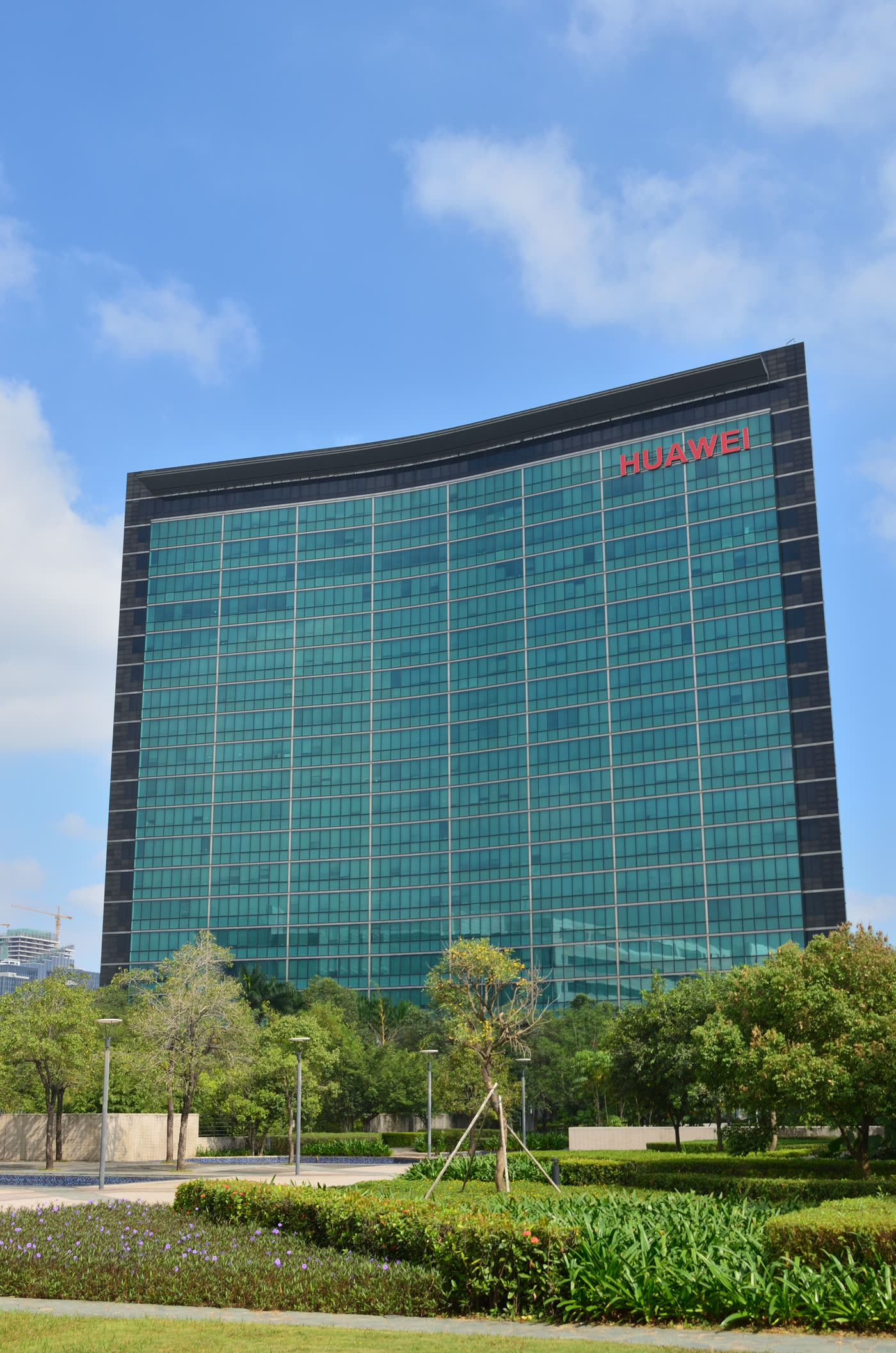
Image context: the cover uses a real Wikimedia Commons photograph of a Huawei office building in Shenzhen. That is the right visual here because the article is about Huawei's company-level attempt to turn AI infrastructure architecture into a stable commercial boundary, not about an abstract rendering of chips or model weights.[5]
CloudMatrix 384 is being framed as a different unit of supply
The April 24 Huawei Cloud announcement is revealing because it does not pitch CloudMatrix 384 as just a bigger rack.[1] It says the new supernode changes resource supply from server-level to matrix-level, and it ties that shift to a new high-speed interconnect philosophy built around pooling, peer equality, and composability.[1] Huawei also stresses three attributes together: high density, high speed, and high efficiency.[1]
That language is more strategic than it first appears. Vendors usually market accelerators in per-chip or per-server terms because those are easy comparison units. Huawei is trying to move the comparison boundary upward. If the product is a matrix rather than a box, then the thing the customer is asked to evaluate is not merely the silicon inside one board. It is the pre-arranged relationship among many boards, the interconnect, the memory movement, and the scheduling logic implied by that shape.[1]
In a supply-constrained environment, that is a meaningful move. A cluster topology that arrives as a cloud product can absorb a lot of upstream heterogeneity before the customer ever sees it. The April launch note makes this intent clearer by pairing the hardware announcement with Ascend AI cloud service optimization and saying the service had already adapted to 160+ third-party models, including DeepSeek.[1] In other words, Huawei is not asking users to buy one closed model lane. It is asking them to buy into a managed resource fabric that can carry many model lanes.
AI Cloud Service turns the topology into something customers can actually consume
The 2025-06-20 Huawei Cloud release matters because it converts that architectural claim into a service claim.[2] Huawei says the new-generation AI Cloud Service is built on CloudMatrix 384 supernodes and describes the supernode as the industry's first peer-to-peer interconnection of 384 proprietary NPUs and 192 Kunpeng CPUs through MatrixLink.[2] The company then attaches a practical serving metric to the architecture: 2,300 tokens per second of single-card inference throughput, roughly 4x non-supernode configurations.[2]
That is the point where topology stops being internal engineering theater and becomes a customer-facing product boundary. Huawei is no longer saying only that it has a novel cluster design. It is saying that the cluster design is the substrate for a public cloud service intended to support advanced model applications.[2] The article also says the architecture can better support MoE inference, including a one-expert-per-card pattern and concurrent inference across 384 experts.[2] Whether those numbers prove broad superiority is a separate question. What they do prove is the shape of Huawei's public pitch: cluster architecture is being packaged as the service itself.
This is why the CloudMatrix story sits naturally inside ai-china rather than in a pure semiconductor article. The commercial object is not only hardware. It is a hosted way of consuming that hardware.
Pangu matters, but Huawei keeps placing models on top of the same fabric
Huawei's Pangu Large Models page helps explain why the company keeps describing the stack this way.[4] Pangu is presented as a ToB model family with a three-layer structure: L0 foundation models, L1 industry-tailored models, and L2 scenario-specific models.[4] That is already a deployment grammar rather than a consumer-chat grammar. Huawei is telling buyers that the real work happens as a model is translated downward into industry and scenario layers.
The same page then makes a second point that is even more revealing for supply-chain analysis. ModelArts Studio is described as a unified portal through which enterprises can access inference services for Pangu models and third-party models, and the page explicitly says the platform is adapted to DeepSeek R1/V3.[4] That means Huawei's own public story is not "our cluster exists so you must use only our model." The story is closer to: the cluster, the portal, and the deployment workflow are the durable layer; model families can sit above them.
That combination changes how Huawei should be compared with other AI-China players. If the company were competing only on one flagship frontier model, its position would rise and fall with each model cycle. If it is competing on a managed fabric that can host Pangu and outside families together, then its stronger moat sits in packaging and operational control.[1][2][4]
The hybrid-cloud extension is what makes this more than a central-cloud play
The 2025-06-21 Huawei Cloud Stack article is the downstream proof point.[3] Huawei says CloudMatrix 384 will be adapted into Huawei Cloud Stack in the second half of the year so government and enterprise customers can have their own local "supernode in the cloud" on premises.[3] The same article frames Cloud Stack around the full workflow of building, moving to, using, and managing cloud resources, and it groups users into data-center engineers, data engineers, AI algorithm/model application engineers, and application developers.[3]
This is where the product-boundary thesis becomes stronger. A topology is one thing when it only exists inside Huawei's own centralized cloud. It becomes more durable when the company says the same supernode form will extend into hybrid and local enterprise environments.[3] That widens the commercial boundary from "rent our AI service" to "standardize your local AI platform around our shaped cluster and toolchain."
For AI-China watchers, that extension matters because many Chinese enterprise and public-sector buyers still care about locality, control, and system integration as much as they care about leaderboard movement. Huawei's public stack is speaking directly to that demand.[3][4]
What changed, in practical terms
The shift is therefore not just that Huawei launched another Pangu version. The sharper change is that Huawei keeps repeating the same stack order:
- first, define a larger compute unit in CloudMatrix 384 rather than in a single server;[1][2]
- then expose that unit as AI Cloud Service with concrete inference claims and MoE-serving logic;[2]
- then place Pangu and third-party models on top through the same enterprise-facing portal and industry grammar;[1][4]
- then push that same shaped unit into hybrid cloud so local customers can keep the topology and not just rent the endpoint.[3]
That sequencing is why I think Huawei's stronger move is packaging cluster topology into a product boundary. The company is trying to ensure that the customer buys a prepared environment for AI work, not just a model name or a batch of accelerators.
Sources
- Huawei Cloud, "华为云发布CloudMatrix 384超节点 多项性能全面突破" (April 24, 2025; CloudMatrix 384 launch, server-level to matrix-level resource supply, Wuhu rollout, and 160+ third-party model adaptation including DeepSeek).
- Huawei Cloud, "Huawei Cloud Announces Pangu Models 5.5 and All-new AI Cloud Service, Positioned as the AI Pioneer in Industries" (June 20, 2025; AI Cloud Service built on CloudMatrix 384, 384 proprietary NPUs, 192 Kunpeng CPUs, and 2,300 tokens/s throughput claim).
- Huawei Cloud, "持续深耕,华为云Stack做智能时代更懂政企的云" (June 21, 2025; CloudMatrix 384 adaptation into Huawei Cloud Stack hybrid cloud and local supernode framing for enterprise customers).
- Huawei Cloud, "Pangu Large Models" product page (ToB three-layer L0/L1/L2 architecture and ModelArts Studio as a unified portal for Pangu and third-party models including DeepSeek R1/V3).
- Wikimedia Commons, "File:HuaweiShenzhen.jpg" (source page for the cover photograph used in this article).