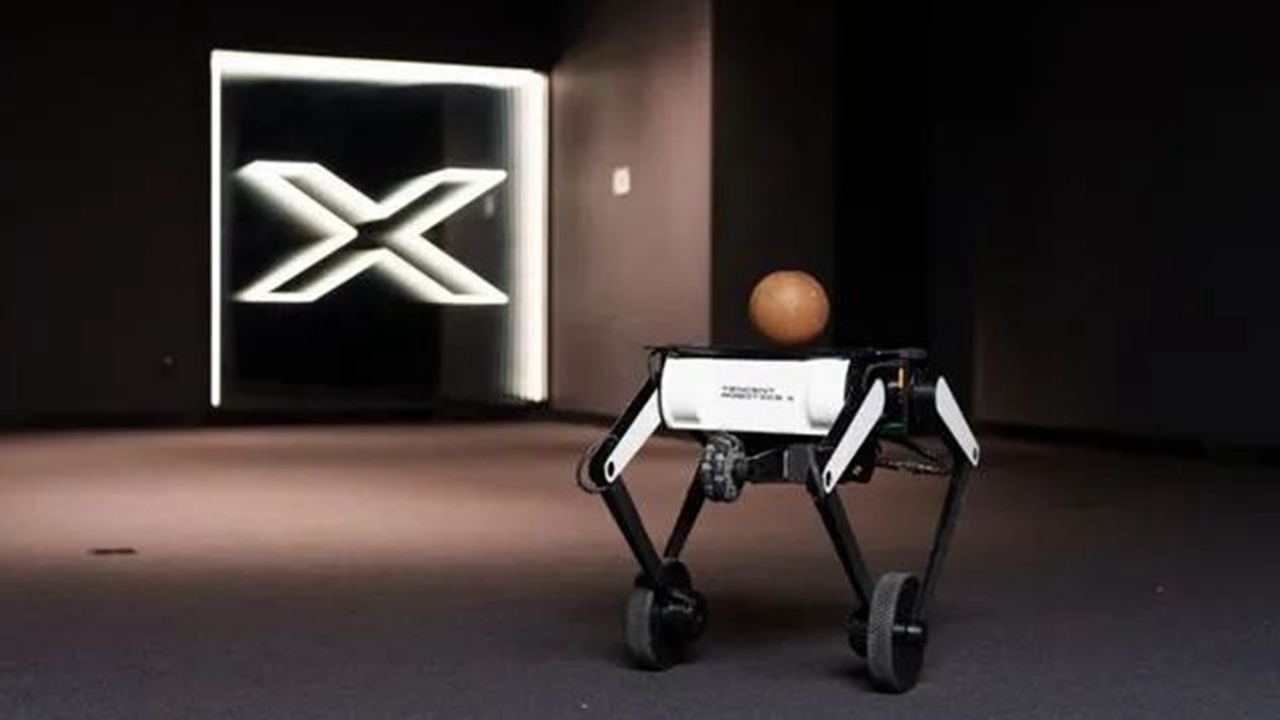
A water bottle lies sideways on Ollie, a wheel-legged robot. When the machine drifts, the bottle rolls. In a study published on January 12, 2023, Tencent's Robotics X researchers combined touch sensing and balance control to keep both in place.[1]
That bottle offers a useful way into the laboratory's larger ambition. Robotics X has spent years making intelligence answer to a physical body. With Tairos, the platform it introduced in July 2025, the lab began offering parts of that accumulated capability to other robot makers.[3] The interesting question is what travels between machines—and what each new body still has to learn.
A balance problem becomes a contact problem
Ollie's earlier controller could keep the robot upright while allowing it to wander. The 2023 study used data gathered during operation to adapt the controller to its working conditions. Experiments varied the robot's height, added an off-center load and placed it on a slope. A tactile sensor supplied information about the bottle's position, while another controller adjusted the robot's upper surface.[1]
The result depended on cooperation between those components: a steadier base gave the bottle controller a workable starting point. The authors also set clear limits. Their experiments addressed changed conditions rather than continuously varying disturbances, and operated within a range where the robot's dynamics could be approximated by a linear model.[1]
This is a small but revealing definition of useful AI. Learning improves a particular part of an engineered system; the task succeeds when sensing, mechanics and control agree about what happens next.
The room adds another set of demands
Tencent's September 2024 introduction of The Five gathered several research strands into a robot intended for human living environments. Its predecessor list included the quadruped Jamoca, Ollie, the multimodal robot Max and the TRX-Hand dexterous hand. The new prototype combined four extendable legs with wheels, tactile skin and manipulation capabilities.[2]
The design made the floor part of the problem. Wheels offered efficient travel on level ground; the legs helped accommodate obstacles and changes in height. Tencent described mapping and localization, online movement planning, and whole-body control working together. Its demonstration included fetching parcels and assisting an older person, but the release explicitly called the machine a prototype facing more complicated real environments.[2]
That distinction changes how to read the images. A successful sequence shows that researchers have connected capabilities. Routine assistance would require evidence about repetition, intervention and recovery when the sequence goes wrong. A laboratory can demonstrate the first without having established the second.
Why a laboratory builds a platform
Robotics X was founded in 2018. In a July 2025 interview, director Zhengyou Zhang described an early period when the team had to develop hardware, software and planning itself because suitable suppliers were scarce. By the second half of 2023, he said, the growing population of robot companies had changed the opportunity.[3]
His proposed role for Tencent was to supply reusable capabilities. Manufacturers could select perception or planning modules according to what they lacked. Zhang said the lab would work closely with a few cooperative partners, improve and standardize the products, then broaden their use; he did not present mass production of robot bodies as its intended business.[3]
Read against the prototypes, that strategy has a practical logic. Building a whole machine exposes dependencies that a software-only demonstration can leave hidden. A platform then asks which of those hard-won solutions can become useful interfaces for somebody else's machine.
Sharing a model still takes adaptation
The Tairos report, produced by Robotics X and Shenzhen's Futian Laboratory, combines perception, planning and perception-action modules, also usable separately. Its manipulation work builds on the π0 architecture with training for particular applications.[4]
One example is unusually concrete. On a Dobot X-Trainer with two arms, wrist cameras and an overhead camera, the task was to grasp a cosmetic bottle and insert it vertically into a close-fitting container. The researchers collected 1,000 demonstration trajectories for post-training and reported over 80% success, with initial bottle and container positions randomized.[4]
That result belongs to a specified robot, task and training procedure. It does not establish the same performance on arbitrary hands, objects or camera arrangements. The report describes the visual gap between human-operated data collection and a robot's view, including differences in arm appearance and movement.[4]
What travels next
As accessed on October 25, 2026, the Chinese Tairos site presents a broader software offering: Hy-Embodied models, agent frameworks, a hardware abstraction layer and RoboFusion communication technology. It also describes a robot-guide collaboration with Unitree in pilot operation at the Dunhuang Mogao Grottoes Digital Exhibition Center.[5]
Those are different kinds of evidence. The software inventory makes the proposed division of work visible; the pilot identifies a setting where integration can be observed. Neither, by itself, supplies an independent account of operating reliability.
My reading of this lab's trajectory is that its most consequential work lies in making research transferable without pretending bodies are interchangeable. The next persuasive evidence would follow tasks across installations: how much new training each robot needs, how often a person intervenes, and whether a software update preserves reliable behavior. The rolling bottle remains a useful test of the ambition. However capable the planner becomes, something still has to keep the object from falling.
Sources
- Jingfan Zhang and colleagues, “Adaptive optimal output regulation for wheel-legged robot Ollie: A data-driven approach,” Frontiers in Neurorobotics (January 12, 2023) — experiments, tactile feedback and stated limitations.
- Tencent, “Meet our new robot, The Five” (Chinese original, reproduced by Xiaoteng News on Tencent Cloud Developer Community, September 25, 2024) — prototype lineage, mechanisms and demonstration context.
- Feng Liange, Time Finance, interview with Zhengyou Zhang following Tencent's July 27, 2025 WAIC forum (Chinese original, syndicated on Tencent Cloud, July 30, 2025) — first-hand account of the laboratory's origins and platform strategy.
- Tencent Robotics X Team and Futian Laboratory, Shenzhen, “TAIROS: An Embodied AI Platform for Robotics Applications,” technical report, especially Sections 5.1 and 6 (official PDF accessed October 25, 2026) — architecture, adaptation and the Dobot manipulation experiment.
- Tairos, official Chinese platform website (accessed October 25, 2026) — software offerings, hardware interfaces and the stated Dunhuang pilot.
- Tencent photograph of Ollie, published with Zhang Yu, “Tencent's robot Ollie has tactile sensing abilities,” Shenzhen Daily / EyeShenzhen (September 14, 2022) — original photographic context and Tencent credit.