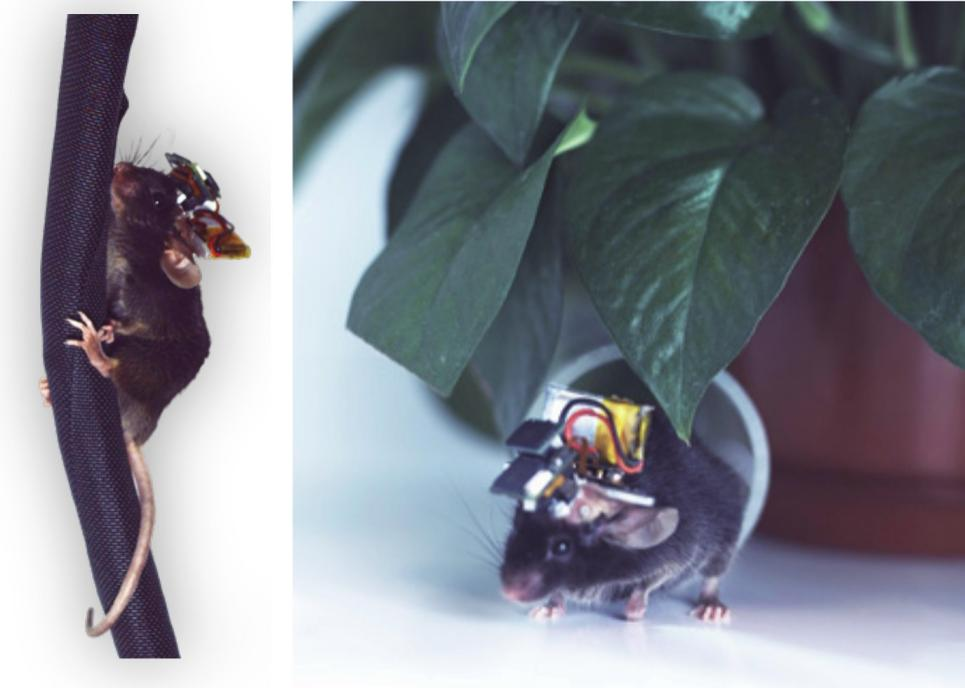
A mouse climbs a rope; another view shows one squeezing through a transparent tube. In photographs released by Tsinghua University, the conspicuous object is the small instrument riding on the animal's head. There is no trailing microscope cable. These scenes introduce Airscope, a wireless mesoscope developed by a Tsinghua-led collaboration with the Chinese PLA General Hospital. The university presented the work on October 20, 2026, a day after its publication in Nature.[1][2]
The instrument enlarges the experiment's room for movement. Its companion software faces a different task: keeping track of which mouse is doing what. For research that joins neural activity to social encounters, an identity carried correctly through a crowded video can matter as much as a sharp image inside the skull.
Making space for the animal
The earlier instrument in this research line, SOMM, already offered an unusually broad view for a head-mounted microscope. Its June 2024 paper described a device weighing less than 2.5 grams, resolving individual neurons across a 3.6-by-3.6-millimetre field. It was used during exploration, social interaction and fear-conditioning experiments. The engineering problem was how to retain useful optical performance while reducing weight and tolerating movement; miniaturization alone would not solve it.[3]
Tsinghua's account identifies the remaining tether as a constraint on that earlier system. Airscope combines redesigned optics, electronics and wireless transmission, with AI-assisted lens design and compression helping to fit the instrument into a small package.[2] The new paper reports a six-millimetre field of view and recordings from more than 8,500 neurons in an animal.[1]
The advertised one-gram weight needs its qualifier. It describes the microscope body, excluding the battery; the study's supplementary table lists approximately 1.73 grams for the battery alone.[1][2] That distinction matters when judging what the animal actually carries. Wireless operation removes a cable, while the physical burden still belongs in the experimental accounting.
Keeping the right mouse in the record
Airscope's behavioral-analysis tool, SAM2Mice, adapts Meta's SAM 2 video-segmentation model. SAM 2 accepts prompts that identify an object, then uses memory to follow its segmentation across frames. A segmentation mask describes the pixels belonging to that object. This supplies a different representation from a few tracked body landmarks: an outline that changes as the animal turns, stretches or meets another animal.[4]
SAM2Mice applies that foundation to mouse videos. Its documentation describes training on thousands of frames with expert-labeled masks, spanning different group sizes, viewpoints and environments. Users can initialize a recording with manual prompts or let a YOLOv11 detector supply them automatically. For long recordings, overlapping batches pass a mask from the final shared frame into the next batch.[5]
These details explain the practical attraction. A laboratory can accumulate large volumes of neural activity and behavioral video without making a person trace every animal in every frame. Yet a mask is useful only if its identity remains dependable. Imagine two mice crossing at a feeding place: if their labels swap, the resulting record can pair one animal's neural signal with the other's movement. More video would then amplify an association built on the wrong pairing. This is an implication of the workflow, rather than a reported failure in the Airscope experiments.
What the tracking result establishes
The project's documentation reports a multi-object tracking accuracy score, MOTA, of 0.958 for its five-mouse comparison, against 0.703 for DeepLabCut. The paper's supplementary material places that comparison in a 60-centimetre circular open field, using three 333-frame video segments. Those conditions belong alongside the result: this is evidence about tracking in a specified evaluation, with specified comparison systems.[1][5]
It does not measure whether a proposed explanation of social behavior is correct. The tracking software supplies a record on which such explanations depend. A useful scientific reading separates those two achievements: following an animal reliably and understanding why its neural activity changes.
The release also makes an operational distinction easy to miss in the phrase zero-shot. The segmentation model has already learned from mouse data. Transfer to a new scene without further segmentation training is one claim; generating suitable starting prompts automatically is another. The supplied YOLO checkpoint targets overhead open-field footage. For different environments or camera angles, the SAM2Mice README recommends retraining that detector using masks from a representative clip. Manual prompting remains available.[5]
A changed camera position can therefore change the preparation work, even when the underlying segmentation model transfers well. That is useful information for another laboratory trying to reproduce the workflow.
A wider experiment, with an inspectable method
The public Airscope toolbox includes mechanical designs, optical files, electronics, firmware, acquisition software and analysis components.[5] Its significance extends beyond a striking device photograph: other researchers can examine how the physical instrument and the behavioral record fit together.
My reading is that this is the most interesting AI contribution here. A general video model becomes part of a particular scientific measurement, with named animals, frames, prompts and experimental conditions. The rope and tube show the freedom the hardware permits. The software's job is to preserve enough continuity that a researcher can relate that movement to the neural recording—and investigate the relationship without losing track of its subject.
Sources
- Yuanlong Zhang and colleagues, “Cortex-wide imaging in naturally behaving mice with 1-gram wireless mesoscopes,” Nature, October 19, 2026 — accepted early publication; instrument performance. Supplementary Information, especially Figure 13 and Table 4 — tracking comparison and component masses.
- Tsinghua University, BNRist, “Autonomous scientific intelligence research team develops an ultralight mesoscope,” October 20, 2026 — Chinese firsthand account, predecessor's tether, design choices and source of the research photographs.
- Yuanlong Zhang and colleagues, “A miniaturized mesoscope for the large-scale single-neuron-resolved imaging of neuronal activity in freely behaving mice,” Nature Biomedical Engineering, June 20, 2024 — SOMM's optical design, movement constraints and experimental uses.
- Nikhila Ravi and colleagues, “SAM 2: Segment Anything in Images and Videos,” arXiv:2408.00714, first submitted August 2024 — promptable video segmentation and streaming memory.
- Neurallabware, Airscope toolbox — hardware and software release. SAM2Mice documentation — training data, benchmark scores and long-video processing. SAM2Mice README — manual prompts and the camera-setup limits of the YOLO detector; project materials accessed October 24, 2026.