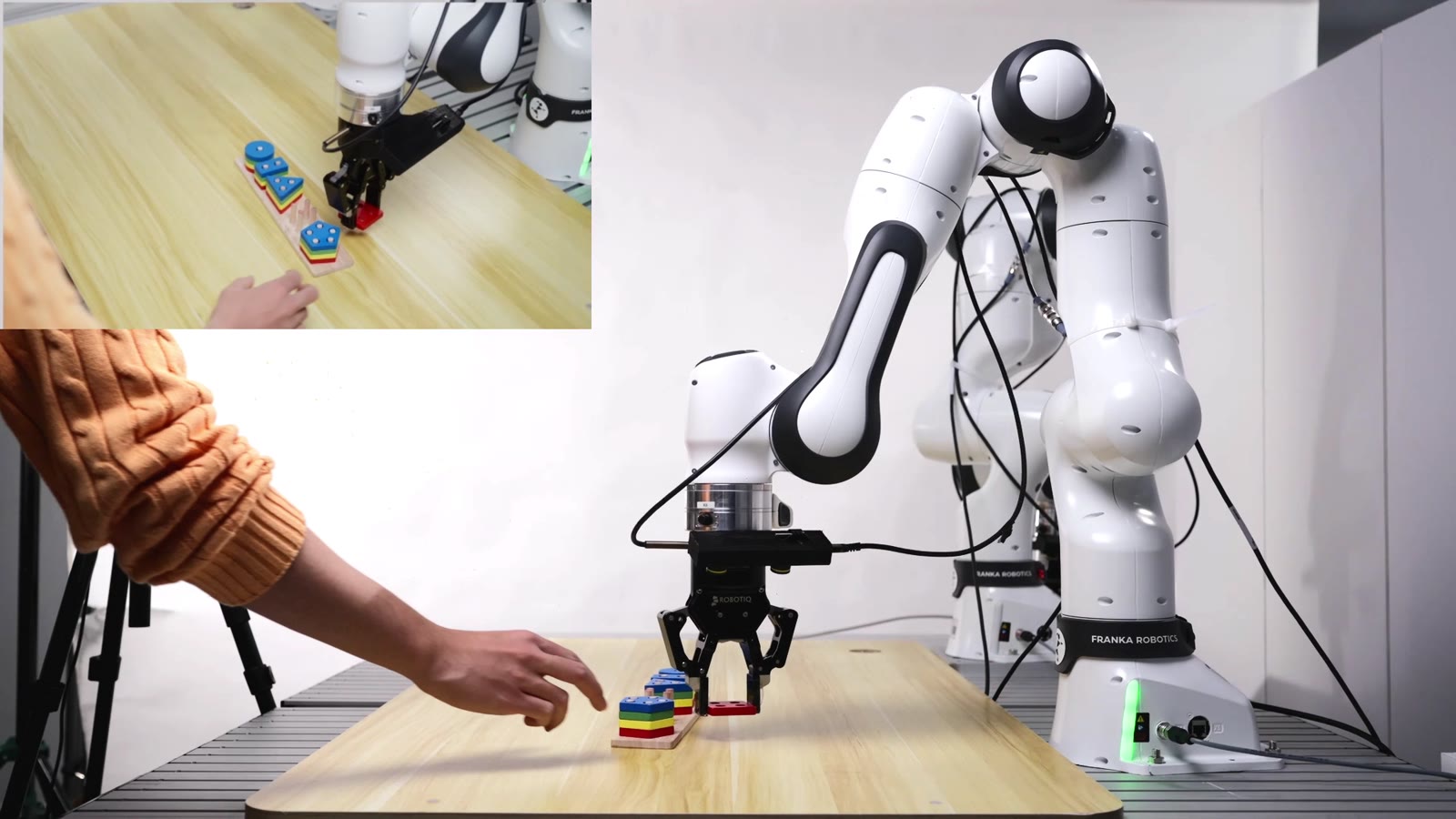
A person moves the board just as a robot is trying to insert a square block. The arm misses its alignment; the estimate of task progress drops. In the demonstration reproduced on RoboBrain 2.5's project page, the trained policy adjusts and eventually completes the insertion. The interesting moment is the setback: the system registers that a movement has left the job further from completion.[6]
Beijing Academy of Artificial Intelligence's RoboBrain 2.5 makes that judgment one of its central additions. This release review follows the 8B checkpoints announced on January 9, 2026, the institute's Chinese explanation on January 27, and the smaller 4B checkpoint announced on March 1. Two changes connect the releases: spatial predictions acquire depth, and observations of an unfolding task acquire an explicit progress estimate.[1][3]
What changed from 2.0
The previous model already had a substantial account of action. Its July 2025 technical report described spatial referring, predictions of where movement would go, feedback during interaction, planning across longer tasks, and updates to a structured representation of the scene. Version 2.5 therefore builds on an existing effort to connect visual reasoning with robot behavior.[2]
The change is in what downstream software can receive. A target marked on a picture becomes a point with an estimated depth. A judgment about the unfolding task becomes a numerical signal that can rise, stall or fall. These outputs make specific parts of the model's reasoning easier to connect to motion planning and learning.[3]
A point needs a distance
BAAI's Chinese release explanation describes each spatial point as three values: its horizontal and vertical image coordinates, plus absolute depth. Known camera parameters then convert that representation into three-dimensional coordinates. The model can supply an ordered sequence of such points, describing a route through an operation rather than only its destination.[3]
Estimated depth lets receiving software check clearances along a route, while an image-plane target alone leaves that distance unspecified.
The public trajectory example exposes the distinction plainly. It returns a list of coordinate-and-depth tuples. That is an intermediate representation for integration with robot software. The example alone does not establish how an unfamiliar arm will translate those points into a safe, accurate movement.[1]
Progress can go backward
The temporal addition draws on Robo-Dopamine, a companion research project that separates estimating progress from learning a control policy. Its reward model compares observations before and after a movement, alongside the task description and reference views of the initial and successful states. It predicts a relative change that can represent advance or regression.[4]
Estimating many small changes creates a problem: errors accumulate. The method therefore combines a local comparison with estimates anchored to the task's beginning and its goal. Each reference supplies a different check on the same developing action. The research also distinguishes the model's estimate from the reward used to train the policy; how that estimate becomes a learning signal affects what behavior the robot is encouraged to repeat.[4]
The board-moving demonstration makes this division visible. The progress estimate registers misalignment; a trained policy carries out the correction.[6] A useful critic and a capable mover contribute different things. Recognizing a setback creates an opportunity to recover, while recovery still requires an action the machine can execute.
Reading the backward-video test
The technical report tests temporal judgment with both forward and reversed videos. Its VOC rank-correlation metric measures how predicted progress agrees with temporal ordering. The evaluation supplies a task instruction, multiple camera views of initial and goal states, and paired before-and-after observations.[5]
On DROID, the authors report forward/reverse scores of 90.82/90.07 for RoboBrain 2.5-8B-NV. Their GPT-5.2 comparison scores 91.45/15.29 under the reported setup. The revealing difference is the reverse direction: a model can appear convincing on ordinary forward sequences yet struggle when those sequences run backward. These are ordering scores, not percentages of physical tasks completed.[5]
The report also acknowledges that unfamiliar states can produce erroneously high progress estimates. It uses disagreement between differently anchored predictions as a reliability signal to restrain uncertain updates. That check is a proxy; it does not establish that every confident estimate is correct.[5]
What the release puts within reach
The repository records two 8B variants trained on different clusters—NVIDIA and Moore Threads—using the same architecture and training data, followed by the 4B release. It also directs users to Robo-Dopamine for detailed temporal-value inference. The release thus offers model choices and a separate route for trying the feedback component.[1]
My reading is that the most useful next experiment would preserve the connection between judgment and outcome. When the progress estimate falls, record what physically went wrong, what correction followed, and whether the task finished. When it rises, check that the object actually moved closer to the intended state. Those paired records would show where the new output saves a failed attempt, and where it merely gives a mistaken movement a reassuring score.
Sources
- BAAI / FlagOpen, “RoboBrain 2.5” official repository — dated checkpoint announcements, trajectory output example and temporal-inference entry point.
- BAAI RoboBrain Team, “RoboBrain 2.0 Technical Report,” July 2025 — the preceding model's spatial, planning and feedback capabilities.
- Beijing Academy of Artificial Intelligence, “Why do robots keep failing in the last centimeter? RoboBrain 2.5 offers an answer,” January 27, 2026 — Chinese first-hand release explanation, spatial representation and capability changes.
- Huajie Tan and colleagues, “Robo-Dopamine: General Process Reward Modeling for High-Precision Robotic Manipulation,” December 2025, version 1 — progress estimation, reference states, fusion and reward shaping.
- BAAI RoboBrain Team, “RoboBrain 2.5: Depth in Sight, Time in Mind,” January 2026, version 1 — sections 2.2 and 6.3, temporal evaluation setup, DROID results and uncertainty handling.
- BAAI RoboBrain Team, official RoboBrain 2.5 project page — Robo-Dopamine physical demonstrations and artificial-disturbance analysis; source page for the reproduced photographic frame.