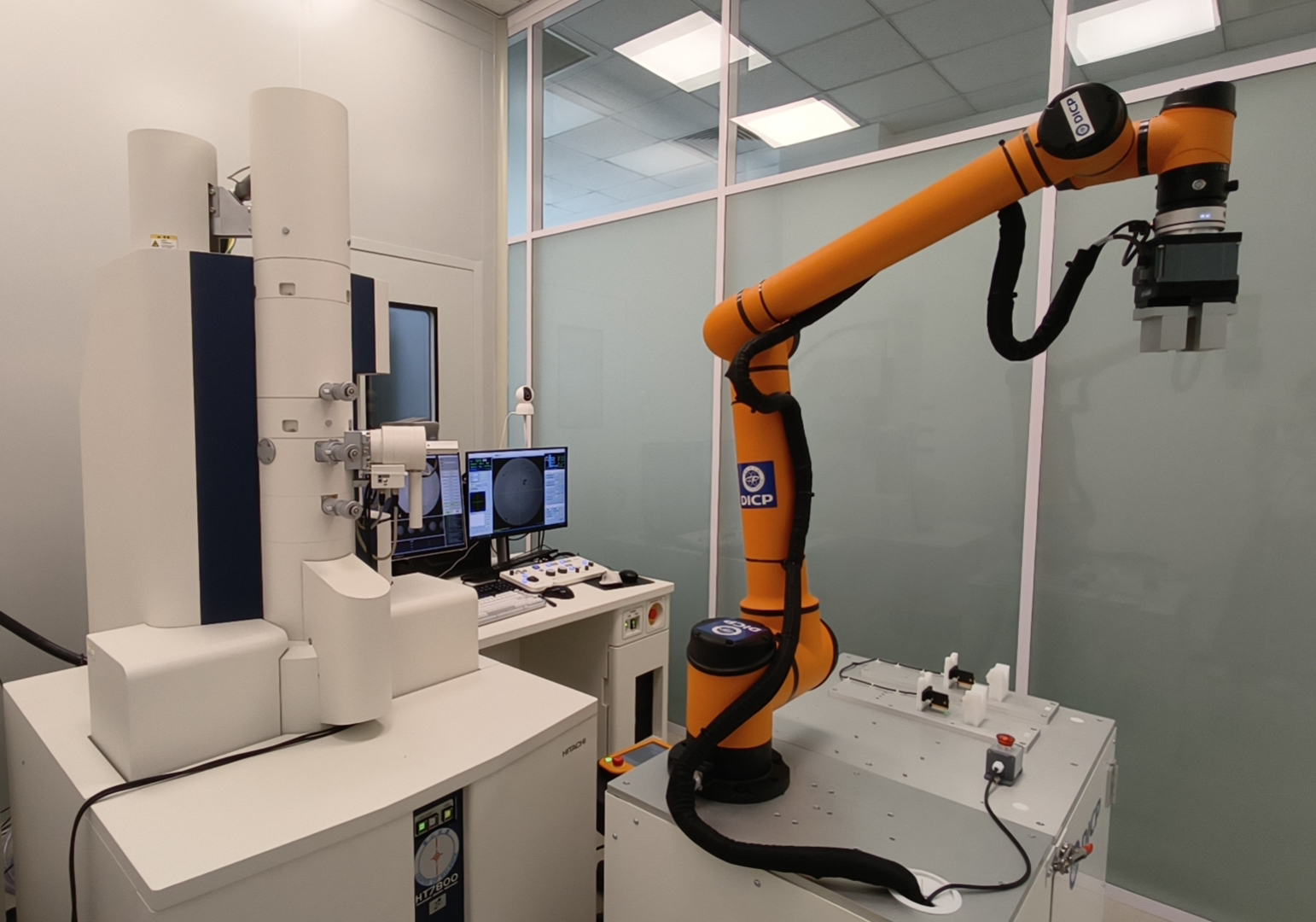
A microscope can produce a remarkable picture and still leave a queue of samples waiting. Moving from one specimen to the next, finding the region worth inspecting and turning the resulting images into measurements are separate jobs. Aeye-1, developed by the Chinese Academy of Sciences' Dalian Institute of Chemical Physics with the Shenyang Institute of Automation, connects those jobs across sample transfer, imaging and analysis.[2]
The useful question is what that connection buys a working laboratory. The public evidence centers on catalyst samples and a sustained operating trial in April 2026, followed by a formal evaluation on May 24. It offers a concrete view of Chinese AI entering the instrument itself, with results that deserve to be read at the scale of the experiment.[1]
The work between pictures
Shenyang's machine-intelligence team describes a particularly revealing part of its contribution: selecting regions of interest at multiple levels, locating samples precisely, and separating particle shapes for analysis. Its software also coordinates several devices and handles rapid image acquisition and processing.[2]
These functions explain why an image classifier alone would leave much of the workflow unfinished. A system must decide where to look before it can classify what it sees. It must relate a chosen region to a physical position, acquire a usable image, and make the result available to the next operation. Faster analysis would have limited value if the instrument were still waiting for someone to complete every preceding step.
The reported integration includes sample transfer under high vacuum and autonomous adjustment of electron optics.[2] Those are instrument operations with physical consequences. The intelligence here is distributed across perception, positioning and coordination, each tied to a stage of the physical measurement.
There is also a scientific choice inside the apparently practical task of selecting a region. A consistently chosen field of view can make repeated measurements easier to compare. A consistently biased choice can make a large collection misleading. My reading is that automated selection increases the importance of recording how the instrument chose its observations.
What the long run establishes
DICP reports a 72-hour assessment, April 17–20, organized by the China Petroleum and Chemical Industry Federation. For microstructural analysis of catalysts including molecular sieves, the reported daily averages were 168 samples and more than 4,000 images. The system generated reports describing particle dimensions, dispersion and crystal configuration.[1]
Those figures make the achievement tangible: the claim concerns a continuing sequence of samples and outputs. They do not, by themselves, tell a laboratory how many of its own specimens would produce acceptable measurements. Sample preparation, selection criteria, failed acquisitions and agreement with expert measurements would all matter in a transfer to another setting.
The public numbers also have different contexts. A June 5 notice for Wei Liu's forthcoming Xiamen University lecture describes 200 samples and 5,000 images in a day. It presents these as capabilities in nanocatalyst imaging, without identifying them as the averages from the April assessment.[3] The two descriptions should remain attached to their respective contexts. Combining them into a single throughput claim would conceal the distinction between a reported trial average and a separately stated daily capability.
A useful follow-up would publish the number of samples attempted alongside the number successfully analyzed, with the rules for accepting a result. That would reveal whether automation saves researchers time across the whole queue, including its awkward specimens.
Autonomous microscopy already had a history
Aeye-1's announcement uses a sweeping first-of-its-kind description. Earlier research helps place the achievement more precisely.
In a 2022 Advanced Science paper, Kevin Roccapriore, Sergei Kalinin and Maxim Ziatdinov demonstrated autonomous experiments on a scanning transmission electron microscope. Their system combined structural images with measurements of electron energy loss. As measurements arrived, a learning algorithm updated its account of the specimen and selected where to measure next.[4]
The experiment also exposed a crucial role for the scientist. Changing the numerical criterion used to evaluate a spectrum changed the algorithm's route through the sample and the features it pursued. The researchers set the scientific objective; the system adapted its measurements within that objective.[4]
That earlier work establishes that AI-directed electron microscopy predates Aeye-1. The narrower contribution emphasized by the Dalian and Shenyang reports is the connection of sample handling, instrument adjustment, image acquisition and quantitative reporting into an unattended workflow.[2] Those are different achievements within a developing field, and distinguishing them makes the new machine easier to assess.
A larger collection, with a reason to trust it
For a catalyst researcher, the attraction is a shift from collecting a few persuasive pictures toward making repeated measurements across a substantial set of samples. The most valuable output would be a collection whose selection rules and measurement errors are understood well enough to support a scientific comparison.
Aeye-1's reported trial makes that possibility concrete. Its next persuasive demonstration would show how the system handles samples it cannot confidently locate, image or analyze. A microscope that keeps working becomes more useful when its record also explains where the work stopped—and why.
Sources
- Dalian Institute of Chemical Physics, “Aeye-1 intelligent transmission electron microscope system passes scientific and technological evaluation,” May 25, 2026 — Chinese first-hand account of the April operating trial, May evaluation, workflow and photographs.
- Shenyang Institute of Automation, Machine Intelligence Group, “The group's AI and image-recognition technology supports the development of Aeye-1,” May 2026 — Chinese first-hand account of device coordination, region selection, positioning and particle analysis.
- Xiamen University, College of Chemistry and Chemical Engineering, lecture announcement for Wei Liu, “Transmission electron microscopy methods for dynamic imaging of chemical reactions,” June 5, 2026 — the researcher's description of daily nanocatalyst-imaging capability.
- Kevin M. Roccapriore, Sergei V. Kalinin and Maxim Ziatdinov, “Physics Discovery in Nanoplasmonic Systems via Autonomous Experiments in Scanning Transmission Electron Microscopy,” Advanced Science, November 7, 2022 — an earlier physical demonstration of learning-guided measurement selection.