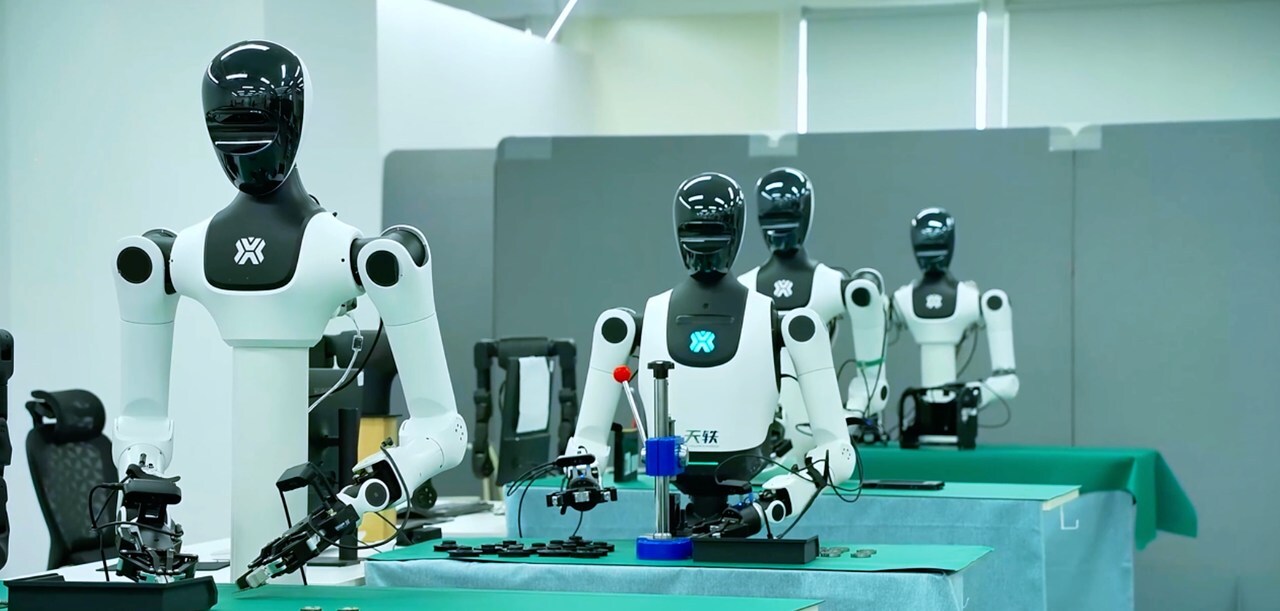
Four humanoids stand at four laboratory benches. One grips a small component above a fixture; another waits behind a circuit board. The scene looks like a lesson in dexterity, but the harder problem begins after the motion: which parts of that practice should the next robot imitate?
Human demonstrations are not clean answer keys. They contain hesitation, awkward corrections, efficient recoveries, and failed attempts. Online robot rollouts add another mixture of useful exploration and repeated mistakes. A policy trained to copy every recorded action equally can become better at reproducing the dataset without becoming better at finishing the job.
Robo-ValueRL, released in July 2026 by researchers at Renmin University of China, the Beijing Innovation Center of Humanoid Robotics, and partner institutions, puts a learned judge in that gap. A history-conditioned value estimator reads recent visual observations, estimates task progress, and turns changes in that estimate into action-quality labels. Those labels shape offline policy training; after deployment, they also decide which rollout segments should teach a small online correction module.[1][3]
As of 2026-08-11T09:35:58Z UTC, this is more than a paper launch. The team has published code, model checkpoints, a dataset card describing 240 hours of offline demonstrations and more than 3,000 online rollouts, and real-robot videos for two tasks.[2][3][4][5] The release makes an important AI-China shift inspectable: the bottleneck is moving from collecting more robot footage to deciding which experience deserves to become policy. Its headline results remain a research envelope, however—not proof of general humanoid reliability or a factory-ready product.
The judge sits between the data and the policy
In Robo-ValueRL, “value” is a prediction of normalized progress toward successful completion. A single camera frame can be ambiguous: the gripper may look nearly identical while approaching a chip, pausing above it, or recovering from a miss. The estimator therefore sees a short visual history from head and wrist cameras as well as the current observation. It produces a progress estimate; the change over a later interval becomes evidence that an action chunk was helpful, neutral, or harmful.[1]
That distinction matters because a demonstration can be globally successful and locally clumsy. A human operator might align a chip, overshoot, back away, and then insert it. Ordinary behavior cloning treats every action in that successful trajectory as something to reproduce. Robo-ValueRL instead tries to retain the movements that advanced the task and suppress the detour.
The team also tests whether its judge behaves like one. Its global metric asks whether estimated progress is correctly ordered across a trajectory. Local metrics look for smooth estimates during fluent motion and a sustained drop when an error begins. In the paper’s ablation, a five-frame history produced the strongest overall metrics and the best downstream policies; using no history or a 30-frame history performed worse. More context was not automatically better. A long window can add stale or distracting evidence just as a single frame can omit the motion needed to interpret a pose.[1]
This is not an all-knowing reward model. Its training target is derived largely from remaining time to completion, with a penalty for failed trajectories. That construction is practical and inspectable, but it can confuse speed with quality if the task admits a slower, safer route. It is best read as a learned task-progress instrument for these workflows, not a universal measure of whether a robot action is “good.”
Three gates replace one end-to-end leap
The first gate operates on recorded experience. Robo-ValueRL assigns quality conditions to chunks of heterogeneous offline data, then trains a vision-language-action policy to generate movements consistent with the requested task and the higher-quality behavior. The released pipeline builds on openpi and LeRobot, and its quality-generation script ranks changes in predicted remaining time into good, medium, and bad conditions.[1][3]
The second gate is task dependent. For millimeter-scale chip insertion, a strict filter favors short intervals showing immediate progress and removes hesitant micro-corrections. For block disassembly, a softer filter retains longer and more varied sequences because useful progress may include temporarily putting an object down or switching hands. In the paper, the strict policy worked best on insertion while the softer policy worked best on disassembly. The release therefore does not discover one universal data-cleaning threshold; it shows that the definition of a useful action has a horizon.[1]
The third gate opens during online improvement. The pretrained policy remains frozen. A lightweight residual adapter learns corrections from value-filtered real-world rollouts, and a learned gate is intended to activate the adapter around error-prone stages while leaving familiar behavior alone. For chip insertion, that can mean preserving a competent grasp and changing only the final alignment. This is a deliberately conservative architecture: new experience edits a correction layer rather than rewriting the whole offline policy.[1]
Human intervention remains inside the loop. Operators correct rollouts, and the value model selects useful segments from those corrections. That is materially different from autonomous self-improvement without supervision. The system is trying to make costly human corrections more selective—not to eliminate the human who supplies them.
Read 86% as a task envelope
The central result comes from two physical tasks on the center’s dual-arm Tienkung platform. Chip insertion requires the robot to grasp and place a PCB, adjust its pose, pick up a chip, and fit it into millimeter-scale clearance. Block disassembly requires bimanual separation and color-matched placement under randomized layouts. The sensor setup uses a head camera and two wrist cameras.[1][3]
On chip insertion, the strongest offline policy began at a 46% success rate. Three online rounds, each collecting 500 rollout trajectories, raised the reported result to 86%. A DAgger comparison that treated human-corrected trajectories as uniformly positive supervision fell toward the behavior-cloning baseline instead. On block disassembly, the best reported final result was 84%. The authors’ interpretation is plausible: corrections still contain low-quality motion, so adding them without ranking can make the policy worse.[1]
The paper provides a useful second receipt. In continuous, one-take supplementary runs, the robot completed 30 of 35 chip insertions and 58 of 70 block-disassembly trials—85.7% and 82.9%, respectively. It also discloses intermittent pauses caused by dropped frames in the Orbbec Gemini 336 camera software during the insertion run.[1][2] That long-run footage is stronger evidence than a highlight reel, and the camera failure is exactly the kind of operational detail robotics releases often hide.
The boundary is equally important. Both tasks come from one team, one robot family, and one laboratory setup. Success is measured on structured tabletop work, not an open-ended factory shift with changing fixtures, lighting, wear, people, and production tolerances. The paper’s 240 hours and 3,000-plus rollouts describe experience volume, not domain breadth. No independent group has yet shown that the same value metrics select better data on another robot, task, or camera stack.
Compute also travels with the result. The paper reports training the full vision-language-action model for 50,000 steps on 32 A100 GPUs. The public repository documents an eight-GPU-per-node training recipe and a two-machine deployment in which a GPU policy server can run inference on one RTX 4090 while the robot host streams observations and executes action chunks.[1][3] Open code lowers the inspection barrier; it does not make the training path small or the robot interface portable by default.
The artifacts are open to inspect, but the reuse contract is unfinished
The release repository contains the four advertised stages: value-estimator training, value annotation and quality generation, offline pretraining, and online residual adaptation. It also publishes Tienkung-specific environment wrappers, socket-based deployment scripts, model configurations, and conversion into LeRobot’s data format. The model hub contains separate offline chip, offline block, online chip, online block, and value-estimator checkpoints; the dataset hub exposes real-robot episode files for both tasks.[3][4][5]
That is a substantial release. It is not yet a frictionless reproduction package. The installation script patches files directly into the active transformers package, some legacy experiment configurations retain original absolute paths, and the hardware path is explicitly validated around the Tienkung robot and its three-camera observation contract. A careful adopter will need an isolated environment, pinned dependencies, an adapter for a different embodiment, and tests showing that action dimensions, timing, and safety limits survived the port.[3]
The licensing surfaces also disagree. The Hugging Face model metadata declares MIT, but its card directs readers to a license file in the GitHub repository; the current repository tree has no root project license. The dataset card declares no license and makes the same reference to the repository. Meanwhile, the Chinese launch announcement describes the framework as fully open and free of commercial-authorization barriers.[3][4][5][6] These facts do not erase the published code or weights, but they leave code, checkpoint, and dataset reuse on different levels of clarity. A root license plus explicit dataset terms would turn an openness claim into a usable contract.
Why this is an AI-China signal
Beijing’s June 2026 call for humanoid-robot “real-scene training” projects describes a loop from field practice to data accumulation, product iteration, and scaled deployment. It targets industrial, service, and special-purpose settings and treats real operating scenarios as infrastructure for improving embodied models.[7] Robo-ValueRL supplies a technical answer to one problem inside that policy logic: once field practice produces mixed-quality data, a training system needs a defensible way to decide what gets learned.
The fit should not be overstated. The release photograph shows laboratory benches, and the published evaluation remains a lab study. The team’s launch material points toward semiconductor and precision-assembly applications, but it does not provide factory cycle time, part-damage rate, human-intervention frequency, uptime, or a production deployment.[6] The project is evidence of an increasingly complete research stack—robot body, cameras, offline data, value model, VLA policy, online correction, and public artifacts—not yet evidence that the stack has cleared industrial acceptance.
The next release needs three kinds of proof. First, an outside team should reproduce the training and evaluate the value metrics on a new embodiment and an unseen task. Second, the team should publish intervention rates, failure denominators, camera and network faults, cycle time, and performance after long shifts rather than only task success. Third, the repository, model, and dataset should receive aligned licenses, pinned environments, and a tagged recipe matching the paper’s compute and preprocessing.
Robo-ValueRL’s most durable contribution may not be the 86% endpoint. It is the decision to expose the judge that sits before policy improvement—and to test whether that judge’s reliability predicts what the robot learns. More demonstrations are easy to count. Knowing which practice to trust is the harder scaling problem.
Sources
- Wenke Xia et al., “Robo-ValueRL: Reliable Value Estimation for Offline-to-Online Reinforcement Learning,” arXiv:2607.09866 (July 10, 2026; method, ablations, hardware, task results, and one-take experiment appendix).
- Robo-ValueRL research team, official project page (released artifacts, task descriptions, result summaries, and real-robot videos).
- Open-X-Humanoid, official
Robo-ValueRLGitHub repository (public pipeline code, release instructions, hardware requirements, deployment topology, and repository licensing state). - X-Humanoid,
Robo-ValueRLmodel repository on Hugging Face (released value estimator and offline/online policy checkpoints, model card, and MIT metadata). - X-Humanoid,
Robo-ValueRLdataset repository on Hugging Face (dataset scope, task files, card metadata, and stated license reference). - Beijing Innovation Center of Humanoid Robotics, “From ‘not knowing why’ to ‘distinguishing right from wrong’: Robo-ValueRL open-source framework officially released” (July 10, 2026; Chinese first-hand launch claims and source page for the laboratory photograph).
- Beijing Municipal People’s Government, “Notice on collecting applications for the 2026 humanoid robot and embodied-intelligence real-scene training initiative” (June 12, 2026; official policy scope and field-training loop).