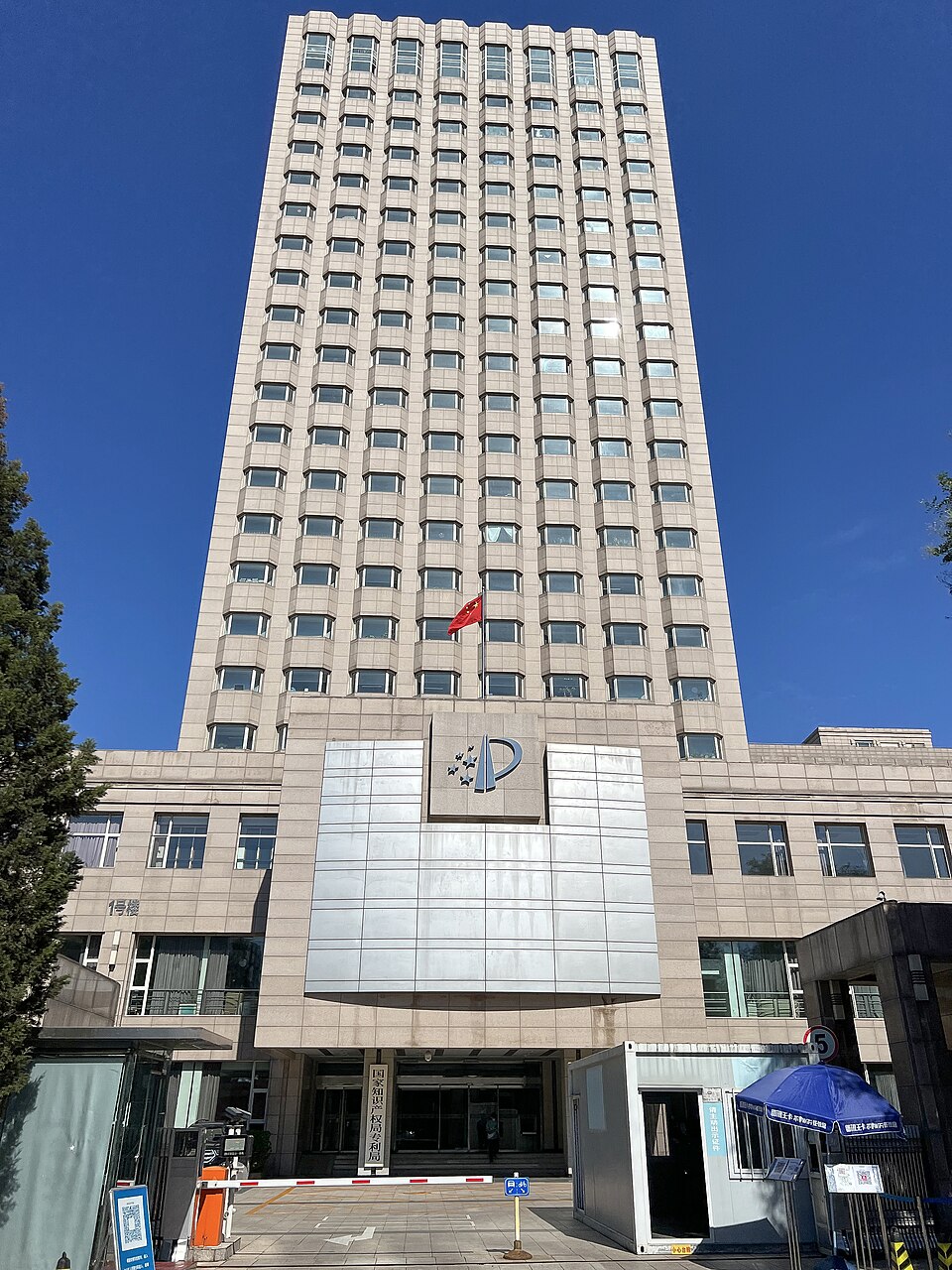
A patent office makes artificial intelligence speak a different language. A launch can trade on speed, a benchmark can reward one bounded result, and an app can hide most of its machinery behind an interface. A patent asks for something less theatrical and more durable: what was invented, how does it work, and why is it not merely yesterday's technique wearing a new use-case label?
China has already won the easiest headline in this arena. The World Intellectual Property Organization's 2026 update counts more than 43,000 generative-AI patent families from China-based inventors published in 2024 and 2025—more than the country's total for the preceding decade. Globally, annual GenAI family publications rose from 18,862 in 2024 to 37,808 in 2025.[1]
As of 2026-08-12T16:37:23Z UTC, however, the more revealing change is happening beneath that volume. Revised examination guidelines in force since January 1 tell AI applicants what a sufficiently disclosed model-based invention should contain. A July invalidation decision then showed how China's patent authority may separate model design, model training, and model application when it tests inventive step.[2][3] The next phase of China's patent lead is therefore not just a filing race. It is a quality test conducted through disclosure, comparison, and adversarial review.
The 43,000-family headline is not a capability score
WIPO uses published patent families to approximate distinct inventions rather than counting every document generated as one idea moves among offices. That makes the measure more useful than a raw application tally, but it does not turn a family into a working product, a granted patent, an independently reproduced model, or a technically important advance. Publication usually arrives after an approximately 18-month lag, so the surge is also a delayed view of research and commercial decisions made around the post-ChatGPT expansion.[1]
Another cut of WIPO's data exposes the boundary. International patent families—those published in at least two jurisdictions—grew to 3,297 in 2025, yet represented only about 9% of that year's GenAI families. WIPO notes that Chinese applicants, who account for most publications, typically file much of their portfolio domestically. Some young filings may later travel abroad, but the current total mixes inventions pursued internationally with claims aimed primarily at one national market.[1]
The applicant list also describes an industrial system, not simply a contest among foundation-model laboratories. Tencent, Ping An, and Baidu remain major cumulative owners, while State Grid Corporation of China and China Southern Power Grid have entered WIPO's leading group. Their presence suggests that GenAI patenting is spreading into utilities, infrastructure, finance, and operational software as well as model architecture.[1]
Stanford's 2026 AI Index supplies a useful, differently scoped warning label. Its broad AI comparison says China leads patent output while the United States leads in higher-impact patents.[4] WIPO's GenAI families and Stanford's impact measure are not interchangeable datasets, but together they prevent a common category error: patent volume is evidence of invention-claiming activity, not a substitute for technical performance or influence.
The black box now has to become a specification
China's revised Patent Examination Guidelines make that distinction concrete. For inventions involving model construction or training, the specification generally needs to describe the necessary modules, layers or connection relationships, along with the concrete training steps and parameters required to implement the solution. For an AI model applied in a particular field, the filing generally needs to explain how the model connects to that setting and how its inputs and outputs relate.[2]
This is the old patent bargain meeting a black-box technology. An applicant seeks an exclusionary right; the public is supposed to receive an enabling technical disclosure in return. The rule does not say that every patented model must publish its source code, full training corpus, or production weights. It does say that a filing cannot rely on the word “AI” to bridge the technical gaps that prevent a skilled reader from carrying out the claimed solution.[2]
CNIPA's examples sharpen the inventive-step threshold. Moving a conventional deep-learning counting method from fruit to ships, without a substantive change to the algorithm, model construction, or training process, is presented as ordinarily non-inventive. By contrast, a scrap-steel grading system may clear the threshold when its technical problem requires different visual features and corresponding changes to convolution and pooling layers, produces a useful effect, and is not suggested by prior art.[2]
The same revision extends examination beyond engineering mechanics. Data collection, label management, rule setting, or recommendation decisions that violate law, social morality, or the public interest cannot support a patent grant. One example rejects covert facial collection for mattress marketing when the application does not establish lawful collection or the required consent; another rejects an autonomous-driving decision model that encodes discriminatory choices by sex and age.[2] Patent quality, in this framework, includes both implementable technical content and a lawful route to producing the result.
One digital-human dispute shows how the test can work
On July 2, CNIPA published its account of China's first patent-invalidation request in the virtual-digital-human field. The challenged patent covered generating a moving image from audio. The office maintained the patent, but the more reusable part of the decision was its method: identify whether the claimed difference sits in model design, model training, or model application, then compare the model's purpose, object, output, and use against the prior art.[3]
CNIPA said a different training method can support inventiveness when earlier technology does not suggest the change and the change produces a technical benefit such as more accurate output or lower training cost. That is narrower than declaring an “AI-powered” product novel. It locates the claimed advance in a stage of the system and asks for a causal technical effect.[3]
The case should not carry more weight than it can bear. It is one summarized invalidation decision concerning one digital-human patent, not a representative success rate for Chinese AI patents and not independent validation of the underlying model. It does, however, show the 2026 rulebook becoming legal reasoning: the model pipeline is being decomposed rather than treated as an indivisible magic box.
Filing capacity is becoming evidence-production capacity
This changes what a defensible AI portfolio requires. Engineering teams need records that a patent drafter can turn into a technical account: which architecture and data interface existed at each version, which training intervention changed the outcome, what baseline was used, and whether the measured effect survives a controlled comparison. Legal teams, in turn, need to distinguish an enabling disclosure from implementation detail that remains better protected as a trade secret. That operational conclusion is an inference from the new guidelines and the invalidation case, not a disclosed metric about how companies have already changed their practice.[2][3]
It also makes generic vertical-AI claims more fragile. The rapid spread of GenAI families into many industries may represent real specialization, but CNIPA's ship-counting example warns that a new noun is not necessarily a new invention. A credible energy, medical, industrial, or financial claim must show what changed inside the technical solution because the setting posed a different problem—not simply state that a familiar model is now used there.[2]
Three signals will show whether the filing boom is maturing. First, examination and invalidation decisions should reveal whether applications filed under the 2026 disclosure standard describe models precisely enough to be implemented and compared. Second, more claims should survive serious prior-art challenges for reasons tied to specific training or architecture advances rather than broad application language. Third, portfolio indicators that carry more friction—international filings, durable citations, licensing, and traceable use in products—should begin to grow alongside domestic publication counts. Each signal arrives slowly, which is precisely why the current volume headline cannot settle the question.[1][3][4]
China's GenAI patent advantage is real as a measure of the scale and breadth of its claiming activity. It is not proof that every family contains a frontier invention, nor that the country leads every measure of patent influence. The better question is now available: can the claimed advance be disclosed clearly enough to teach, distinguished specifically enough to deserve protection, and defended when another party attacks it? That is a harder contest than counting filings—and a much more informative one.
Sources
- World Intellectual Property Organization, SPARK: Patent Trends Update in GenAI — global patenting trends through 2025, including publication lag, inventor locations, owners, international families, and model types (2026).
- China National Intellectual Property Administration, “Interpretation of the 2025 revisions to the Patent Examination Guidelines” (December 4, 2025; Chinese primary source on AI ethics, inventive step, disclosure, and the January 1, 2026 effective date).
- China National Intellectual Property Administration, “Case 7: Invalidation request for the patent ‘Method, apparatus, device and storage medium for generating dynamic images from audio’” (July 2, 2026; Chinese primary case summary).
- Stanford Institute for Human-Centered Artificial Intelligence, 2026 AI Index Report — top takeaways on comparative US–China AI patent output and impact.
- N509FZ, “China National Intellectual Property Administration” (photographed July 28, 2022; Wikimedia Commons, CC BY-SA 4.0; source for the cover photograph).