The most important word in China's latest computing-power headline is not 2,185. It is rack.
On July 20, the Ministry of Industry and Information Technology said China's intelligent-computing capacity had reached 2,185 EFLOPS at FP16 precision by the end of June 2026, up 177% from a year earlier. The same announcement reported a 71.4% overall rack occupancy rate for computing facilities, more than 70 major data routes built around national hubs in the past two years, and a 10% improvement in network performance between the relevant hubs.[1] Together, the figures describe a formidable infrastructure build.
They do not yet describe the amount of AI work that build produces.
As of 2026-08-11T06:37:25Z UTC, China has disclosed a national measure of arithmetic capacity and a rack-occupancy measure, but the July release does not publish the calculation method behind either aggregate. Nor does it place beside them a national measure of accelerator active time, successful training goodput, delivered inference, saleable capacity, or realized revenue. That gap matters because the market has moved from proving that China can build computing centers to proving that heterogeneous machines in different provinces can be discovered, scheduled, paid for, and kept busy with useful jobs.
The capacity curve is real—and narrower than it looks
The March baseline was already large. A May analysis by China Academy of Information and Communications Technology chief engineer He Baohong put intelligent-computing capacity at 1,882 FP16 EFLOPS at the end of March.[3] Against that point estimate, the June figure was 303 EFLOPS, or about 16.1%, higher in three months. The July release also says the June total was 177% above the year-earlier level.[1] Even allowing for possible changes in facility coverage or reporting, the direction is unambiguous: the measured stock expanded rapidly.
A June 2025 consultation draft prepared by the National Data Standardization Technical Committee under National Data Administration guidance shows the measurement system policymakers were considering, although it is not a final standard and the July release does not say that its 2,185-EFLOPS total follows this exact method. The draft would define intelligent-computing scale in FP16 operations per second and calculate broader computing capacity from the peak capability of installed CPUs, GPUs, and other chips at specified precisions. Separately, it proposes dispatchable capacity as the portion that can enter the national integrated computing network for coordinated scheduling, explicitly excluding enterprise capacity reserved for internal use.[2]
Those are three different economic objects. Installed capacity says what the hardware could theoretically calculate. Dispatchable capacity says what can be offered across the network. Useful work says what customers actually receive after software compatibility, memory, networking, storage, scheduling, failures, and queueing have taken their share. Only the first has a new national headline.
This is not an argument that peak EFLOPS are meaningless. A country cannot schedule hardware it never installed, and common precision labels make a sprawling estate more legible. The boundary is that FP16 peak capacity does not make different accelerators interchangeable. A nominal operation on one chip does not carry the same software support, memory bandwidth, interconnect behavior, or model-level throughput as the same nominal operation on another. Aggregate EFLOPS measure the size of the engine room, not the freight delivered.
The 71.4% figure measures occupied racks, not busy accelerators
English-language summaries have rendered the second headline as a facility "utilization rate." The Chinese announcement uses the narrower term overall rack occupancy (zhengti shangjialü) but does not supply a denominator. The 2025 consultation draft proposes that physical rack occupancy equal used racks divided by completed physical racks; it treats power utilization as a separate ratio of installed-equipment rated power to completed-rack design power.[2] That draft does not establish MIIT's final method for the 71.4% figure. It does show why the headline should be read as a facility-occupancy indicator unless and until MIIT publishes a workload-utilization methodology.
Facility occupancy is not GPU utilization. A server can occupy a rack while awaiting a customer. A customer can reserve an accelerator while a job waits on data. A device can report high activity while communication stalls reduce model-level goodput. A center can also run a useful but low-intensity inference workload that leaves arithmetic units quiet without making the service economically idle. Nothing in the July disclosure lets the national 71.4% number distinguish among those cases.[1]
That semantic distinction changes the macro reading. A 71.4% rack-occupancy rate is evidence that a substantial share of the country's built shell has equipment in it. It is not evidence that 71.4% of 2,185 EFLOPS is working, saleable, or earning money. Multiplying the two figures would create a false national output estimate.
The reverse error would be just as bad. The disclosure does not prove that China's compute build is wasteful. A 2025 report on the Digital China Summit site said there was no accurate nationwide statistic for idle intelligent compute; its source estimated that some small and midsize centers in lower-tier cities operated below 30%. The same report described mismatches in which some racks were designed below 15 kW even though high-performance AI training could require at least 40 kW per rack.[5] Those observations identify a real quality and geography problem, but they cannot be promoted into a national utilization rate. The defensible conclusion is that China has both scarce high-quality capacity and underused or poorly matched capacity at the same time.
The market is shifting from rooms to completed tasks
China's own industry research points toward the missing meter. CAICT's 2026 report distinguishes three businesses: an internet data center sells cabinets, space, and bandwidth; a cloud sells standardized resources by specification and time; an intelligent-computing service can sell card-hours, tokens, training jobs, rendering jobs, or other task outputs. In that last model, heterogeneous resources must be abstracted, measured, scheduled, and priced across owners and regions.[4]
That progression explains why the July announcement's next steps matter more than another construction target. MIIT said it would strengthen unified monitoring, develop standards for service-capability assessment and market-based pricing, and continue work on transmission protocols and card-to-card interconnects.[1] These are market-making tasks. A national pool cannot clear merely because two facilities both report FP16 capacity. Buyers need to know whether a model runs on the offered hardware, how long it will wait, what failure and retry terms apply, what throughput it receives, and what the completed job costs.
Two field examples show the distance between a rack and a service. In Guizhou, an April Xinhua report said more than 20 large data centers had settled in Gui'an New Area, over 90% of local compute users came from outside the province, and direct connections offered stated latency circles of 3 milliseconds within Guizhou, 10 milliseconds to the Greater Bay Area, and 20 milliseconds to the Yangtze River Delta and Beijing-Tianjin-Hebei. But the province was also raising its compute-voucher support from 80 million yuan to 140 million yuan.[6] The network was becoming exportable while public money was still helping demand meet supply.
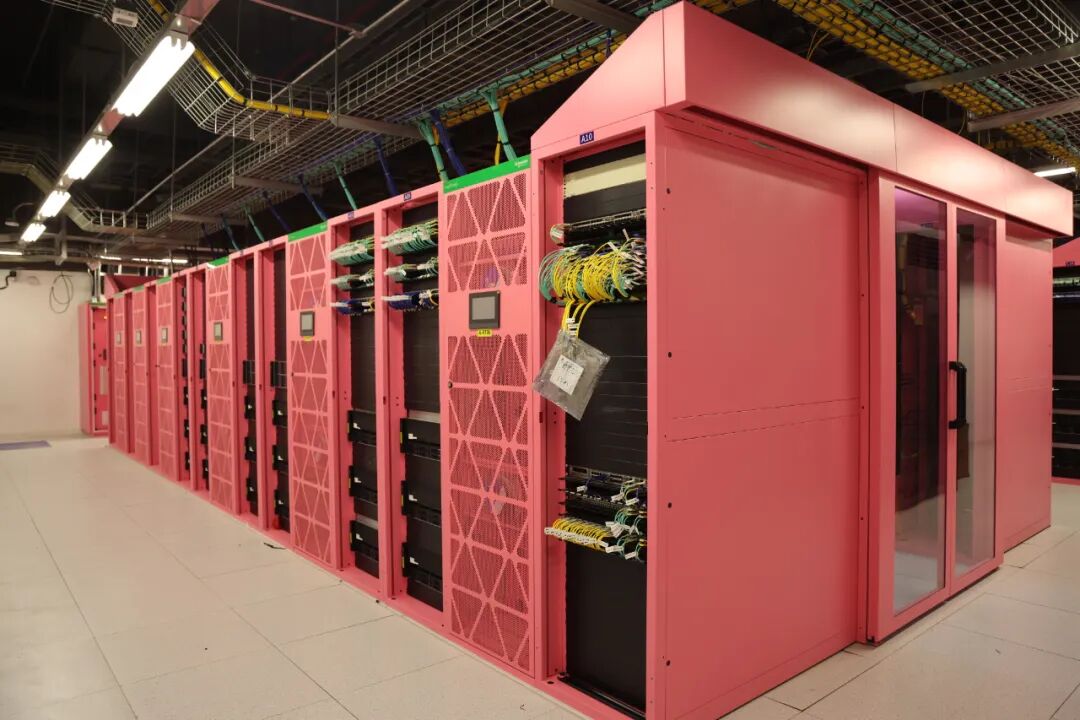
In Baicheng, Jilin, the photographed facility accompanying this article opened its first phase in June with 320 high-power racks rated at 22.3 kW each. Its operator said the first resources had been delivered to a major domestic model company and expected full-load operation later that month.[7] That is useful project-level evidence: named hardware density, a customer handoff, and a time-bound operating claim. It still needs a later receipt—sustained power draw, booked card-hours, completed jobs, revenue, or another output measure—to establish durable use.
The two sites also expose the geography in the national strategy. Western and northeastern regions can offer cooler climates and abundant power; many AI companies and latency-sensitive users remain farther east. High-speed routes narrow that distance, but they do not erase data-transfer cost, model portability, accelerator incompatibility, security constraints, or the need for local technical support. The national computing network has to turn geographic power advantage into a service-level agreement.
Four meters would make the market visible
The first missing disclosure is dispatchable capacity. The 2025 consultation draft already proposes a definition for it. Publishing how much FP16 capacity can actually enter the shared network—by region and accelerator family—would separate private or captive machines from supply available to other users.[2]
The second is scheduled use: allocated card-hours, active accelerator time, queue length, failed-job time, and the share of reserved capacity that never begins useful computation. These figures should be broken out by training, batch inference, realtime inference, rendering, and scientific work. One pooled average would hide too much.
The third is delivered work. Training services can report successful job completion, effective model FLOP utilization, checkpoint progress, and time to train. Inference services can report accepted tokens, output tokens, latency bands, throughput, and error rates. The point is not to crown one universal metric; it is to connect physical capacity with a customer outcome.
The fourth is market realization: posted and realized card-hour prices, subsidy share, repeat customers, cross-region traffic, revenue per available accelerator-hour, and energy consumed per completed unit of work. Compute vouchers may be a sensible way to seed demand, but a market indicator should show the price after the voucher as well as before it.
These meters would not necessarily produce a flattering number. They would produce a useful one. They could reveal an oversupplied chip class beside a queue for another, a power-rich province with weak software support, or a busy cluster whose failed jobs destroy its economics. That is exactly the information pricing and scheduling need.
What would change the verdict
The strongest bull case is that China has built ahead of a demand curve now steepening through agents, industrial models, scientific computing, video generation, and inference. Under that view, today's disclosure gap is temporary: the nationwide monitoring platform, interconnection standards, and task-based services will turn installed machines into a liquid pool, while scale drives down unit cost.[1][3][4]
The counterweight is that infrastructure can look national in an aggregate while remaining fragmented in operation. Local construction incentives favor visible assets. Accelerator and software diversity raise switching costs. Cheap power sits far from some users. Rack occupancy can improve even when completed-work economics do not.
The thesis therefore has a clean falsifier. If dispatchable capacity, paid card-hours, completed tasks, repeat customers, and realized revenue rise alongside installed EFLOPS—and if those gains persist after subsidies are disclosed—the missing-meter concern weakens. If the stock keeps rising while those operating measures remain absent or flat, the 2,185-EFLOPS headline will describe capital formation more convincingly than AI production.
China has proved that it can fill an engine room. The next competitive number is how much dependable work leaves the door.
Sources
- Xinhua, "China's intelligent-computing capacity reaches 2,185 EFLOPS" (July 20, 2026; MIIT capacity, year-over-year growth, rack occupancy, network, monitoring, assessment, and pricing disclosures, in Chinese).
- National Data Standardization Technical Committee (TC609), Requirements for Capability Assessment of Computing Centers in the National Integrated Computing Network (consultation draft prepared under National Data Administration guidance, June 2025; proposed definitions of rack occupancy, power utilization, FP16 intelligent-computing scale, and dispatchable capacity, in Chinese).
- Digital China Summit, "Future trends in computing-power development" (May 9, 2026; Study Times analysis by CAICT chief engineer He Baohong covering the March capacity baseline, national hub topology, networking, scheduling, and compute-power coordination, in Chinese).
- China Academy of Information and Communications Technology, Intelligent Computing Services Research Report (2026) (April 2026; service definitions, heterogeneous scheduling, delivery units, and the shift from cabinet rental to task- and usage-based pricing, in Chinese).
- Digital China Summit, "Utilization is only 30%: how can 'sleeping' computing power be activated?" (July 17, 2025; reported limits of national idle-capacity data, local utilization estimates, rack-density mismatch, and demand-matching challenges, in Chinese).
- Xinhua, "Temperature, speed and depth in Guizhou's mountain data centers" (April 14, 2026; Gui'an data-center count, compute vouchers, cross-region users, latency circles, and network capacity, in Chinese).
- Xinhua, "First phase of LanYun Baicheng Advanced Intelligent Computing Center comes online" (June 10, 2026; GPU-server photograph, rack count and power density, first-customer delivery, and operating claims, in Chinese).