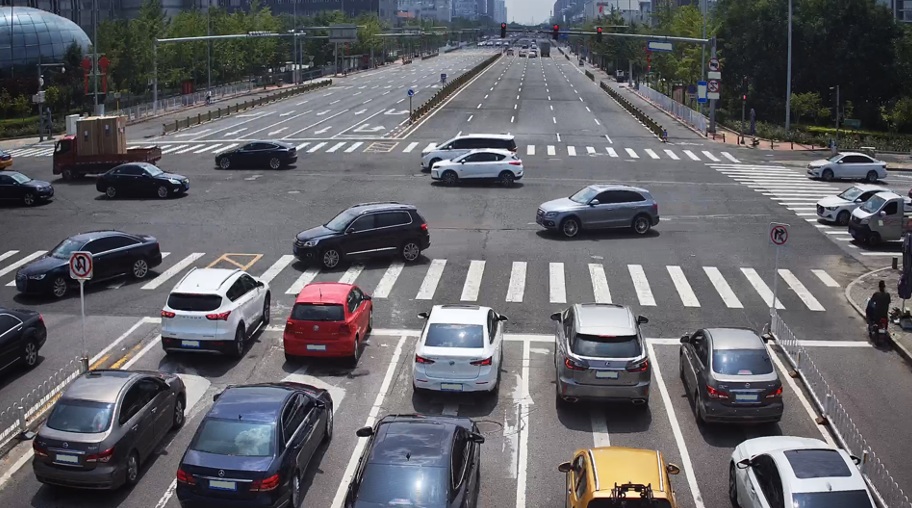
From above the stop line, the roadside camera can see cars crossing in front of a queue several lanes wide. Imagine sitting in that queue behind a delivery van. An elevated sensor might be the first to tell your car that another vehicle is crossing its path. But where will the crossing vehicle be by the time the message arrives? In a Beijing driving experiment, researchers found a way to put a number on the cost of an old observation. They kept the car’s view of the intersection and turned back the clock on the roadside sensor. [1]
What fits in a message
For the DAIR-V2X dataset presented in June 2022, Haibao Yu and colleagues collected camera and laser-ranging data at 28 intersections in Beijing’s autonomous driving demonstration area. The photograph gives a sense of the sight lines. The clearest experiment on timing used the laser sensors, or LiDAR. Each measured a cloud of points on nearby surfaces. A detector called PointPillars used those points to fit three-dimensional boxes around vehicles. [1][2]
The team tried sending two different things from the roadside. Sending the points themselves let the detector assemble a vehicle from surfaces visible at either vantage point. It also took an average of about 1.38 million bytes per frame in the synchronized test. Alternatively, the roadside computer could fit its own boxes and send those. That message averaged just 336 bytes. The price of the smaller message is easiest to picture when the roadside detector misses a car. Once it sends its list of boxes, the receiver has no roadside points to inspect for a car left off the list. [1]
Replaying the junction two frames late
On synchronized recordings, the detector scored 31.33 points of average precision using the car’s LiDAR alone and 41.90 when it combined the two sets of boxes. For this score, a predicted box had to overlap the reference box by a specified amount (intersection divided by union of at least 0.5). A box drawn accurately around where a car was can therefore count as a miss when judged against where it is. [1]
The researchers then substituted the roadside observation from two frames earlier. They could do this with the recording while keeping the vehicle frame and the answer against which it was judged. With the older roadside boxes, the combined score fell to 35.29. Using successive roadside observations to estimate velocity and advance the boxes to the vehicle’s observation time brought it back to 36.72. Some of the second viewpoint’s advantage survived the delay. Estimating motion recovered another part, though it still left a gap of more than five points to the synchronized result. These are detection scores from replayed scenes. The experiment measured neither network latency on a live journey nor a change in collision rates. [1]
Following one car across the junction
At CVPR a year later, the V2X-Seq team made it possible to ask what happens to a particular car across a run of observations. Their sequential perception data included more than 15,000 frames from 95 scenarios. A separate forecasting collection included trajectories, lane maps and traffic signals. In September 2023 the team released code for both parts, giving other groups a way to evaluate tracking and forecasting separately. [3][4]
That separation matters back at the stop line. A model might place a box accurately around the crossing car each time it appears, yet assign it a fresh identity when it emerges from behind the van. A forecast built on that broken track would lose the earlier evidence of its speed and heading. The two Beijing releases suggest a revealing question to ask of a roadside sensor. After it sees a car disappear from the driver’s view, for how long can its messages help the receiver follow that same car? The first experiment shows what two stale frames cost in position. The second supplies the histories needed to investigate continuity. [1][3]
Sources
- Haibao Yu and colleagues, DAIR-V2X, CVPR 2022. Figure 2 shows the camera views and Table 3 reports the delay and transmission experiments.
- Tsinghua University Institute for AI Industry Research, DAIR-V2X dataset and cooperative detection toolkit.
- Haibao Yu and colleagues, V2X-Seq, CVPR 2023. Sequential perception and trajectory forecasting datasets and tasks.
- Tsinghua University Institute for AI Industry Research, V2X-Seq release history and benchmark implementations.