As of 2026-04-16 UTC, the cleanest way to read Zhipu's recent public updates is to stop treating them as one flagship model announcement plus a few adjacent tools. The company is assembling an agent funnel.[1][2][3][4][5][6] At the top sits GLM-5.1, framed as the long-horizon flagship for sustained autonomous work. Around it sit GLM-5V-Turbo for perception-heavy coding and GUI tasks, Web Search API for structured retrieval, and GLM-4.7-Flash as a free entry model for high-frequency use.[1][2][3][4][5]
That matters because it changes the commercial and technical reading of the stack. Zhipu's public platform page does not describe a company selling one isolated model endpoint. It describes a one-stop model-as-a-service platform spanning model access, agent development, tuning, inference, and evaluation.[6] My inference from [1] through [6] is that Zhipu wants developers to move upward through one branded ladder: start with the free lane, add search and multimodal tools when workloads get messier, and graduate to a flagship that is explicitly sold on endurance rather than only on single-turn cleverness.
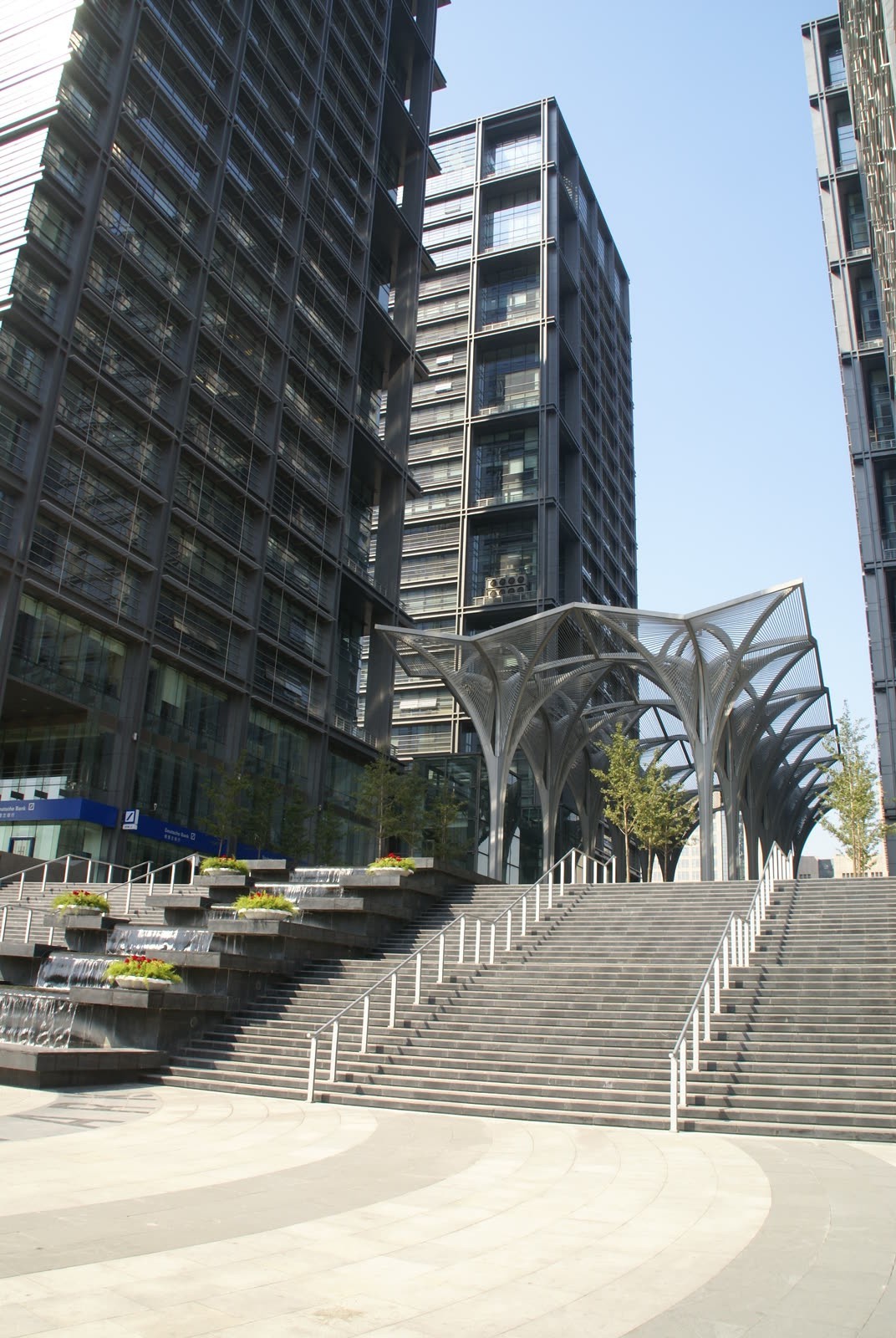
Image context: the cover uses a real Wikimedia Commons photograph of Tsinghua Science Park in Beijing. It fits this article because the story is about institutional stack-building in Zhipu's home corridor, where platform layers, not launch graphics, do the important work.[7]
GLM-5.1 is the top of the funnel because it promises endurance, not only peak scores
The most important change in the April release sequence is not that Zhipu has another large model. It is that the company is naming duration as a product boundary.
On the 2026-04-07 release page, Zhipu says GLM-5.1 supports independent work for up to 8 hours in a single task and can carry a workflow from planning to execution to delivery.[1] The dedicated model page makes the same point more explicitly: it says long-horizon performance has improved enough for the model to work autonomously through planning, execution, testing, repair, and delivery inside one task loop.[2] That is a different product promise from "better reasoning" in the abstract. It is a promise about how long the model can keep its goal stable without drifting.
Zhipu's benchmark language reinforces that message. On the model page, the company says GLM-5.1 reached 58.4 on SWE-Bench Pro and describes the model as aligned with Claude Opus 4.6 on overall and coding ability.[2] Those are company-reported claims, and they should be read that way. Even so, the more important signal is what the company has chosen to emphasize beside the score: long-horizon execution, engineering delivery, and autonomous-agent fit.[1][2]
That is why GLM-5.1 reads as the top of a funnel rather than as a standalone vanity release. Zhipu is telling developers that the premium lane is for workloads where the real bottleneck is not one answer, but repeated planning, code edits, tool use, verification, and recovery inside a longer task arc.[1][2]
GLM-5V-Turbo gives the stack perception and GUI discipline
The second layer of the funnel is GLM-5V-Turbo, announced on 2026-04-02.[1] The release note describes it as a multimodal coding foundation model with stronger GUI-agent and coding-agent performance, especially in "understand the environment, plan the action, execute the task" scenarios.[1]
The model page fills in why that matters. Zhipu calls GLM-5V-Turbo its first multimodal coding base model, built to handle images, video, and text natively while staying strong at long-horizon planning and action execution.[3] The page also says it is deeply adapted to agent workflows and can work with Claude Code and OpenClaw, which makes the model less of a generic vision add-on and more of a perception layer for coding and GUI automation.[3]
The tool details are the real tell. Zhipu says the model now supports multimodal tools such as bounding boxes, screenshots, and webpage reading with image recognition.[1][3] That means the company is not treating vision as a side demo. It is trying to turn visual grounding into a normal part of the agent stack. Once that happens, the ladder becomes more coherent: GLM-5.1 handles the long task spine, while GLM-5V-Turbo handles the messy screen and environment-reading cases that text-only agents usually punt away.[2][3]
Web Search API turns retrieval into a managed model primitive
The third layer is search, and here again the important move is not the existence of a feature but the way it is productized.
Zhipu's updated Web Search API page says the service is a search engine designed for large models, returning structured fields such as title, URL, summary, site name, and favicon instead of only raw page results.[4] The same page says it supports intent-aware retrieval, adjustable result counts, domain filters, time-range filters, and multiple engines, including Zhipu's own engine plus Sogou and Quark.[4]
This matters because retrieval is being turned into a managed model primitive rather than a custom patch each developer must build alone. In the release log, Zhipu places Web Search API, Web Search in Chat, and Search Agent together as one search-tool family.[1] That grouping suggests the company wants search to sit inside the same operating logic as chat and agents, not outside it as a generic external service.
In practical terms, that gives the funnel a middle layer. A developer who does not yet need a full multimodal agent can still add structured search and source-grounding to the stack. That is a meaningful bridge between a free starter model and a more expensive, long-horizon execution workflow.[4][5]
GLM-4.7-Flash gives the platform a free front door
Funnels only matter if there is a usable first step. That is the role of GLM-4.7-Flash.
The free-model page describes GLM-4.7-Flash as a 30B-class model built to balance performance and efficiency, with stronger Agentic Coding, long-task planning, and tool coordination.[5] The same page says it has a 200K context window and can work with external MCP tools and data sources.[5]
This is strategically important because it gives Zhipu a no-cost developer entry point that is still shaped around agent work, not only casual chat. The page does not frame the model as a toy. It frames it as a practical starting layer for complex demos, prototypes, front-end generation, and collaborative problem solving.[5]
That changes how the rest of the stack should be read. If GLM-4.7-Flash were just a traffic magnet, the platform would still look like a standard model catalog. Because the free lane itself is described through Agentic Coding, tool use, and long-task planning, it looks more like the first rung of a progression that is meant to pull serious builders upward.[5]
Why this reads as a funnel instead of a loose product shelf
The platform overview page is what ties the pieces together. Zhipu describes bigmodel.cn as a platform for model APIs, agent development, fine-tuning, inference, and evaluation, and says the site already lists dozens of models across text, reasoning, image, video, audio, and more.[6] That is not the language of a single-model company.
Put the pieces in order and the strategy becomes clearer. GLM-4.7-Flash lowers the entry barrier for repeated developer use.[5] Web Search API adds structured retrieval and source-grounding when the application starts needing live information.[4] GLM-5V-Turbo handles visual environments, GUI tasks, and multimodal coding cases.[3] GLM-5.1 sits at the top as the long-horizon flagship for builders who need the model to stay coherent across hours, not minutes.[1][2]
My inference from [1] through [6] is that Zhipu's latest release pattern is less about winning one more benchmark headline and more about reducing friction between these layers. The strategic question is no longer only "How good is the flagship?" It is "How many agent workloads can Zhipu keep inside one platform before the developer reaches for an outside tool chain?"
What to watch next
Three follow-up signals now matter more than another isolated benchmark graphic.
First, watch whether the tool semantics converge across the stack.[2][3][4][5] If the same task can move cleanly from a free text model to multimodal perception to search grounding to long-horizon execution, the funnel thesis strengthens.
Second, watch whether Zhipu keeps documenting real workload boundaries instead of only leaderboard positions.[2][3][5] The current product pages are unusually explicit about planning loops, GUI tasks, screenshots, web reading, tool use, and MCP integration. If that level of operational detail continues, the platform story gets more credible.
Third, watch whether GLM-5.1's long-horizon framing starts to appear in surrounding tools, templates, and examples.[1][2][6] If the platform increasingly assumes multi-step, tool-using, hours-long work as the default unit, Zhipu will look less like a company with a flagship model and more like a company standardizing how agent work is entered, grounded, perceived, and carried through.
Sources
- 智谱 AI 开放文档, "新品发布" (2026 年 4 月 7 日 GLM-5.1;2026 年 4 月 2 日 GLM-5V-Turbo;以及 AI 搜索工具更新条目).
- 智谱 AI 开放文档, "GLM-5.1" (8 小时级长程任务、SWE-Bench Pro 58.4、工程交付与 Autonomous Agent 定位).
- 智谱 AI 开放文档, "GLM-5V-Turbo" (多模态 Coding 基座、GUI Agent / Coding Agent 适配、与 Claude Code / OpenClaw 协同、画框/截图/读网页 tools).
- 智谱 AI 开放文档, "Web Search API" (面向大模型的结构化搜索结果、多引擎支持、域名/时间范围控制与检索管控).
- 智谱 AI 开放文档, "GLM-4.7-Flash" (免费模型定位、30B 级 Agentic Coding、200K 上下文与 MCP 工具支持).
- 智谱 AI 开放文档, "平台介绍" (bigmodel.cn 作为一站式模型即服务平台,覆盖智能体开发、模型精调、推理、评测与多模态模型矩阵).
- Wikimedia Commons, "File:Tsinghua Science Park Towers.jpg" (cover image source page).