As of 2026-04-17 UTC, the sharper way to read MiniMax's March 18, 2026 M2.7 release is through distribution rather than through one more model-rank headline. The release note gives the expected slogan, "self-iteration," but the more useful signal is where MiniMax has already placed the model: official coding-tool guides, a revamped Token Plan subscription, and hosted-agent surfaces such as MaxClaw and MaxHermes.[1][2][3][6][7] In practical terms, MiniMax is trying to make self-iteration a workload contract, not only a research phrase.
That matters in ai-china because the market's public language often splits into two lanes that drift apart. One lane is model prestige: faster output, better benchmarks, a fresh release date. The other lane is adoption gravity: where developers actually plug the model in, how the billing unit is defined, and whether the vendor owns a usable agent surface above the API. The current M2.7 materials point much more strongly at the second lane.[1][2][3][4][5][6][7]
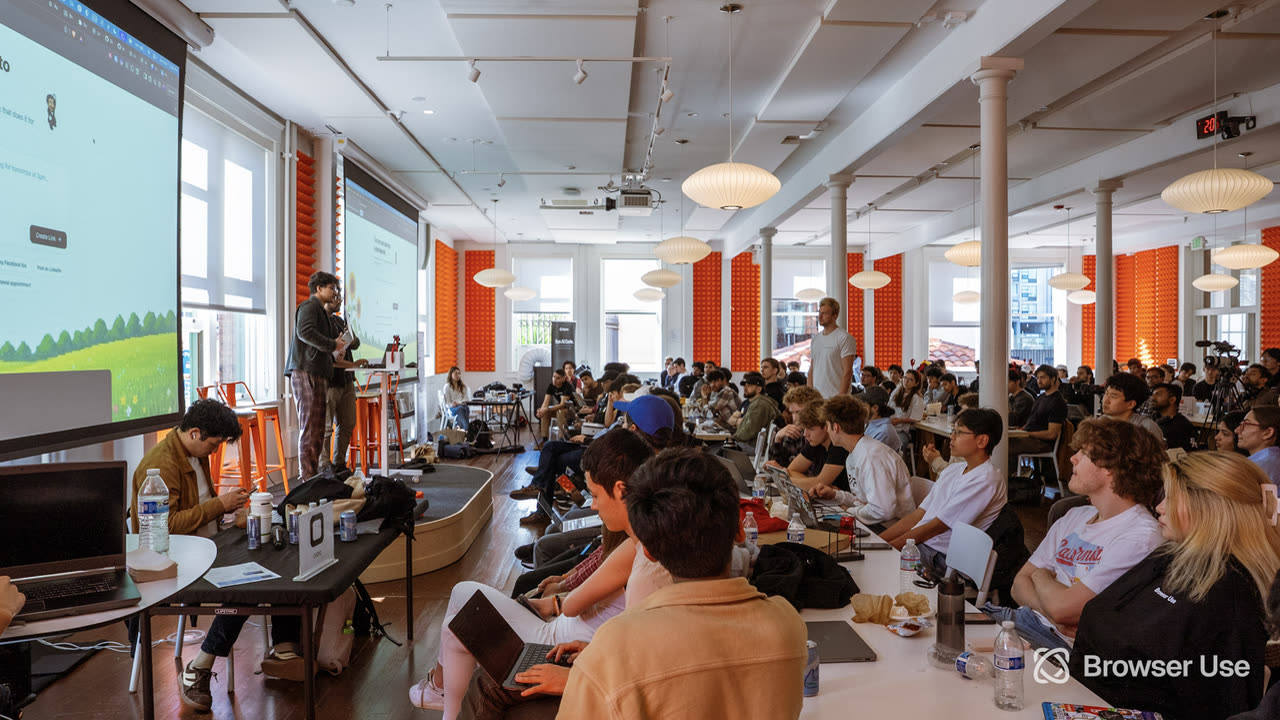
Image context: the cover uses an official MiniMax workplace event photograph. It fits this article because the release is best understood as a distribution layer for builders and operators doing real coding and agent work in live team settings.[9]
What changed on March 18
MiniMax's official release-notes page is brief but revealing. On 2026-03-18, the company published MiniMax-M2.7 and MiniMax-M2.7-highspeed as a new text-model pair and described the release with one decisive phrase: "开启模型的自我迭代", or "opening model self-iteration."[1] The broader API compatibility docs add the concrete operating envelope. Under both the OpenAI-compatible and AI-SDK surfaces, MiniMax lists 204,800-token context windows for M2.7 and M2.7-highspeed, with approximate output speeds of 60 TPS and 100 TPS respectively.[5]
The pricing pages show that the company expects the model to sit inside sustained, tool-heavy work rather than occasional chat. In pay-as-you-go mode, MiniMax-M2.7 is priced at 2.1 yuan per million input tokens and 8.4 yuan per million output tokens, while M2.7-highspeed doubles those headline input/output rates to 4.2 and 16.8 yuan per million tokens.[4] Those are not the details a vendor foregrounds when it only wants applause for a benchmark chart. They are the details it foregrounds when it expects developers to make routing decisions.
The strongest capability claims still come from MiniMax-adjacent or partner material, so they need to be read with discipline. In MiniMax's April 12 news item on the FlagOS day-zero adaptation, the company says M2.7 is the first M2-series model to participate deeply in its own iteration, able to build complex Agent Harnesses and Skills, update its own Memory, and improve through reinforcement-learning-driven loops.[8] The same post reports 56.22% on SWE-Pro, says the model matches GPT-5.3-Codex on that benchmark, places its GDPval-AA score behind only Opus4.6, Sonnet4.6, and GPT-5.4, and claims 97% instruction-following across 40 complex-skills scenarios above 2,000 tokens.[8] Those numbers are useful as vendor-reported direction, not as settled cross-vendor proof, because the public materials do not establish one shared evaluation harness across every comparison.
Even with that boundary, the release still looks distinctive. MiniMax is not merely saying that M2.7 writes code better. It is saying that the model is suited to longer agent loops in which memory, tools, skill reuse, and instruction durability matter as much as one-shot answers.[1][5][8]
The coding-tool footprint is the tell
The official coding-tools guide is where the release becomes legible as a distribution move. MiniMax does not stop at one preferred client. It documents M2.7 across Claude Code, Cursor, TRAE, OpenCode, Kilo Code, OpenClaw, Hermes Agent, Cline, Roo Code, Codex CLI, Droid, Zed, and MonkeyCode.[2] That list is much more important than the slogan alone. It shows that the company wants M2.7 to travel through the interfaces where developers already spend time rather than asking them to learn a fresh proprietary workbench from scratch.
The compatibility layer reinforces that point. MiniMax says M2.7 and M2.7-highspeed support both OpenAI and Anthropic protocol surfaces.[2][5] In Claude Code, the docs route users to https://api.minimaxi.com/anthropic and map all default Claude model variables to MiniMax-M2.7.[2] In Cursor, the docs push users toward https://api.minimaxi.com/v1 as an overridden OpenAI base URL and let them register M2.7 as a custom model.[2] The technical point is simple, but the strategic point is bigger: MiniMax wants the migration cost to feel administrative, not architectural.
The OpenClaw guide makes the same logic even clearer. MiniMax's Token Plan documentation now includes a dedicated OpenClaw path in which MiniMax is chosen as the provider, MiniMax CN is selected as the auth method, and M2.7 is set as the default model during setup.[2][6] Once a vendor starts documenting the default path into a third-party agent shell this explicitly, the model is no longer being sold as a detached API line item. It is being sold as a default worker inside an existing agent habit.
Packaging moved with the model
The Token Plan docs show that MiniMax also changed the commercial container around this release. The company says Token Plan is a full upgrade from the former Coding Plan, widening the package beyond language models into speech, video, music, and image quotas so users can build broader agents and applications under one subscription.[3] That is a meaningful shift in emphasis. The package is no longer "pay for code help." The package is "keep more of the agent's surrounding work in one account."
The quotas are concrete. In the standard plans, M2.7 is sold at 600, 1,500, or 4,500 requests per 5 hours. In the high-speed tier, M2.7-highspeed is sold at 1,500, 4,500, or 30,000 requests per 5 hours.[3] MiniMax says the text-model window rolls every five hours, while other models reset daily.[3] If a user hits the request ceiling, the docs explicitly tell them to swap to the pay-as-you-go API key and continue from there.[3] That is clean platform behavior. The company is teaching users to think in MiniMax-defined workload units first, while preserving a fallback into token billing when volume spills over.
Taken together with the pay-as-you-go page, the commercial message is clear. MiniMax wants M2.7 to sit in two adjacent lanes at once: subscription packaging for repeated developer and agent use, and ordinary token billing for overflow or custom workloads.[3][4] That is a wider release footprint than a plain model announcement.
Hosted agents are where the claim becomes real
The official hosted-agent surfaces are the reason the release note matters beyond documentation. MaxClaw is presented as MiniMax's official cloud AI Agent platform, built on the open-source OpenClaw framework and driven by MiniMax M2.7.[6] The page says users can create an agent in 10 seconds without handling servers, Docker, or API keys, then run multi-step work through browser, code-execution, and file-analysis tools with long-term memory kept across sessions.[6] This is already a much more opinionated product surface than a generic API console.
The MiniMax Agent changelog shows how quickly that hosted layer is moving. On 2026-04-11, the company shipped a MaxClaw settings panel for managing timed tasks, channels, persona configuration, and skills.[7] On 2026-04-16, it launched MaxHermes, a cloud assistant built on Hermes Agent, with self-evolving skills, cross-session persistent memory, natural-language scheduled tasks, parallel sub-agents, and explicit language saying that MiniMax M2.7 improves tool-calling accuracy, skills adherence, and agent fit.[7] That is the moment the release-note language becomes concrete. "Self-iteration" is no longer confined to a model description. It has been translated into reusable skills, memory retention, and 7x24 automated execution inside a hosted product.[7]
This does not prove MiniMax has already secured a durable moat. Tool guides can go stale, hosted-agent usage can stay narrower than the product copy suggests, and subscription economics can still change if the request mix becomes heavier than expected. But the directional signal is strong. M2.7 is being released as the default engine for a connected stack: coding clients, agent shells, subscription packaging, and MiniMax-owned cloud agents.[2][3][6][7]
What to watch next
Three follow-up questions matter more than the launch slogan.
First, watch whether M2.7 remains the default model across MiniMax's coding-tool pages over the next release cycle, or whether the current breadth is mainly launch-week enthusiasm.[2][6]
Second, watch whether the company's self-iteration claim keeps appearing as product behavior rather than as benchmark theater alone. The strongest proof would be more visible signs of better tool reliability, better skill reuse, and less manual configuration burden in hosted or semi-hosted agent products.[6][7][8]
Third, watch whether the commercial split between Token Plan and pay-as-you-go billing keeps the product attractive once heavier agent workloads accumulate. If repeated tool-heavy sessions stay cheap enough inside the subscription, the model-release story hardens into a workload-retention story.[3][4]
MiniMax's March 18 release still looks like a model launch on the surface. The more useful reading is narrower: M2.7 is the model MiniMax is trying to wire into every serious agent surface it currently owns or documents.
Sources
- MiniMax 开放平台文档中心, "模型发布" (2026 年 3 月 18 日 MiniMax M2.7 / M2.7-highspeed 发布说明).
- MiniMax 开放平台文档中心, "通过 AI 编程工具接入" (M2.7 在 Claude Code、Cursor、OpenClaw、Hermes Agent、Codex CLI 等工具中的接入指南).
- MiniMax 开放平台文档中心, "Token Plan 概要" (从 Coding Plan 升级而来、M2.7 请求额度、全模态配额与超额后的切换路径).
- MiniMax 开放平台文档中心, "按量计费" (MiniMax-M2.7 / M2.7-highspeed 的输入、输出与缓存价格).
- MiniMax 开放平台文档中心, "OpenAI API 兼容" (M2.7 与 M2.7-highspeed 的 204,800 上下文窗口与大致输出速度).
- MiniMax Agent, "MaxClaw" (官方云端 AI Agent 平台、10 秒创建、工具能力、长期记忆与 M2.7 驱动说明).
- MiniMax Agent, "更新日志" (2026-04-11 MaxClaw 设置面板;2026-04-16 MaxHermes、自进化 Skills、持久记忆、定时任务与 M2.7 驱动说明).
- MiniMax News, "Day 0 实现 MiniMax M2.7 六芯落地,众智FlagOS 又双叒叕让大模型多芯可用了!" (2026 年 4 月 12 日;Agent Harness、Skills、Memory、SWE-Pro、GDPval-AA 与指令遵循率等披露).
- MiniMax News, "MiniMax @YCombinator Hackathon: Building the Future of Web Agents" (official event page and source page for the cover photograph used in this article).