As of 2026-04-18 UTC, the sharper way to read SenseTime's July 30, 2025 SenseNova V6.5 release is not as one more multimodal ranking cycle. The more durable signal is that SenseTime was trying to connect three layers into one workplace loop: interleaved image-text reasoning at the model layer, a large cost-performance improvement at the systems layer, and an upgraded Raccoon product that turns those gains into office analysis, visualization, and vertical-agent behavior.[1][2][3][4] In other words, this was not just a better model note. It was an attempt to make multimodal reasoning legible as a commercial agent surface.
That matters in ai-china because SenseTime is often easier to misread than peers. It is not the cleanest open-weight story, not the most obvious consumer-app story, and not the simplest API-first story. Its public materials are strongest when the company is read as a stack builder trying to move from model capability into deployable work products.[1][3][4] SenseNova V6.5 is one of the clearest places where that transition becomes visible.
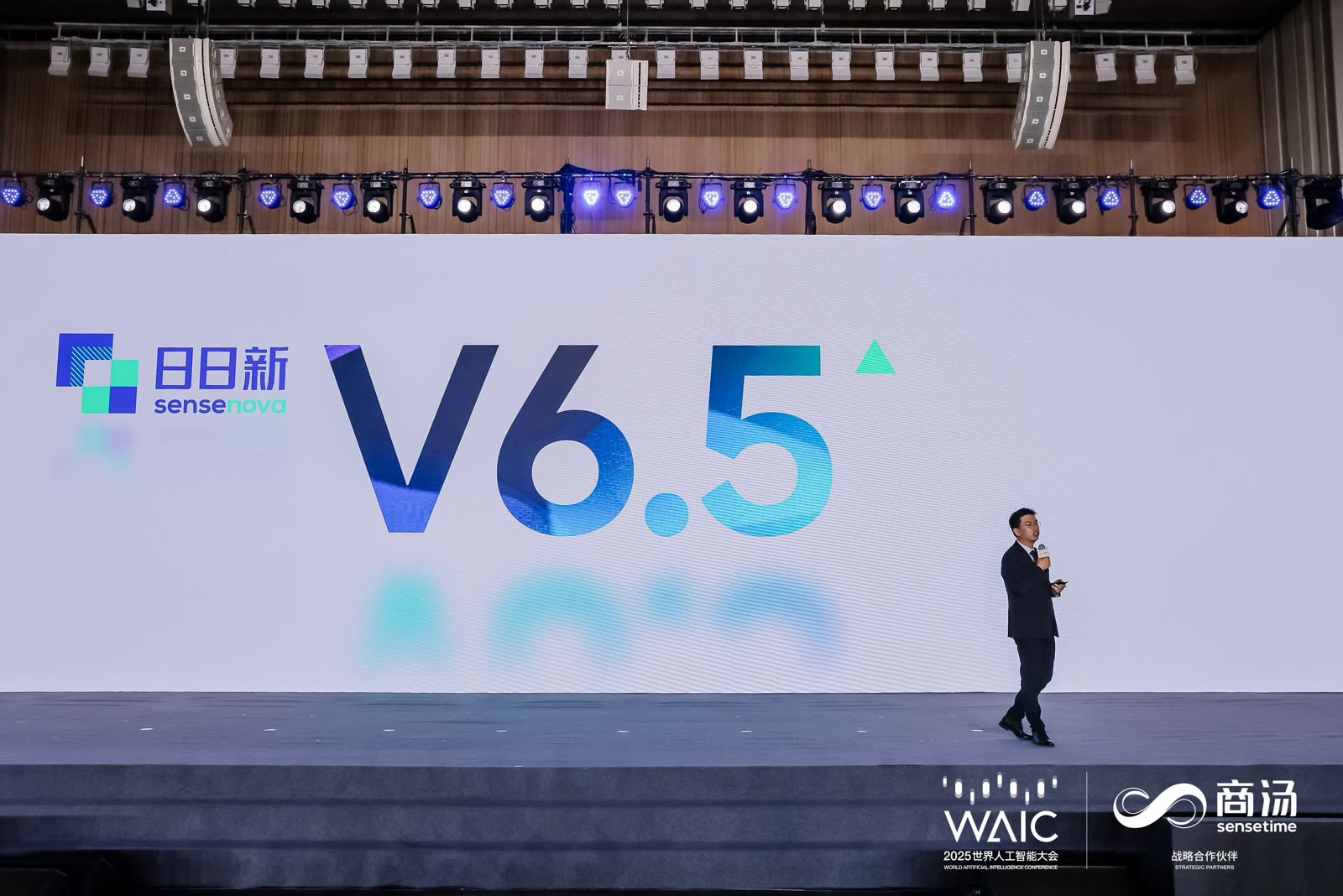
Image context: the cover uses SenseTime's official WAIC 2025 launch-stage photograph from the V6.5 release page. It works here because the article is about a real company trying to productize multimodal reasoning for workplace use, not about an abstract benchmark race.[1]
What actually changed in the release
SenseTime's own release page names three upgrades, and the mix is revealing. First, the company says SenseNova V6.5 introduced intertwined visual-textual multimodal thought chains. Second, it says architectural changes improved the model's performance-to-cost ratio by more than threefold. Third, it frames intelligent agents as a first-class output of the release rather than as an afterthought.[1]
Those three claims belong together. A lot of multimodal launch notes stop at "the model sees more" or "the benchmark went up." SenseTime's language pushes in a different direction. The company is telling readers that multimodal reasoning should now be understood as something closer to a usable work engine: better reasoning structure, cheaper deployment, and a named agent product above the model.[1]
The efficiency numbers make that reading harder to dismiss as marketing fog. SenseTime says V6.5 delivered over 20% improvement in pretraining throughput, a 40% increase in reinforcement-learning efficiency, and more than 35% higher inference throughput, while reducing total cost enough to produce that 3x cost-performance gain over SenseNova V6.0.[1] Those are vendor-reported figures, so they are not a neutral market audit. But they are still important because they show which operating variables SenseTime itself thinks matter: not only capability, but the price of carrying capability into production.
The model-side change matters because it tries to put visual reasoning inside the chain, not beside it
The deepest technical clue in the release is the move from ordinary multimodal input handling toward interleaved image-text thought chains.[1] SenseTime's argument is that mainstream multimodal models still rely too heavily on language even when they accept images, which leaves spatial and graphical reasoning underdeveloped. V6.5 is presented as an attempt to push visual nodes inside the reasoning process itself rather than treating images as a front-end attachment.[1]
This is where the later NEO architecture note helps clarify the release in retrospect. In December 2025, SenseTime wrote that with V6.5 it had already reached encoder-level early fusion, tripled multimodal cost-performance, and taken the lead in commercial-grade text-image interleaved reasoning in China before pushing further into a native multimodal architecture.[3] That later document matters because it makes V6.5 look less like an isolated summer launch and more like a bridge stage. SenseTime was already moving away from the older "visual encoder plus language model" patchwork and toward a tighter multimodal core.[3]
The practical implication is narrower than "SenseTime solved multimodal reasoning." It did not. The more defensible claim is that the company was trying to make visual reasoning a more native part of the agent loop. That is strategically different from simply improving captioning, OCR, or one-off image question answering. It aims at workloads where the model has to inspect mixed materials, reason across them, and then return something a user can act on.
Raccoon is where the release becomes a product story
The release becomes much more interesting once Raccoon enters the frame. SenseTime says Raccoon was "comprehensively upgraded" on top of V6.5's multimodal data-analysis ability, and it describes the product as able to manage complex multimodal inputs, perform deep fusion and analysis, and produce professional-grade visualizations.[1] That is a much more concrete commercial surface than a benchmark chart.
The examples are operationally specific. SenseTime says Raccoon can analyze difficult Excel files containing merged cells, missing values, nested tables, embedded charts, and external images, then establish relationships across the sub-tables and generate a full analysis report.[1] This is the important detail in the entire package. It tells readers the company is not trying to sell V6.5 only as a "smarter multimodal assistant." It is trying to sell a system that can survive messy business artifacts and still deliver structured output.
The vertical numbers push the same point. SenseTime says the Education Edition had already been adopted by 500+ institutions across 10+ scenarios, served 250,000+ teachers and students, improved learning efficiency by 15-30%, reduced academic anxiety by 40%, increased classroom engagement by 2.1x, lowered resource mismatch by 30%, and improved the timeliness of mental-wellbeing intervention by 50%.[1] It also says the broader Raccoon product suite had surpassed 10 million users.[1] These are company claims, not third-party field audits, but they still matter because they show SenseTime trying to anchor the release in workflow outcomes and installed surfaces rather than pure model mystique.
The benchmark and the annual results make the commercial direction easier to read
A release note alone is never enough. The later documents make the pattern firmer.
On December 31, 2025, SenseTime published a company note saying SenseNova V6.5 Pro scored 75.35 in SuperCLUE's December Chinese multimodal VLM evaluation and led Chinese models in the overall ranking, with the domestic high score in visual reasoning and first place in China across tasks such as object description, text recognition, environment identification, logical reasoning, code design, and autonomous-driving scenarios.[2] Because this summary is published by SenseTime itself, the right way to use it is as company-reported benchmark context, not as an independent verdict. Still, it helps explain why the company kept leaning on V6.5 months after the launch: the model line was performing well enough to support the product story.[2]
The March 25, 2026 annual-results release matters even more. SenseTime said 2025 revenue rose 33% to more than RMB 5 billion, second-half EBITDA turned positive at RMB 380 million, and the company planned a new foundational model based on second-generation NEO in Q2 2026 to broaden deployment of agentic AI applications.[4] The same release also said SenseCore had reached 40,400 PFLOPS (FP16) of operational computing scale and explicitly framed the business around closing the loop from infrastructure to model to application.[4]
That financial language is the missing context for V6.5. SenseTime was not releasing a multimodal model into a vacuum. It was trying to prove that multimodal reasoning could feed a broader B2B and agentic-application business. When the model, the agent product, and the annual-results language all point in the same direction, the release starts to read less like a one-day announcement and more like part of a company-wide commercial transition.[1][3][4]
What to watch next
Three follow-up questions matter more than another isolated benchmark comparison.
First, watch whether SenseTime keeps turning interleaved reasoning into concrete product behavior rather than leaving it as architectural vocabulary.[1][3] The strongest proof would be more public examples of office, finance, and data-analysis tasks where visual materials and structured business artifacts are handled inside one loop.
Second, watch whether the company continues to publish efficiency and deployment numbers alongside capability claims.[1][4] The V6.5 package is unusually explicit about throughput, RL efficiency, and cost-performance. If that disclosure pattern continues, the product story becomes more credible.
Third, watch whether the newer NEO line strengthens the same workplace-agent thesis instead of replacing it with a fresh abstract race.[3][4] If SenseTime keeps tying architecture changes to agent deployment, B2B workflows, and repeatable application surfaces, then V6.5 will look like an early and important transition point rather than a temporary launch spike.
SenseNova V6.5 matters because it shows SenseTime trying to move multimodal AI one step up the stack. The release was not only about seeing better or ranking higher. It was about making multimodal reasoning cheap enough, structured enough, and productized enough to support a workplace-agent loop through Raccoon and related vertical surfaces.[1][2][3][4]
Sources
- SenseTime, "SenseTime Launches the Enhanced SenseNova V6.5: Marking the Leap from AI as a 'Tool' to a 'Partner'" (July 30, 2025; V6.5 launch, multimodal thought chains, 3x cost-performance improvement, Raccoon upgrade, workplace examples, vertical metrics, and source page for the cover photograph used in this article).
- SenseTime, "SenseTime SenseNova V6.5 Multimodal Large Model Ranked No.1 in China in 2025" (December 31, 2025; company summary of SuperCLUE-based ranking context, 75.35 overall score, and task-level claims).
- SenseTime, "Evolving From 'Data Fusion' to 'Native Architecture', SenseTime Releases NEO Architecture Redefining the Efficiency Boundaries of Multimodal Models" (December 1, 2025; encoder-level early fusion reference, native multimodal architecture framing, and downstream deployment scenarios).
- SenseTime, "SenseTime Group Reports Record High Revenue of Over RMB 5 billion in 2025; Second Half EBITDA Turns Positive" (March 25, 2026; revenue, EBITDA, second-generation NEO roadmap, agentic-AI deployment framing, and 40,400 PFLOPS SenseCore operating scale).