As of 2026-04-18 UTC, the useful way to read GLM-OCR is not as one more small-model victory lap. The more durable signal sits in the product surface. Z.ai's public documentation does not frame GLM-OCR as a generic "read text from image" utility. It frames the model as a document parsing system that accepts PDF and image inputs, supports documents up to 100 pages, and returns Markdown, structured layout data, and downstream-friendly outputs.[1][2]
That difference matters because plain OCR and document intelligence are not the same thing. A plain OCR endpoint extracts characters. GLM-OCR's production API returns md_results, typed layout_details, normalized bounding boxes, page metadata, and optional layout visualizations.[2] My inference from that public interface is that Z.ai is trying to move OCR upward into a layout-first document pipeline: parse the page, preserve structure, and hand the result directly to retrieval, workflow, or extraction systems rather than forcing developers to rebuild that layer themselves.[1][2]
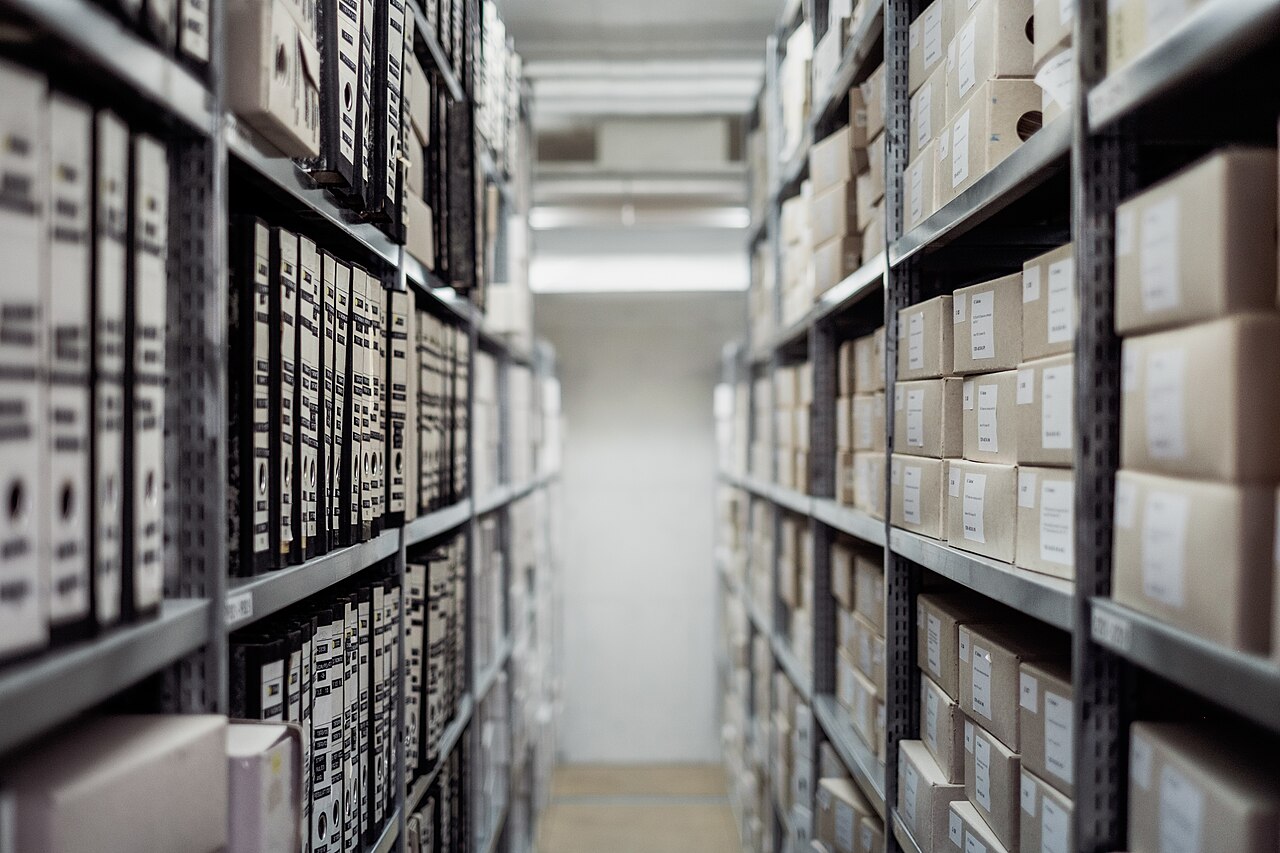
Image context: the cover uses a real archival photograph of shelves filled with binders and archive boxes. It fits this piece because the article is about where GLM-OCR is meant to operate in practice: inside institutions that need large volumes of paper, scans, screenshots, and PDFs turned into structured digital material.[5]
The public surface is already broader than OCR
The strongest evidence is sitting in the docs themselves. Z.ai says GLM-OCR is a 0.9B-parameter professional OCR model that reached 94.62 on OmniDocBench V1.5 at release time, while also emphasizing difficult business scenarios such as code documents, complex tables, seals, handwriting, and multilingual material.[1] Just as important, the same page does not stop at recognition quality. It highlights direct HTML output for complex tables, standardized JSON extraction for cards, tickets, and forms, and explicit support for bulk parsing as a foundation for RAG pipelines.[1]
That is why the pricing and throughput details are more revealing than the leaderboard number. The docs say API input and output cost RMB 0.2 per million tokens, estimate that RMB 1 can process roughly 2,000 A4 scanned images or 200 simple 10-page PDFs, and describe the model as about one-tenth the cost of traditional OCR schemes.[1] Even if those economics should be treated as vendor-side guidance rather than as a universal field result, the direction is clear: Z.ai wants GLM-OCR to look inexpensive enough to sit inside high-volume production lanes, not only inside demo notebooks.[1]
The API reference reinforces the same point from the system side. The response schema distinguishes text, image, formula, and table regions, and returns their coordinates plus content in machine-usable form.[2] Once a provider exposes OCR that way, it is no longer selling characters alone. It is selling a structured parsing layer that can plug into review queues, search indexes, invoice flows, compliance systems, and document-grounded agents.
The eval story only makes sense because the pipeline changed
The model card and technical report explain why this product surface looks different. GLM-OCR is built on a CogViT visual encoder plus a GLM language decoder, and the technical report describes a two-stage system in which PP-DocLayout-V3 performs layout analysis before parallel region-level recognition begins.[3][4] The paper also says the model uses Multi-Token Prediction (MTP) to improve decoding efficiency in deterministic OCR-style tasks.[4]
That architecture is the real benchmark story. A lot of multimodal model releases imply that document understanding can be treated as a side effect of a general vision-language model. GLM-OCR's public stack says the opposite. It treats layout as first-class, which means pages are broken into meaningful regions before recognition and generation finish the job.[2][3][4] This is a narrower ambition than "one model sees everything," but it is also the more operational one for enterprises that live on forms, statements, contracts, invoices, and scanned archives.
The speed claims fit the same reading. The docs and the model card both report throughput of 1.86 pages per second for PDFs and 0.67 images per second for image inputs under identical single-replica, single-concurrency tests.[1][3] Those are bounded lab-style numbers, and the docs explicitly say real performance will vary with file quality, network, and concurrency.[1] Still, the point of publishing them is unmistakable: Z.ai wants buyers to see GLM-OCR as a deployable parsing component, not merely as an academic result with a pretty benchmark table.
Why this matters in AI-China
The larger AI-China signal is that document work is being repackaged as infrastructure. China's model market has already spent two years proving it can ship strong chat models, coding assistants, reasoning variants, and multimodal demos. The next competitive layer is quieter and more practical: who owns the translation from messy page images into machine-usable structure. GLM-OCR is Z.ai's attempt to own part of that layer.[1][2][3][4]
The sector clues are right on the page. Z.ai names banking, insurance, government, and logistics as natural fits for structured extraction output.[1] The model card adds support for deployment through vLLM, SGLang, and Ollama, which broadens the lane from hosted API use into self-managed environments and edge cases.[3] Put together, those signals suggest a company that is not only chasing top-line multimodal prestige. It is also trying to become the default parsing layer when institutions need documents turned into fields, tables, and searchable text at scale.
There is a real boundary to the claim. Public materials do not prove how GLM-OCR will hold up across every long-tail archive, every low-quality mobile scan, or every regulated production workflow.[1][3][4] The benchmark lead is time-bounded, some scenario data is internal, and the best public numbers still come from the vendor's own stack.[1][3] But even with those limits, the product direction is unusually legible.
GLM-OCR matters because Z.ai is treating OCR as a layout-first production primitive rather than as a legacy utility. If that framing holds, the strategic value will not sit mainly in one 0.9B surprise score. It will sit in whether GLM-OCR becomes the quiet layer under document search, extraction, knowledge ingestion, and agent workflows across China's paper-heavy institutions.
Sources
- Z.ai Open Docs, "GLM-OCR" (model overview, 0.9B size, OmniDocBench V1.5 score of 94.62, supported inputs/outputs, scenario guidance, throughput notes, and pricing guidance).
- Z.ai Open Docs API Reference, "Layout Parsing" (response schema for
glm-ocr, including Markdown output, layout labels, bounding boxes, visualization, page counts, and request constraints). - Hugging Face, "zai-org/GLM-OCR" model card (two-stage pipeline with PP-DocLayout-V3, performance summary, deployment options, and speed-test framing).
- Duan et al., "GLM-OCR Technical Report" (arXiv:2603.10910; March 11, 2026 technical abstract describing the CogViT encoder, GLM decoder, MTP, and two-stage document pipeline).
- Wikimedia Commons, "File:Archive storage (Unsplash).jpg" (source page for the archival cover photograph used in this article).