As of 2026-04-18 UTC, the useful way to read SenseTime's January 30, 2026 open-source release of SenseNova-MARS is not as one more leaderboard chest beat over Gemini 3 Pro or GPT-5.2. The more durable signal is that SenseTime published a whole multimodal search-reasoning package: open checkpoints, training and inference code, a new HR-MMSearch benchmark, and an explicit tool stack built around text search, image search, and image crop.[1][2][3][4] In ai-china, that matters more than a single score because it turns a research claim into a lane that other developers can inspect, reproduce, or challenge.
That distinction is important. China's model cycle has already produced plenty of chat launches, coding assistants, and multimodal demos. SenseNova-MARS points at a narrower but strategically interesting surface: models that can look at an image, decide which detail matters, crop it, search outward, and then connect the result into an answer.[1][2][3] The score table is only the front door. The stronger story is that SenseTime chose to publish the surrounding evaluation and infrastructure assumptions instead of leaving the whole workflow inside a closed internal stack.
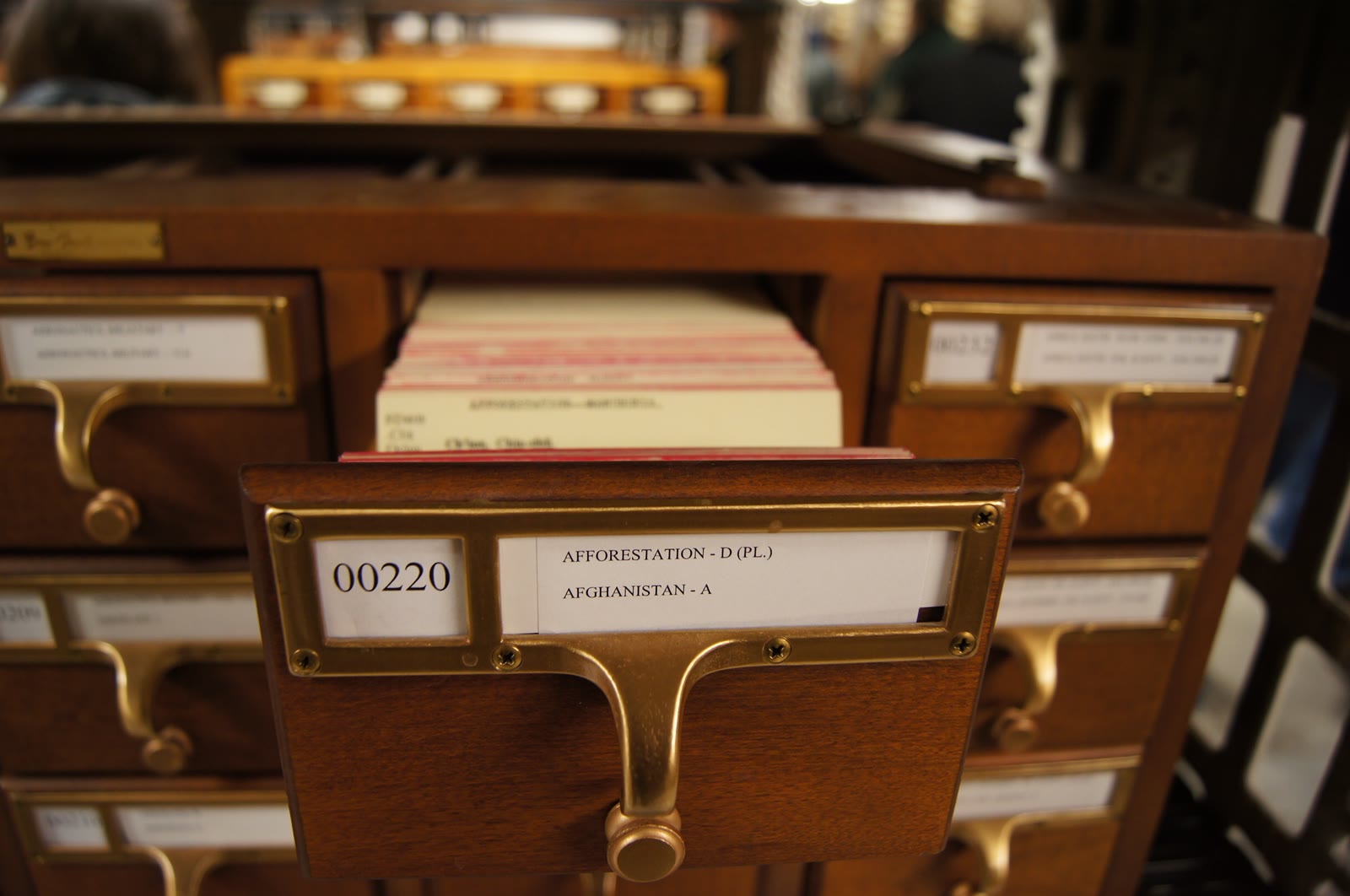
Image context: the cover uses a real 2011 Library of Congress card-catalog photograph. It fits this article because SenseNova-MARS is ultimately about search discipline rather than generic chatbot fluency: isolate a clue, route toward the right catalog of evidence, and connect visual fragments to external knowledge.[6]
What the benchmark claim actually says
The headline numbers are clear enough. In the repo and paper, SenseNova-MARS-32B is reported at 74.3 on MMSearch and 54.4 on HR-MMSearch, ahead of the proprietary models used in the authors' comparison table, including Gemini-3-Pro and GPT-5.2.[2][3] But those scores only mean something if the evaluation boundary is kept in view.
MMSearch is not a generic "vision benchmark." Its maintainers describe it as a 300-instance benchmark across 14 subfields, scored through four linked tasks: requery, rerank, summarization, and an end-to-end search process.[5] In other words, it is already optimized to test whether a model can behave like a multimodal search engine instead of merely answering from what it already knows. HR-MMSearch narrows that further: the SenseNova dataset card describes 305 high-resolution examples designed for agentic reasoning and search, where the model must combine visual detail with outside information across multiple domains.[4]
That is why the comparison should be read as a task-specific systems result, not as a universal ranking of multimodal intelligence. SenseTime's own paper is explicit that the model dynamically integrates image search, text search, and image crop inside the reasoning loop.[2][3] The benchmark win matters because the tests reward exactly that behavior. If a reader strips away the tool setup and treats the result as "SenseTime now has the best multimodal model overall," the boundary is lost.
The repo matters more than the press release
The most interesting part of this release sits in the GitHub README, not in the slogan. The repository does not just ship a paper link and a weight file. It ships release dates for the checkpoints, links to the SenseNova-MARS-Data and HR-MMSearch datasets, a prebuilt Docker image, and a concrete infrastructure recipe.[2] That recipe is revealing.
For full RL training, the repo calls for three separate nodes, each with 8x NVIDIA H100 80GB GPUs: one for training, one for infrastructure services, and one for the judge model.[2] Even evaluation-only use still assumes two nodes and a separate infrastructure stack. The README also spells out the surrounding services: a web-search server, a local Wikipedia retrieval database, a summarizer model, and a judge server.[2] That is a real deployment boundary, and it is one of the most valuable facts in the whole package.
Why? Because it tells readers that SenseNova-MARS is not a magic weight drop. It is an agentic system design with explicit operational dependencies. SenseTime is effectively saying that if you want this kind of multimodal search behavior, you need more than a strong VLM checkpoint. You need tool plumbing, retrieval, routing, and a way to evaluate multi-step behavior under those conditions.[2][3]
That makes the open release more important than the headline itself. Plenty of companies publish benchmark tables. Fewer publish the stack assumptions that produced the table.
The real signal is the new open benchmark lane
The release is also stronger because SenseTime did not stop at model weights. It paired the model with a benchmark that sharpens the question being asked.
The HR-MMSearch dataset card frames the benchmark around high-resolution images, knowledge-intensive questions, and search-driven answers that cannot be solved from the image alone.[4] The paper adds the intended use more concretely: complex visual tasks where models must interleave reasoning with external tools such as search and cropping.[3] That is a more demanding target than captioning, OCR, or one-shot visual QA. It moves the center of gravity toward visual evidence gathering.
This is where the ai-china signal becomes clearer. SenseTime has spent much of the last year trying to show that it can matter above pure foundation-model branding. SenseNova-MARS extends that effort into open research packaging. Instead of asking outsiders to trust a vague claim about "agentic vision," SenseTime released a dataset, a benchmark, and an implementation path that make the claim legible.[1][2][4]
There is also a competitive implication. If Chinese labs keep publishing model weights without publishing the surrounding search and evaluation frame, their public releases will still look thinner than the closed systems they are trying to rival. SenseNova-MARS suggests one answer: publish the task definition and the tool contract, not only the checkpoint.
What to watch next
Three follow-up questions matter more than repeating the top-line score.
First, watch whether independent teams actually use HR-MMSearch and the released code to reproduce or contest SenseTime's numbers.[2][3][4] A benchmark only becomes durable once other groups start treating it as shared ground rather than vendor theater.
Second, watch whether SenseTime or peers can make the same search-and-crop workflow less infrastructure-heavy.[2] Right now the repo makes the boundary visible, but it also shows how expensive that boundary still is.
Third, watch whether multimodal search reasoning starts appearing as a product layer rather than a research artifact.[1][3] If future China AI launches begin exposing crop-search-verify loops in enterprise or consumer workflows, then SenseNova-MARS will look less like an isolated benchmark note and more like an early open map of a new surface.
SenseNova-MARS matters because it makes a specific kind of multimodal capability easier to name. The public release is not mainly saying "SenseTime has a stronger model." It is saying that multimodal search reasoning can be packaged as a reproducible open-source lane with explicit tools, explicit benchmarks, and explicit infrastructure costs.[1][2][3][4][5]
Sources
- SenseTime, "SenseTime Open Sources SenseNova-MARS A Breakthrough in Multimodal Search and Reasoning" (January 30, 2026; official launch note, benchmark framing, tool-use examples, and release links).
- OpenSenseNova, "SenseNova-MARS" GitHub repository README (release timeline, checkpoints, benchmark table, Docker image, hardware requirements, and infrastructure setup).
- Chng et al., "SenseNova-MARS: Empowering Multimodal Agentic Reasoning and Search via Reinforcement Learning" (arXiv:2512.24330; submitted December 30, 2025, revised January 25, 2026).
- sensenova, "HR-MMSearch" dataset card on Hugging Face (305-example benchmark description, data fields, and domain coverage).
- CaraJ7, "MMSearch" project README (300-instance benchmark across 14 subfields and four-task weighted evaluation design).
- Wikimedia Commons, "File:2011 Library of Congress USA 5466788868 card catalog.jpg" (2011 Ted Eytan photograph; source page for the cover image used in this article).