As of 2026-04-01 UTC, the useful way to read Tencent's 2025 Hunyuan text-model cycle is not as a search for one permanent flagship. It is a routing design. Tencent's product and docs trail shows a deliberate split between a faster general lane and a slower, more explicit reasoning lane, while keeping the developer entry surface unusually stable.[1][2][3][4][5][6]
The sequence is visible in Tencent's own product dynamics and current product pages. Tencent Cloud's Hunyuan updates list Hunyuan-TurboS on 2025-03-01 and Hunyuan-T1 on 2025-03-21.[2] The current Hunyuan product page still preserves that logic in public form: Hunyuan-T1-latest is presented as a flagship reasoning model with 32K maximum input and 64K maximum output, while the broader Hunyuan family keeps a separate fast-response lane and later extends that split again through Tencent HY 2.0 Think and Tencent HY 2.0 Instruct.[1]
That matters because Tencent is not only naming two models. It is shaping one developer habit: stay inside one Hunyuan control surface, then decide how much latency, cost, and visible reasoning you want per request.
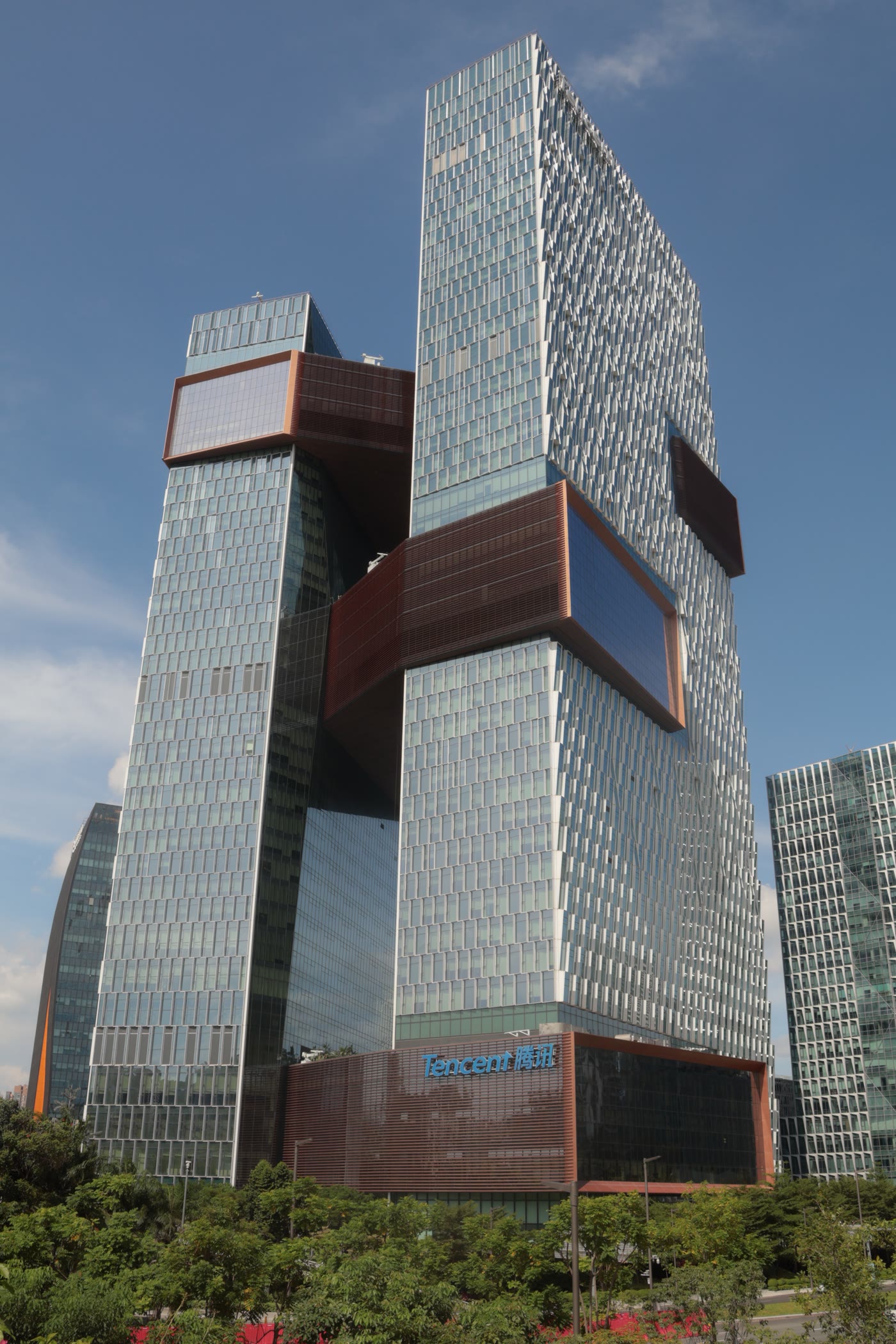
Image context: the cover uses a real Wikimedia Commons photograph of Tencent Binhai Mansion in Shenzhen. That is the right visual here because the article is about Tencent's company-level model packaging and routing strategy, not a synthetic AI visual.[7]
What changed in the release sequence
Tencent's own materials make the dependency chain fairly explicit.
The Hunyuan-T1 repository says the formal T1 model was built on top of the TurboS fast-thinking base that Tencent had released earlier in March 2025, then pushed much harder through post-training for deep reasoning.[5] The repo describes T1 as Tencent's first flagship reasoning model and says the team put 96.7% of post-training compute into reinforcement learning. It also says the TurboS base helped with long-context capture and that, under the same deployment conditions, decoding ran 2x faster because of the long-sequence handling advantages of the Hybrid-Transformer-Mamba design.[5]
That is the first important signal. Tencent is not treating the fast model and the reasoner as unrelated checkpoints. The deep lane inherits from the fast lane. In product terms, that means TurboS is not just a cheaper fallback. It is the foundation from which the reasoning SKU is derived.[5]
The second signal comes from Tencent's current API and docs surface. The OpenAI-compatible examples page tells developers to use one base URL and the familiar /chat/completions path.[3] The data-structure docs then expose ReasoningContent as a distinct field tied to the T1 series and note that this reasoning field should not be sent back in the next round of messages.[4] That is not a trivial implementation detail. Tencent is making the fast/deep split observable at the schema level without forcing developers to abandon one client pattern for another.
The real product is interface continuity
This is the core digest claim.
Tencent's product design is not only "we have a fast model and a smart model." The stronger claim is that both lanes can live behind one recognizable interface contract.[1][3][4] A developer can keep the OpenAI-style calling pattern, switch the model name, and decide whether they need ordinary answer generation or an explicitly reasoned path that returns separate reasoning content.[3][4]
That is a meaningful competitive move in AI-China because model-line sprawl usually creates a hidden tax: new SDK quirks, new response parsing, new orchestration logic, or new endpoint assumptions. Tencent is trying to reduce that tax. The routing decision is meant to happen inside the same client habit rather than across different product surfaces.[3][4]
The current public SKU page reinforces the same reading. Even beyond TurboS and T1, Tencent now presents a continuing split between Think and Instruct lanes, which suggests the company sees fast/deep separation as a durable packaging principle rather than a one-off launch trick.[1] My inference from these sources is that Tencent wants Hunyuan to be read less as one benchmark hero and more as a family whose value lies in predictable switching costs.[1][2][3][4]
Pricing makes the routing logic legible
The pricing page makes the operational tradeoff concrete. Tencent Cloud's pricing documentation lists Hunyuan-TurboS at RMB 0.8 per million input tokens and RMB 2 per million output tokens, while Hunyuan-T1 is listed at RMB 1 per million input tokens and RMB 4 per million output tokens.[6] The same pricing page also shows the shared free-quota table that includes both T1 and TurboS in the current text-model package.[6]
That spread is revealing. Tencent is not making T1 dramatically more expensive on the input side, but it is making the reasoning lane materially more expensive on the output side.[6] That fits the routing thesis. A developer can keep routine interaction, tool use, and short-turn generation on the cheaper fast lane, then escalate to T1 when the value of longer, heavier reasoning justifies the extra output-token cost.
This is also why the schema decision around ReasoningContent matters.[4] Once reasoning becomes a typed output difference rather than only a brand label, teams can route requests more deliberately. They can choose not just a model, but a response shape and cost profile.
Why this is more important than one benchmark snapshot
Tencent's release materials do include performance claims, but the strategic signal is elsewhere.[5] Benchmark leadership moves quickly. Interface discipline, pricing gradients, and response-shape continuity tend to survive longer than one leaderboard cycle.
The practical consequence is that Hunyuan can become easier to integrate into mixed workloads. One application can start on a low-latency lane, escalate selected tasks into a reasoning lane, and keep most of its surrounding client code intact.[3][4] That is closer to a routing stack than to a single-model launch.
This thesis would weaken if Tencent later fragments the surface by forcing materially different APIs, authentication flows, or incompatible response contracts across its fast and deep lanes. But the current documentation points the other way. Tencent is trying to make model selection feel like a controlled switch inside one stack.[1][3][4]
Bottom line
Tencent's important Hunyuan move in 2025 was not only that it launched TurboS and then T1.[2][5] It was that Tencent turned those launches into a coherent routing system: fast generation as the base lane, explicit reasoning as the heavier lane, both carried through one Hunyuan API story and one OpenAI-compatible entry pattern.[3][4][6]
That is the release note worth keeping. The durable product is not one model card. It is Tencent's attempt to make fast and deep thinking coexist behind the same developer surface.
Sources
- Tencent Cloud, "腾讯混元大模型" product page (current public SKU page covering Hunyuan-T1-latest and the later Think/Instruct split).
- Tencent Cloud Docs, "产品动态" for Tencent Hunyuan (official release timeline showing Hunyuan-TurboS on 2025-03-01 and Hunyuan-T1 on 2025-03-21).
- Tencent Cloud Docs, "OpenAI 兼容接口示例" (official OpenAI-compatible examples using a single base URL and
/chat/completions). - Tencent Cloud Docs, "返回数据结构" (official response-schema page documenting
ReasoningContentfor the T1 series). - Tencent, "混元-T1: 强化学习驱动,业内首个超大规模混合Mamba推理模型正式发布!" GitHub repository README (T1 built on TurboS base, 96.7% RL post-training compute, and 2x decode-speed claim under equal deployment conditions).
- Tencent Cloud Docs, "混元生文计费概述" (official pricing page listing Hunyuan-TurboS at 0.8/2 RMB per million input/output tokens and Hunyuan-T1 at 1/4).
- Wikimedia Commons, "File:TencentBinhaiMansion.jpg" (source page for the cover photograph used in this article).