As of 2026-04-01 UTC, the most useful way to watch Baidu's 3-minute 23-second video "Meet ERNIE 4.5: Baidu Open-Source AI Model Family Explained in 3 Minutes", published on September 2, 2025, is to stop reading it as a compressed benchmark commercial.[1] The clip certainly mentions capability, multimodality, multilingual support, and long context. But the sequencing matters more than the slogans. Baidu does not open with one heroic model and then add smaller variants as afterthoughts. It opens with the table of the whole family, then spends the rest of the video explaining why that family exists at all.[1]
The written materials support that reading. Baidu's ERNIE blog presents 10 distinct variants, spanning 47B and 3B activated-parameter MoE lanes, a 424B total-parameter top model, and a 0.3B dense model, all under Apache 2.0.[2][6] The technical report and the Hugging Face model cards make the design logic more concrete: this is not one model resized mechanically, but a portfolio built around heterogeneous multimodal MoE structure, modality-specific post-training, long context, and multiple deployment surfaces for different workload sizes.[3][4]
My inference from the video and the docs is that ERNIE 4.5 is being sold as a coverage system before it is sold as a single frontier object.[1][2][3][4][5][6] Baidu wants developers to feel that they do not need one vendor for a heavyweight multilingual text model, another for compact edge use, and a third for multimodal document or video work. The point of the family is to keep those workload classes inside one naming scheme, one release story, and one developer habit.
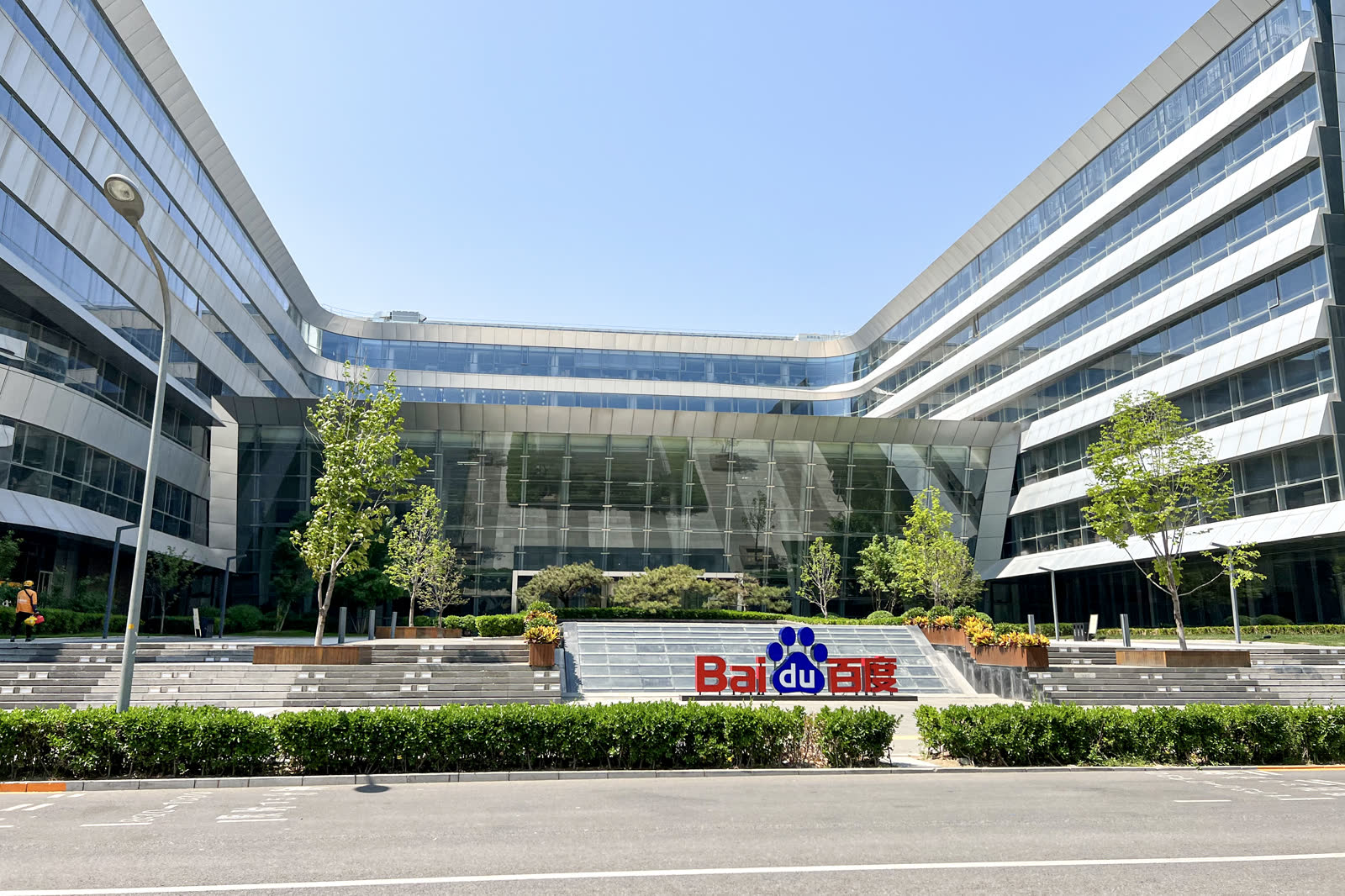
Image context: the cover uses a real Wikimedia Commons photograph of Baidu's ZPark Phase II campus in Beijing. That is the right visual here because the article is about company-level product organization and model-family coverage, not about an abstract AI illustration.[7]
Around 0:20, the video reveals its real subject: choice architecture
The decisive move comes almost immediately. Around 0:20, the presenter says there are different model sizes for different application scenarios, and that each offers both base and post-trained versions.[1] That sounds simple, but it changes the whole meaning of the clip. A benchmark ad tries to persuade you that one model is the best. A family ad tries to persuade you that the menu has been designed intelligently.
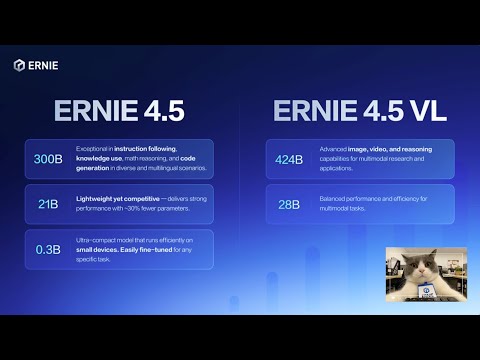
The first minute follows exactly that pattern. The 300B line is framed as the flagship for instruction following, knowledge retrieval, math reasoning, code generation, and multilingual work. The 21B line is framed as the practical choice in the 20B class. The 0.3B dense model is framed as ultra-compact and suitable for edge deployment or narrow fine-tuning.[1] Put together, these claims are less about maximum capability than about boundary-setting. Baidu is telling viewers where each lane starts to make sense.
That framing is visible in the written materials too. The blog and repository list separate base and post-trained variants, while the Hugging Face cards make the smaller lanes legible rather than hiding them behind one flagship badge.[2][4][5] That matters in AI-China because many model releases still feel like prestige objects first and product systems second. ERNIE 4.5 is presented differently. The video tries to lower the cognitive cost of choosing within the family rather than forcing every workload through one halo model.[1][2][5]
Around 1:07, the multimodal turn shows that Baidu wants symmetry, not a sidecar
The next strong signal arrives when the video pivots to ERNIE 4.5-VL around 1:07.[1] Here again, Baidu does not describe multimodality as a detached moonshot product. It keeps the same family grammar: a heavyweight 424B vision-language lane for advanced image, video, and reasoning workloads, and a 28B lane that balances performance and efficiency.[1] The message is subtle but important. Multimodal work is not being treated as a separate research island. It is being folded back into the same portfolio logic.
That is exactly where the technical report matters. Baidu describes a heterogeneous multimodal MoE structure, modality-isolated routing, and modality-specific post-training so that text and vision capabilities can coexist without one degrading the other.[3] The Hugging Face material then adds a more operational layer, distinguishing text models from vision-language models and noting thinking versus non-thinking behavior in the broader family documentation.[4] The portfolio therefore has symmetry: heavyweight and lighter text lanes on one side, heavyweight and lighter multimodal lanes on the other.[2][3][4][5]
This is the article's central inference. ERNIE 4.5 is not just a collection of checkpoints. It is a claim that Baidu can map developer demand onto a tidy ladder: big or small, text or vision-language, base or post-trained, thinking or non-thinking, while keeping the whole set recognizably part of one system.[1][2][3][4] That is a stronger strategic message than "our top model scores well."
Around 2:07, long context and multilingual support turn the family into a coverage promise
Around 2:07, the video shifts from model categories to usage surface: 128,000 tokens of context, books, financial reports, large code bases, and then 100+ languages for global-market work.[1] This section is easy to treat as generic launch copy, but it is doing something more specific. It explains why a family structure is supposed to matter in practice. The point is not merely that one model can ingest a lot of tokens or respond in many languages. The point is that a developer can remain inside ERNIE while moving across document length, code analysis, multilingual support, and visual tasks.
The sources back that up. The blog and repo both keep returning to 128K context across the family table, while the video description itself foregrounds multilingual support and long context alongside the model-size spread.[1][2][5] The smaller models are there so the family can descend into constrained environments. The larger models are there so the family can stretch into research-heavy or multimodal workloads. Long context and language breadth are the connective tissue that keep that ladder feeling like one product story instead of five unrelated releases.
That is also why the video's examples are so ordinary. Books, reports, labels, spreadsheets, and code bases are not glamorous demo objects.[1] They are workload categories that help a developer imagine replacement cost. Baidu is effectively saying: if your work moves between text-heavy enterprise documents, multilingual customer contexts, and vision-language inputs, the family has already been shaped for that drift. Whether that promise holds in third-party production is a separate question, but the pitch itself is unusually clear.[1][2][5]
Around 2:47, the ending matters because a family pitch fails if it cannot be entered
The last useful segment begins around 2:47, when the presenter stops talking about capabilities and starts listing access points: the top models on ernie.baidu.com, open weights and code on Hugging Face and GitHub, and a model playground in AI Studio for testing and experimentation.[1] That ending is not filler. It is how Baidu tries to convert taxonomy into habit.
This is where the article diverges from the earlier ERNIE 4.5 stack-and-supply-chain framing in the archive. The point here is not primarily deployment plumbing. The point is that Baidu knows a model family only works as a family if developers can touch it from more than one entry point.[1][2][4][5] One viewer may want the hosted flagship. Another may want local weights. Another may want a playground before choosing a lane. The video ends on those surfaces because the family argument would feel hollow without them.
That is why the clip is worth replaying now. Its strongest message is not one benchmark boast or one multimodal flourish. Its strongest message is organizational: Baidu wants ERNIE 4.5 to be read as a controlled spread of options that still resolve back into one developer-facing portfolio. In AI-China terms, that is a meaningful competitive move. The company is trying to make model selection look less like switching ecosystems and more like moving one rung up or down the same ladder.
Sources
- ERNIE for Developers, "Meet ERNIE 4.5: Baidu Open-Source AI Model Family Explained in 3 Minutes," official YouTube video, published September 2, 2025.
- ERNIE Blog, "Announcing the Open Source Release of the ERNIE 4.5 Model Family" (June 30, 2025; 10 variants, 47B and 3B activated-parameter MoE lanes, 424B top model, and Apache 2.0 release).
- Baidu ERNIE Team, "ERNIE Technical Report" PDF (technical report linked from the ERNIE publication page; multimodal heterogeneous MoE structure and post-training design).
- Hugging Face, "baidu/ERNIE-4.5-21B-A3B-PT" (official Baidu model card; 21B total parameters, 3B activated parameters, and 131072-token context window).
- PaddlePaddle, "ERNIE" GitHub repository README (family table covering 300B, 21B, 0.3B, and VL variants with base/post-trained split).
- ERNIE Blog, "ERNIE 4.5 模型系列正式开源" (Chinese first-hand release note; 10-model family, 47B/3B activated-parameter MoE lanes, 424B top model, and 0.3B dense lane).
- Wikimedia Commons, "File:Baidu Technology Park at ZPark Phase II (20220502113650).jpg" (source page for the campus photograph used in this article).